


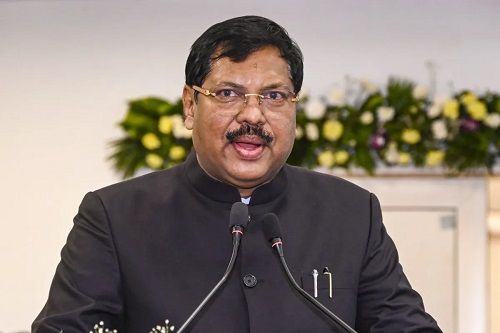
Chief Justice B R Gavai, in a significant address at a felicitation ceremony organized by the Bar Association in Amaravati, reiterated the foundational principle that the Constitution of India stands as the supreme authority, transcending all other institutions, including Parliament. His remarks underscored the crucial role of the Constitution in guiding the functioning of all three pillars of democracy.
In his address, Justice Gavai challenged the notion that Parliament holds the highest authority, asserting instead that it is the Constitution of India that holds this position. He emphasized, "While many say and believe that Parliament is supreme, according to me, it is the Constitution of India that is supreme. All three wings of democracy work under the Constitution."
Referring to the Basic Structure doctrine established by the Supreme Court, Justice Gavai highlighted its pivotal role in safeguarding the integrity of the Constitution. He noted that while Parliament possesses the authority to amend the Constitution, it is constrained by the Basic Structure doctrine, which delineates the fundamental framework and principles that cannot be altered.
The Chief Justice invoked the landmark case of Kesavananda Bharati vs State of Kerala (1973), where the Supreme Court articulated the Basic Structure doctrine, cementing principles such as judicial review, federalism, and secularism as inviolable aspects of the Constitution. This judgment remains a cornerstone of constitutional law in India, ensuring that the essence and core principles of the Constitution endure beyond transient legislative changes.
Justice Gavai also addressed the concept of judicial independence, asserting that the judiciary's duty is not merely to pass orders but to uphold the Constitution faithfully. He emphasized that judicial independence is upheld not by confrontation with other branches of government but by steadfast adherence to constitutional principles and the rule of law.
Recently sworn in as the 52nd Chief Justice of India, Justice Gavai's remarks underscored his commitment to upholding the integrity and supremacy of the Constitution. His address in Amravati, his hometown in eastern Maharashtra, resonated with legal scholars, practitioners, and the public alike, reaffirming the enduring importance of constitutional principles in India's democratic framework.





















Leave Your Comment