


When the Bharatiya Janata Party (BJP) elected 45-year-old Nitin Nabeen as its national president in January 2026, it marked more than just a routine change at the top of the world’s largest political party. It signalled a generational shift, a strategic recalibration after the 2024 general elections, and a recognition that Indian politics is entering a more competitive, fragmented, and demanding phase. As the youngest-ever BJP president, Nabeen inherits a party that remains electorally dominant but is no longer unchallenged. His task is to consolidate power, expand into difficult regions, manage internal dynamics, and prepare the organisation for the long road to the 2029 Lok Sabha elections.
Nabeen’s elevation comes at a time when the BJP governs 19 of India’s 28 states and continues to be the single largest party nationally. Yet, the loss of an outright majority in the 2024 general election and increased dependence on allies have changed the political arithmetic. The BJP is still the central pole of Indian politics, but it now operates in a more coalition-driven, regionally assertive environment. For Nabeen, this means his presidency will not be about managing a comfortable status quo, but about navigating a party and a polity in transition.
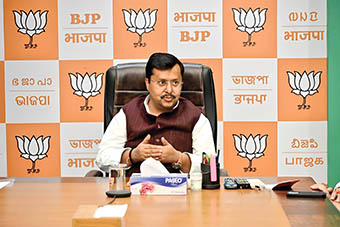
The Immediate Test: 2026 State Elections
The first major challenge before Nabeen is electoral and immediate. The 2026 assembly elections in key states such as West Bengal, Tamil Nadu, Kerala, Assam and Puducherry will be his first real test as party chief. With the exception of Assam and Puducherry, the BJP is either weak or in opposition in these states. West Bengal remains a high-stakes battleground, where the BJP is the principal challenger to Mamata Banerjee’s Trinamool Congress but has struggled to convert momentum into power.
In southern India, the challenge is even more structural. Tamil Nadu and Kerala have long resisted the BJP’s political and ideological appeal, shaped as they are by strong regional identities, linguistic politics, and entrenched Dravidian and Left traditions. Despite years of effort, the BJP’s organisational depth and electoral footprint in these states remain limited. Nabeen will be under pressure to show tangible progress, not just in vote share, but in building durable state-level leadership and alliances that can sustain the party beyond episodic campaigns.
These elections are not just about winning or losing individual states. They will shape perceptions of Nabeen’s leadership within the party. A strong performance would establish his authority and validate the generational shift. A weak showing could raise questions about whether youth and organisational energy alone are enough to overcome deep-rooted regional political realities.
Expanding the BJP’s Geographic Footprint
One of the BJP’s long-standing strategic goals has been to become a truly pan-Indian party with comparable strength across regions. While it has made major inroads in the north, west, and parts of the east and northeast, the south and some eastern states remain its Achilles’ heel. For Nabeen, expanding the party’s footprint in these regions is both a political and symbolic challenge.
This is not merely a matter of campaign strategy. It requires cultural sensitivity, local leadership development, and a willingness to adapt messaging to regional contexts without diluting the party’s core ideological identity. The BJP’s traditional centralised model, which has worked effectively in many Hindi-speaking states, has not always translated well in states where regional pride and linguistic identity are central to political mobilisation.
Nabeen’s task will be to empower state units, identify credible local faces, and invest in long-term organisational work rather than relying solely on high-profile national leaders and short-term electoral tactics. This is slow, painstaking work, and its results may not be immediately visible. Yet, without this sustained effort, the BJP risks remaining structurally weak in regions that together account for a significant share of India’s population and parliamentary seats.
Managing Internal Power Dynamics and Succession Politics
Another major challenge before Nabeen lies within the party itself. The BJP today is dominated by a powerful central leadership, with Prime Minister Narendra Modi and Home Minister Amit Shah forming the core of the party’s strategic and political direction. While this centralisation has delivered electoral success, it also means that the party president operates in a complex power structure where authority is shared, and sometimes constrained.
At the same time, questions about long-term leadership and succession are increasingly part of the political conversation. With Modi approaching his late seventies by the time of the 2029 elections, the issue of future leadership, even if not openly discussed, is part of the background calculus. Nabeen, seen as close to the current top leadership, will have to navigate these undercurrents carefully.
His challenge will be to assert his role as a genuine organisational leader rather than being perceived merely as an extension of the central leadership. Building credibility across factions, managing ambitions of senior leaders, and ensuring that internal competition does not turn into open friction will require political finesse. The BJP’s strength has long been its ability to manage internal differences within a disciplined organisational framework. Maintaining that balance in a period of generational change will test Nabeen’s leadership skills.
Balancing Youth Push With Veteran Experience
One of the most prominent themes of Nabeen’s elevation is the emphasis on youth. With over 40 per cent of India’s voters under the age of 40, the BJP is clearly seeking to project a younger, more relatable leadership to connect with first-time and young voters. Nabeen himself embodies this strategy as a leader born after Independence, with a background in student and youth politics.
However, the push for younger leadership brings its own risks. The BJP’s organisational backbone has been built over decades by senior leaders and long-serving cadre who have deep ideological roots and grassroots experience. Rapid generational turnover can create resentment, alienation, and a sense of marginalisation among veterans who still command respect and influence within the party.
Nabeen will have to strike a careful balance. Youth infusion must be seen as additive, not as a replacement of experience. Creating structures where younger leaders work alongside seasoned organisers, and where institutional memory is preserved, will be critical. If mishandled, the youth push could weaken, rather than strengthen, the party’s famed organisational machinery.
Relationship With the RSS
The BJP’s relationship with the Rashtriya Swayamsevak Sangh (RSS) has historically been a defining element of its organisational and ideological identity. While the BJP has grown into a mass electoral party with its own independent power base, the RSS remains an important source of cadre, ideological orientation, and long-term organisational continuity.
Recent years have seen a perception, in some quarters, that the balance between the BJP and the RSS has shifted, with the party leadership asserting greater autonomy. Nabeen’s appointment, reportedly finalised with limited consultation, has fed into debates about the evolving nature of this relationship.
For Nabeen, maintaining smooth coordination with the RSS will be essential. Any perception of distance or discord could affect cadre morale and grassroots mobilisation. At the same time, he must operate within a party that is increasingly driven by electoral pragmatism and centralised decision-making. Managing this dual reality — respecting the RSS’s role while aligning with the BJP’s modern political imperatives — will be a delicate and ongoing challenge.
Coalition Management in a Changed Political Landscape
The BJP’s reliance on allies after 2024 has altered the nature of national politics. While the party remains dominant, it can no longer take unilateral decisions in the same way it could with a clear parliamentary majority. This places a premium on coalition management, negotiation, and political flexibility.
Although the party president is not directly responsible for government negotiations, the organisational head plays a key role in shaping alliance strategy, managing relations with regional partners, and ensuring that the party’s state units work in harmony with coalition realities. For a leader who has largely operated within a strong single-party framework, this represents a new and more complex political environment.
The Long Road to 2029
Ultimately, Nitin Nabeen’s presidency will be judged not only by short-term electoral outcomes but by how effectively he prepares the BJP for the next general election cycle. This involves strengthening the organisation, broadening the party’s social and regional base, and adapting to a more competitive, multi-polar political environment.
He takes charge at a moment when the BJP is still the central force in Indian politics but faces more assertive regional parties, a more coordinated opposition in some states, and a changing voter profile. The challenge before him is to ensure that the BJP remains not just electorally successful, but institutionally robust and strategically adaptable.
Nabeen’s youth, organisational background, and proximity to the party’s top leadership give him both opportunity and responsibility. Whether he can translate these advantages into durable political gains will depend on his ability to manage elections, internal dynamics, regional expansion, and ideological balance — all at the same time. In that sense, his presidency is not just about leading the BJP today, but about shaping what the party will look like in the next decade of Indian politics.
A Party with a Difference: What Nitin Nabeen’s Elevation Says About the BJP
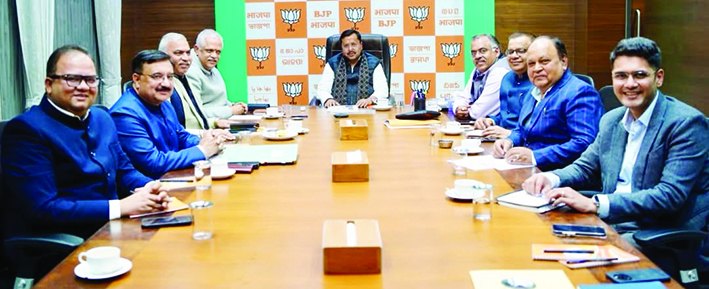
When the Bharatiya Janata Party (BJP) chose Nitin Nabeen as its youngest-ever national president, it was not merely filling an organisational post; it was sending out a carefully calibrated political message. In an era when most Indian parties are still dominated by ageing leaderships and dynastic successions, the BJP’s decision stands out as a statement of intent. It signals confidence, continuity, and a willingness to place organisational responsibility in the hands of a leader shaped by cadre politics rather than inherited privilege.
Indian political parties have traditionally been reluctant to hand over real authority to younger leaders. Youth wings exist, slogans about “young India” are routinely invoked, but the actual centres of power often remain tightly held by veterans or family networks. Against this backdrop, the BJP’s move to elevate a leader in his mid-forties to the party’s top organisational post underlines a structural difference in how it views leadership transition. Nabeen’s rise has not been abrupt or ornamental; it is the culmination of years spent in student politics, state-level organisation, and internal party work. This long grooming process reflects a culture where advancement is tied to organisational investment rather than lineage.
The timing of the decision is equally significant. After the 2024 general election, Indian politics entered a more competitive phase. The BJP remains the single largest political force, but the comfort of an unchallenged majority has given way to coalition management and sharper opposition politics. Choosing a young president at this juncture suggests that the party is not retreating into caution but doubling down on renewal. It conveys a belief that adaptability, energy, and organisational discipline are better tools for the next political phase than nostalgia or risk-averse leadership.
Nabeen’s elevation also reflects the BJP’s self-image as a cadre-based party with an institutional life independent of individuals. While Prime Minister Narendra Modi remains the party’s tallest leader and its principal electoral face, the choice of president shows that the BJP is consciously building a bench beyond one personality. This is where the “party with a difference” argument gains weight. In contrast to parties where leadership changes are either forced by crisis or dictated by family equations, the BJP has institutionalised a system where leadership renewal is periodic, planned, and largely conflict-free.
There is also a clear electoral logic behind the move. India is a young country, both demographically and aspirationally. A significant proportion of voters are under 40, politically aware, digitally connected, and less bound by older ideological loyalties. By projecting a younger party president, the BJP is aligning its organisational face with the social reality of its voter base. This does not mean abandoning its ideological core, but rather repackaging leadership to better communicate with a changing electorate. Nabeen becomes a bridge between the party’s traditional cadre and a generation that expects accessibility, responsiveness, and constant engagement.
At the same time, the decision subtly challenges the entrenched age hierarchies that dominate Indian politics. It suggests that experience in the BJP is measured not just in years, but in work done, structures built, and crises managed. This meritocratic signalling is central to the party’s narrative. Even critics of the BJP acknowledge that its internal promotions often follow a clearer organisational logic than many of its rivals. By elevating its youngest president, the party reinforces this perception and strengthens its claim of being institution-driven rather than personality-driven.
However, the move is not without risk. Youthful leadership brings expectations of results, innovation, and visible impact. Nabeen will be judged not just as a symbol, but as a performer — on elections, organisation, and internal cohesion. Yet, the BJP’s willingness to take this risk itself is telling. It reflects confidence in its systems, its ideological depth, and its capacity to absorb generational change without instability.
Ultimately, Nitin Nabeen’s appointment is less about one individual and more about what it reveals of the BJP’s political DNA. It shows a party comfortable with transition, confident in its organisational strength, and conscious of the future. In a political landscape still shaped by dynasties and inertia, the BJP’s choice underscores why it continues to present itself — convincingly to many — as a party with a difference.

Nilabh Krishna

















Leave Your Comment