


The Central government on Wednesday informed the Supreme Court that it cannot release Ladakh-based climate activist Sonam Wangchuk, who is currently detained under the stringent National Security Act (NSA), despite concerns raised about his health condition.
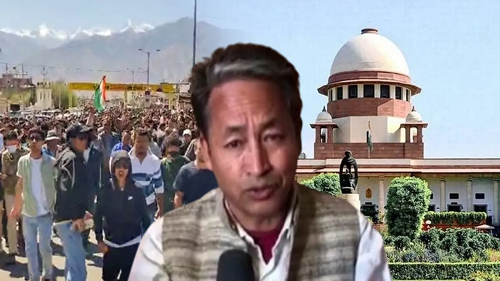
Wangchuk, known for his environmental advocacy and education reforms in Ladakh, has been lodged in Jodhpur Central Jail since his detention on September 26 last year. He was taken into custody two days after violent protests erupted in Leh over demands for statehood and Sixth Schedule status for Ladakh. The unrest left four people dead and more than 150 injured. Authorities have accused him of instigating the violence.
Appearing before a bench of Justices Aravind Kumar and PB Varale, Solicitor General of India Tushar Mehta submitted that the grounds for Wangchuk’s preventive detention continue to exist and that releasing him on medical grounds would not be appropriate. The court had earlier asked the Centre to consider whether his detention could be revisited in light of his reported deteriorating health.
Responding to the court’s query, Mehta said Wangchuk had been examined 24 times in accordance with the jail manual and was found to be “fit and hearty”. According to the Centre, he is suffering only from a digestive issue and an infection, which are being treated. “It will not be possible to release him on health grounds. It may not be desirable, either,” Mehta told the bench, adding that the authorities had given “utmost consideration” to the court’s observations.
The Supreme Court is currently hearing a petition filed by Wangchuk’s wife, Gitanjali J Angmo, challenging his detention under the NSA. On February 4, the apex court had noted that his health report did not appear satisfactory and asked the government to seek instructions on whether his detention could be reconsidered on humanitarian grounds. Additional Solicitor General Nataraj had been directed to obtain further details.
Defending the detention, the Centre and the Ladakh administration have argued that Wangchuk’s actions posed a threat in a sensitive border region. Last week, the government told the court that he had attempted to mobilise young people in a manner similar to protest movements seen in Nepal and Bangladesh. Mehta also claimed that Wangchuk had referred to an “Arab Spring-like” agitation, invoking a series of uprisings in the Arab world that led to the overthrow of several governments.
The government has maintained that all procedural safeguards were followed before invoking the NSA, which allows preventive detention to stop individuals from acting in a manner deemed “prejudicial to the defence of India” or the security of the state. Under the Act, a person can be detained for up to 12 months, though the order can be revoked earlier.
Wangchuk, however, has denied the allegations. On January 29, he rejected claims that he had called for an overthrow of the government, asserting that he was exercising his democratic right to protest and criticise policies affecting Ladakh. His supporters have argued that his detention is excessive and aimed at silencing dissent, while the government insists it is necessary to maintain public order in a strategically sensitive region.
As the hearing continues, the Supreme Court’s eventual decision on the legality and necessity of Wangchuk’s detention is likely to have significant implications for the use of preventive detention laws in cases involving political protests and regional movements.


















Leave Your Comment