


The confrontation between the Opposition and the Election Commission has moved beyond parliamentary criticism and entered the streets of the national capital. The INDIA bloc’s march from Parliament’s Makar Dwar towards Nirvachan Sadan, coupled with its demand for Chief Election Commissioner Gyanesh Kumar’s resignation, reflects a widening political battle over electoral-roll revisions, Form 6 and the credibility of the poll process. The BJP, however, has rejected the allegations, turning the dispute into a larger contest over institutional trust and political accountability.
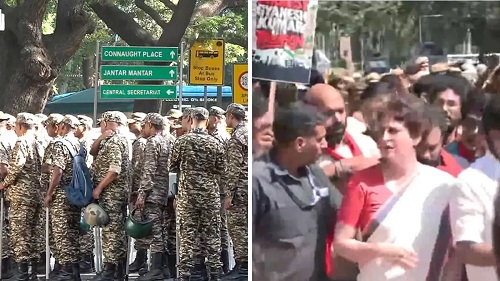
The INDIA bloc's protest has been organised under the Opposition’s broader “Save Democracy” campaign. INDIA bloc MPs gathered at Makar Dwar before proceeding towards the Election Commission headquarters. Congress president Mallikarjun Kharge, Rahul Gandhi, TMC MP Abhishek Banerjee and Samajwadi Party chief Akhilesh Yadav were among the prominent leaders expected to participate. The march itself is significant because it demonstrates that the Opposition intends to sustain pressure on the poll panel rather than confine the issue to parliamentary debate.
At the heart of the controversy is the Opposition’s objection to changes associated with Form 6, the statutory application used for voter enrolment, as well as its broader allegations of irregularities in the revision of electoral rolls. Opposition parties have linked these concerns to the Special Intensive Revision exercise and have questioned the functioning of the Election Commission under CEC Gyanesh Kumar.
The heightened security around Parliament, Vijay Chowk, Akashvani Bhawan and the Election Commission headquarters added another dimension to the protest. Barricades were erected and Rapid Action Force personnel deployed at several locations. The presence of heavy security reflected the administration’s effort to prevent the march from escalating into a law-and-order situation.
The protest also produced moments of confrontation, with Samajwadi Party MP Zia-ur-Rehman Barq seen climbing a police barricade near the NITI Aayog office as the march proceeded towards the Election Commission.
The BJP has strongly rejected the Opposition’s allegations. BJP national spokesperson and MP Sambit Patra described the campaign against the Election Commission as a “sponsored” attempt to target democratic and constitutional institutions. He alleged that the Congress was seeking to create an atmosphere of unrest and use the controversy to politically promote Rahul Gandhi.
The Election Commission, for its part, has rejected allegations surrounding changes to Form 6 and described some of the claims as misleading. This makes the controversy particularly significant: the dispute is no longer simply between political parties, but involves competing claims about the integrity and functioning of an institution central to the electoral process.
The Supreme Court’s involvement has further raised the stakes. The court is examining petitions concerning the SIR exercise and Form 6. It has declined to pass an interim order seeking Kumar’s suspension and has sought responses from the Election Commission and its members. The judicial scrutiny means that questions surrounding the electoral-roll revision are also being examined through a constitutional and legal process.
Politically, the INDIA bloc’s decision to take the issue directly to the Election Commission suggests that the Opposition sees electoral reform and voter-list integrity as a potentially powerful common platform. Different parties within the bloc may have divergent political interests, but the controversy provides them with a shared issue around which they can mobilise.
At the same time, the BJP’s counterattack indicates that the ruling party is determined to portray the protest as an attempt to undermine constitutional institutions rather than protect them. The competing narratives—one centred on alleged institutional erosion and the other on alleged political targeting—are likely to keep the controversy alive.






















Leave Your Comment