


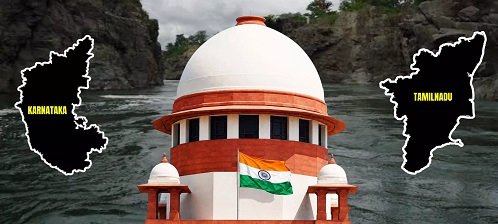
The long-running Cauvery water dispute between Tamil Nadu and Karnataka has once again come under the judicial spotlight, with the Supreme Court rejecting two applications filed by the Tamil Nadu government seeking the immediate release of 11 thousand million cubic (TMC) feet of water by its neighbouring state. The decision highlights the complexities of sharing an increasingly scarce river resource, particularly when competing agricultural requirements and drought conditions intensify tensions between the two states.
A bench comprising Justices Vikram Nath and Aparesh Kumar Singh dismissed the two applications filed by Tamil Nadu, which had sought directions to Karnataka to clear the accumulated deficit of 11 TMC feet of Cauvery water as of October 7. The state had also requested that Karnataka release water at the rate of 1.3 TMC feet per day over a period of 10 days at Billigundulu, a crucial monitoring point situated along the Karnataka-Tamil Nadu border. The bench observed that Tamil Nadu had also filed a third application seeking permission to place additional documents on record, indicating that this application too would be dismissed. The Supreme Court had reserved its order on the two applications on October 12 after hearing the arguments presented by both sides.
The Karnataka government had opposed Tamil Nadu's demand, maintaining that meeting the requested quantity would be extremely difficult given the prevailing water scarcity. During the proceedings, Karnataka highlighted the severity of the drought affecting the state and described the situation as a terrible drought crisis. Tamil Nadu, meanwhile, argued that the inadequate release of water had already caused significant agricultural losses, including damage to its early Kharif crop. The contrasting positions brought into focus the difficult balance between meeting established water-sharing obligations and responding to the immediate needs of a state grappling with inadequate rainfall and depleted water resources.
The dispute also centres on decisions taken by the Cauvery Water Regulation Committee (CWRC) and the Cauvery Water Management Authority (CWMA), the institutional bodies responsible for overseeing the implementation of the river-sharing arrangements. According to Tamil Nadu, the CWRC, on October 8, failed to issue directions requiring Karnataka to compensate for the accumulated shortfall. Instead, it reduced the prescribed water flow from 4,000 cusecs to 3,000 cusecs with effect from October 9. Tamil Nadu contended that this reduction further aggravated its difficulties and sought judicial intervention to enforce the CWMA's September 24 decision.
The state also demanded that Karnataka compensate for a shortfall of 0.94 TMC feet arising from the alleged non-supply of water between September 24 and October 7. It further sought compliance with the additional flow requirements recorded in the CWMA's October 8 proceedings. Tamil Nadu had approached the Supreme Court on August 3, arguing that both the allocation recommended by the CWRC and the actual quantity released by Karnataka were insufficient to meet its requirements. On September 24, the apex court had asked Karnataka to respond to these allegations.
The latest ruling represents a setback for Tamil Nadu's immediate demand for additional water through judicial intervention. However, it does not diminish the larger significance of the Cauvery dispute, which has repeatedly strained relations between the two neighbouring states. With agriculture, drinking water requirements and regional livelihoods dependent on the river, the challenge remains to ensure that established sharing arrangements are implemented fairly while accounting for changing climatic conditions and water availability. The Supreme Court's decision once again underlines the importance of institutional coordination and responsible water management in resolving disputes over one of southern India's most vital river systems.





















Leave Your Comment