


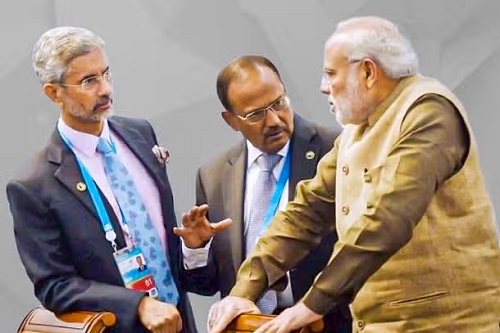
In a significant development amid escalating tensions between India and Canada, the Canadian government issued a statement on Friday, clarifying that it has no evidence linking Indian Prime Minister Narendra Modi, External Affairs Minister S. Jaishankar, or National Security Advisor Ajit Doval to any criminal activities in Canada.
The statement, issued by the intelligence advisor to Canadian Prime Minister Justin Trudeau, aimed to address the ongoing controversy over allegations of Indian government agents' involvement in activities deemed a threat to Canadian public safety.
“On October 14, because of a significant and ongoing threat to public safety, the RCMP and officials took the extraordinary step of making public accusations of serious criminal activity in Canada perpetrated by agents of the Government of India,” read the statement. However, it further clarified, “The government of Canada has not stated, nor is it aware of evidence, linking Prime Minister Modi, Minister Jaishankar, or NSA Doval to the serious criminal activity within Canada. Any suggestion to the contrary is both speculative and inaccurate.”
This statement comes after Prime Minister Trudeau, in October, accused India of conducting covert operations in Canada, which he alleged posed a grave risk to public safety. Trudeau claimed that Canadian authorities had made multiple attempts to engage Indian officials in dialogue but faced rejection.
Trudeau had earlier alleged that agents of the Indian government were involved in activities such as gathering intelligence and coercion within Canada, including connections to serious criminal acts. He condemned these alleged actions, emphasizing respect for Canadian sovereignty. The accusations marked a significant low in diplomatic relations between the two countries.
India strongly denied Trudeau's claims, dismissing them as "baseless" and "politically motivated." The Indian Ministry of External Affairs (MEA) accused Trudeau’s administration of leveraging anti-India rhetoric to serve domestic political interests. Furthermore, Indian officials criticized Canada for harboring extremist elements and providing platforms for groups advocating separatism, citing ongoing investigations into the murder of Khalistani leader Hardeep Singh Nijjar as an example.
The allegations led to severe diplomatic fallout, with India expelling six Canadian diplomats and recalling its High Commissioner from Canada. The MEA summoned Canada’s charge d’affaires, Stewart Wheeler, expressing deep discontent over the allegations and issuing a stern warning of possible further retaliatory measures.
India categorically rejected any involvement of its leadership or officials in the criminal activities alleged by Trudeau, with the government labelling the accusations as “ludicrous” and “politically driven.”
This clarification by Canada attempts to mitigate the diplomatic standoff, but relations between the two countries remain strained. While India has consistently rejected the allegations, the broader geopolitical implications of this rift are yet to unfold fully. Both nations have critical trade and diaspora connections, and the ongoing discord threatens to impact these ties significantly.
Observers suggest that rebuilding trust will require more substantial dialogue and mutual efforts to address the underlying concerns. However, given the entrenched positions and domestic political stakes in both countries, a swift resolution appears unlikely.



















Leave Your Comment