


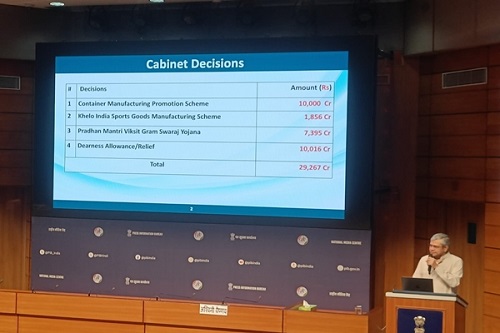
The Union Cabinet has approved a series of measures aimed at strengthening domestic manufacturing, improving grassroots governance and providing financial relief to government employees and pensioners. The decisions include a ₹10,000-crore Container Manufacturing Promotion Scheme, a ₹1,856-crore Khelo India Sports Goods Manufacturing Scheme and the Pradhan Mantri Viksit Gram Swaraj Yojana with an outlay of ₹7,395 crore. The Cabinet has also approved a 3 per cent increase in Dearness Allowance (DA) for Central government employees and Dearness Relief (DR) for pensioners, effective from July 1, 2026.
The decisions reflect a broad policy approach that combines industrial development, sports-related manufacturing, decentralised governance and employee welfare. Announcing the Cabinet decisions at a media briefing in New Delhi on Wednesday, Information and Broadcasting Minister Ashwini Vaishnaw outlined the key features of the initiatives.
₹10,000 Crore Scheme to Boost Container Manufacturing
The Cabinet has approved the Container Manufacturing Promotion Scheme with a total financial outlay of ₹10,000 crore over 13 years, extending up to the financial year 2039-40. The scheme seeks to strengthen India's domestic container manufacturing capabilities and encourage the development of a robust industrial ecosystem.
Containers are essential to international trade, cargo transportation and logistics. Building domestic manufacturing capacity can help expand India's industrial base, strengthen supply-chain resilience and create opportunities for investment and employment. A stronger domestic industry could also support the country's ambitions to become a more competitive player in global manufacturing and trade.
The scheme has four components: Interest Subvention Assistance, Testing and Certification Assistance, Land Leasing Support and Operational Expenditure Assistance. Together, these measures are designed to address financial, infrastructure and operational challenges faced by manufacturers.
Interest subvention can ease the cost of financing investments, while testing and certification assistance can help manufacturers meet quality and compliance requirements. Land leasing support and operational expenditure assistance are intended to address other costs associated with establishing and running manufacturing facilities.
The scheme's long implementation period provides an opportunity to build capacity progressively, attract investment and develop the supporting industrial ecosystem required for sustained growth.
Khelo India Scheme to Develop Sports Goods Manufacturing
In another significant decision, the Cabinet approved the Khelo India Sports Goods Manufacturing Scheme to position India as a global hub for high-quality sports goods. The initiative has an approved outlay of ₹1,856 crore over eight years, covering the period from 2026-27 to 2033-34.
The scheme seeks to strengthen the country's sports goods manufacturing sector and create conditions for Indian producers to compete more effectively in domestic and international markets. Developing this industry can open opportunities for businesses, encourage innovation and support employment across manufacturing and related activities.
India's growing sporting ambitions offer a potential market for equipment and products used by athletes, sports institutions and fitness enthusiasts. A stronger manufacturing ecosystem could help domestic companies improve product quality, develop specialised capabilities and compete with established international producers.
The scheme also reflects the potential for sports development and industrial policy to reinforce each other. Alongside encouraging participation in sports, building domestic production capabilities can support a wider economic ecosystem involving manufacturers, suppliers, designers and skilled workers.
Its success will depend on the ability of manufacturers to deliver internationally competitive products, maintain quality standards and respond to the evolving needs of athletes and consumers.
Pradhan Mantri Viksit Gram Swaraj Yojana to Strengthen Panchayats
The Cabinet has also approved the Pradhan Mantri Viksit Gram Swaraj Yojana (PMVGSY) as a Centrally Sponsored Scheme. With a total financial outlay of ₹7,395 crore, the initiative will run for five years, from 2026-27 to 2030-31.
The scheme aims to transform Panchayats into empowered, self-reliant, accountable and high-performing institutions of local self-government, in line with the vision of Viksit Bharat.
Its coverage extends to all States and Union Territories, including rural local governance institutions in areas not covered under Part IX of the Constitution. The initiative is expected to cover more than 2.78 lakh Rural Local Bodies and Traditional Bodies across the country.
Around 32 lakh elected representatives are expected to benefit directly from the scheme, along with Panchayat functionaries.
Panchayats occupy a crucial position in India's administrative structure because they operate closest to rural communities. Their effectiveness influences the delivery of public services, implementation of development programmes and responsiveness to local needs.
Strengthening these institutions can improve their ability to plan and implement development initiatives, exercise accountability and address community priorities. The emphasis on self-reliance and institutional performance also highlights the importance of developing local governance systems that can function effectively rather than depending entirely on administrative intervention from higher levels.
The scheme's nationwide reach makes its implementation particularly significant. Building the capabilities of elected representatives and Panchayat functionaries will be important for translating its objectives into measurable improvements in rural governance.
Three Per Cent DA Hike for Central Government Employees and Pensioners
Providing relief to government employees and pensioners, the Cabinet has approved a 3 per cent increase in Dearness Allowance and Dearness Relief, effective from July 1, 2026.
The increase in DA will benefit serving Central government employees, while the corresponding DR hike will benefit eligible pensioners. These payments are intended to help offset the impact of inflation on salaries and pensions.
The decision is significant for households that depend on government salaries and pensions to meet their regular expenses. By adjusting these payments in response to changes in the cost of living, the government seeks to protect the purchasing power of employees and pensioners.
With the revision effective from July 1, eligible beneficiaries will receive the benefit from the specified date, subject to the applicable government orders and payment arrangements.
A Combined Push for Growth and Welfare
Taken together, the Cabinet's decisions address several dimensions of India's development agenda. The container manufacturing scheme seeks to expand industrial capacity, the sports goods initiative aims to strengthen a specialised manufacturing sector, and the Viksit Gram Swaraj Yojana focuses on improving the institutions responsible for rural development.
The DA and DR revision, meanwhile, provides financial relief to government employees and pensioners.
The longer-term impact of these measures will depend on effective implementation, the timely utilisation of allocated funds and the ability of the schemes to deliver tangible results. For manufacturing, the key challenge will be to build competitive domestic industries. For rural governance, the priority will be to translate institutional support into better performance at the grassroots.
Together, the initiatives represent an effort to advance economic development, strengthen local institutions and address the financial concerns of government employees and pensioners.




















Leave Your Comment