


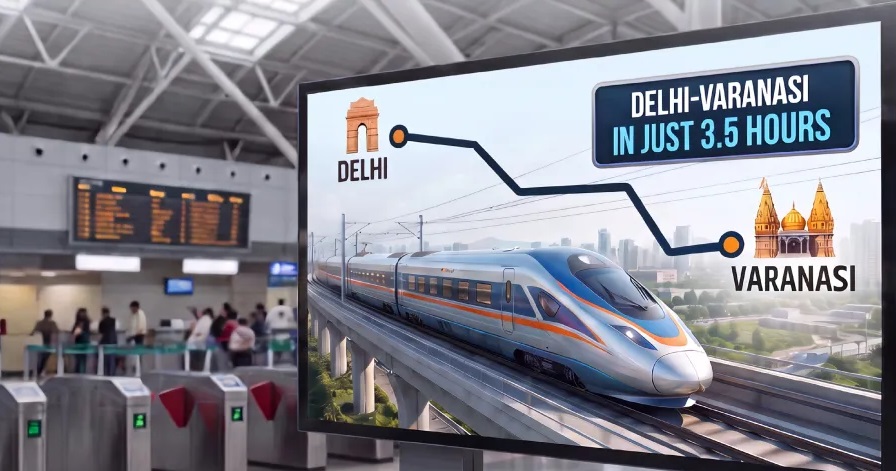
India's high-speed rail ambitions have received a major boost with Prime Minister Narendra Modi approving the proposed Northern Bullet Train Corridor, paving the way for Uttar Pradesh to join the country's emerging bullet train network. Railway Minister Ashwini Vaishnaw has outlined ambitious travel-time targets, including a journey between Delhi and Varanasi in approximately three and a half hours. The proposed corridor is expected to improve connectivity among major cities, facilitate business and tourism, and provide faster travel options for millions of passengers. Complementing this initiative, the construction of the proposed Namo Bridge across the Ganga in Varanasi promises to strengthen road and rail infrastructure, potentially transforming the city's transport network.
India's railway modernisation programme is entering a new phase with the approval of the Northern Bullet Train Corridor. Announcing the development, Railway Minister Ashwini Vaishnaw said the project would deliver long-term benefits and reshape connectivity across several important destinations in northern India.
According to the minister, the proposed high-speed rail service will substantially reduce journey times between Delhi and major cities in Uttar Pradesh and neighbouring states. The estimated travel time from Delhi to Kanpur will be approximately one hour and 45 minutes, while passengers travelling to Agra could reach their destination in just 59 minutes. The journey from Delhi to Lucknow is expected to take around two hours and 12 minutes.
Varanasi, one of India's most important religious and cultural centres, is also expected to benefit significantly. The proposed journey between Delhi and Varanasi would take approximately three hours and 33 minutes. Travel between Varanasi and Prayagraj could be reduced to just 33 minutes, while the journey to Lucknow is expected to take around one hour and 21 minutes. The proposed connection between Varanasi and Patna could bring the journey time down to approximately one hour, while travel to Agra is projected to take two hours and 34 minutes.
These figures represent proposed journey times rather than an operational timetable. Their eventual realisation will depend on the project's detailed planning, construction, commissioning and service arrangements.
The corridor could bring considerable changes to how people travel for employment, education, healthcare, business and tourism. Faster connections between major urban centres may also encourage greater economic interaction, allowing businesses to operate across wider markets and enabling professionals to travel more efficiently.
Affordable High-Speed Travel for Ordinary Passengers
Affordability will be an important factor in determining the success of India's bullet train programme. Vaishnaw has indicated that fares on the proposed Delhi–Varanasi service would be lower than airfares, challenging the perception that high-speed rail is intended exclusively for affluent travellers.
The government's stated objective is to extend the benefits of infrastructure development to the middle class, farmers, young people, economically weaker sections and small businesses. If fares remain competitive and services are accessible, high-speed rail could offer an attractive alternative to air travel on busy intercity routes.
For small and medium enterprises, improved connectivity could reduce the time and logistical difficulties associated with business travel. Tourism may also receive a boost as pilgrims and visitors find it easier to reach destinations such as Varanasi, Prayagraj, Agra and Lucknow.
However, affordability will depend not only on ticket prices but also on station accessibility, feeder transport, service frequency and the overall cost of completing a journey. The corridor's broader economic value will therefore be determined by how effectively high-speed rail is integrated with the existing transport system.
Namo Bridge to Strengthen Varanasi's Infrastructure
Alongside the bullet train initiative, Varanasi is preparing for another major infrastructure addition with the construction of a signature bridge across the River Ganga. Vaishnaw has announced that the structure will be called the Namo Bridge.
Estimated to cost Rs 2,657 crore, the bridge will extend approximately 2.5 kilometres and is targeted for completion by 2029. Its double-decker design will accommodate a six-lane road corridor on the upper deck and four railway tracks on the lower deck, combining road and rail connectivity within a single structure.
A Wider Economic and Social Impact
Taken together, the Northern Bullet Train Corridor and the Namo Bridge reflect an approach to infrastructure development that combines faster intercity travel with improvements in regional transport capacity.
For Uttar Pradesh, the proposed high-speed rail connection could strengthen links between its major urban centres and the national capital. Varanasi, in particular, could benefit from improved access for pilgrims, tourists, traders and business travellers. Better rail connectivity may also encourage investment in hospitality, services, logistics and other sectors that depend on the movement of people and goods.




















Leave Your Comment