


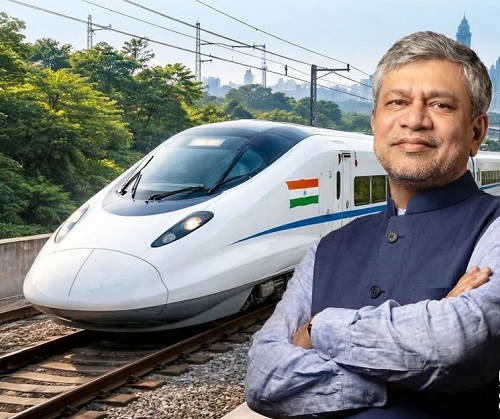
India’s ambitious bullet train project has moved closer to reality, with the first body frame of an indigenously manufactured high-speed train completed and sent for a crucial squeeze test, Union Railway Minister Ashwini Vaishnaw said on Tuesday.
Addressing the ‘NaMo for Viksit Bharat’ event, Vaishnaw said the development marked a significant milestone in India’s push towards self-reliance in advanced railway technology. He said the country’s own bullet train is expected to reach the tracks for testing by May or June next year.
According to the minister, the train will undergo extensive testing for around two to four months before its formal inauguration by Prime Minister Narendra Modi.
Vaishnaw said the high-speed service will dramatically reduce travel time between major cities along the Mumbai-Ahmedabad corridor. Once operational, passengers travelling from Vadodara to Mumbai will be able to cover the distance in approximately one-and-a-half hours.
The minister described the project as a product of Prime Minister Modi’s vision of ‘Atmanirbhar Bharat’, underlining the growing role of domestic manufacturing in India’s high-speed rail ambitions.
The first operational milestone is expected to come on the Surat-Bilimora section of the Mumbai-Ahmedabad High-Speed Rail (MAHSR) Corridor. Vaishnaw had earlier said that this section is targeted for commissioning next year.
Work on the broader corridor is also progressing rapidly, with officials indicating that construction and associated infrastructure development are advancing at a strong pace.
The MAHSR project is considered a landmark addition to India’s transport infrastructure. Beyond reducing journey times, it is expected to introduce advanced railway technologies, modern engineering practices and new standards in passenger rail travel.
The development of an indigenous train body frame also represents an important step in building domestic capabilities in high-speed railway technology.
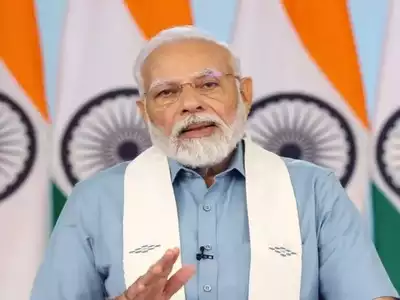
The bullet train announcement came alongside another major railway infrastructure milestone. Prime Minister Narendra Modi on Tuesday dedicated three key sections of the Western Dedicated Freight Corridor (WDFC), marking the completion of a significant phase of the country’s dedicated freight rail network.
The three newly dedicated sections—Sanand (North)-Makarpura, New Umbergaon-New Saphale and New Saphale-Jawaharlal Nehru Port Terminal (JNPT)—span a combined 326 route kilometres and were developed at a cost exceeding Rs 20,700 crore.
The Prime Minister also highlighted the long journey of the Dedicated Freight Corridor project, noting that the idea was first proposed in 2004, while a dedicated company was established in 2006 to execute it.
The completion of these freight corridor sections is expected to strengthen cargo movement and improve the efficiency of India's logistics network.
With the freight corridor expanding and the bullet train project entering a crucial testing phase, Indian Railways is simultaneously pushing ahead with two major transformations—faster passenger travel and more efficient freight transportation.
The upcoming indigenous bullet train is therefore being positioned not merely as a new mode of travel, but as a symbol of India’s growing technological and manufacturing capabilities in the railway sector.



















Leave Your Comment