



RSN Singh
The recent 18th BRICS Summit hosted by India was flawless in its organisation and conduct and in the conducive diplomatic environment it created. Significantly, this summit was held at one of the most critical times of the 21st century, with two of the most intractable and raging conflicts in West Asia and Europe. The first involves Iran, the Arab world and Israel, while the other involves Ukraine and Russia.
TOP LEADERS IN ATTENDANCE
Most of the warring countries, which are also members of BRICS, were represented by their heads of state or apex-level leaders. Vladimir Putin was in attendance. Iran was represented by its President, Masoud Pezeshkian. The UAE and Saudi Arabia, which are locked in bitter military conflict, were represented by Sheikh Khaled bin Mohammad bin Zayed Al Nahyan, Crown Prince of Abu Dhabi, and the Foreign Minister of Saudi Arabia, Prince Faisal bin Farhan Al Saud, respectively.
Not only did these warring countries come together on the BRICS platform, but they were also able to arrive at a consensus, manifesting itself in a Joint Declaration.
CONSENSUS BUILDING
It may be recalled that on 15 May 2026, in New Delhi, the Foreign Ministers of the BRICS countries failed to issue a joint statement. There were deep divisions over the ongoing conflict involving Iran and the Middle East. Iran wanted the group to explicitly condemn the US and Israeli war against Iran and accused the UAE of direct military involvement. The host nation, India, released a Chair's Statement and Presidency Note rather than a unified declaration.
Between May and September, Prime Minister Modi's team was on overdrive to bring contending and warring parties together. The challenge was herculean. Finally, Prime Minister Modi, the Foreign Minister, Mr S. Jaishankar, and the National Security Adviser, Mr Ajit Doval, achieved a consensus declaration that had seemingly appeared impossible.
Modi's politico-diplomacy was outstanding. Bringing the UAE's Sheikh Khaled bin Mohammad bin Zayed Al Nahyan to meet President Pezeshkian to resolve differences over the Delhi Declaration was an exceptional achievement.
On 15 September, the South China Morning Post wrote:
"India scored a diplomatic win at the latest BRICS summit, after steering an increasingly unwieldy bloc towards a joint declaration despite deep divisions and geopolitical conflicts and global order."
It further added:
"New Delhi achieved pragmatic consolidation by avoiding forcing members to assign blame for contentious geopolitical issues, keeping the focus on trade, technology and greater representation of the Global South... The differences over the Middle East and other regional conflicts were merely papered over."
The 45-page, 140-paragraph declaration addressed issues such as global governance and UN reform, trade and economics, geopolitics and conflict, emerging technologies, security and terrorism.
ADDRESSING TERRORISM: A MIXED BAG
The paragraph on terrorism reads:
"We express strong condemnation of any acts of terrorism... We condemn the terrorist attack in J&K on 22 April 2025... We reaffirm our commitment to combating terrorism in all its forms and manifestations, including the cross-border movement of terrorists, terrorism financing and safe havens. We reiterate that terrorism should not be associated with any religion, nationality, civilisation or ethnic group..."
The emphasis of the Joint Declaration is on cross-border terrorism. To say that terrorism should not be associated with any religion, ideology or nationality is, in the author's view, a miscarriage of reality that impacts Indian threat perception and, to some extent, global threat perception as well.
MARITIME TERRORISM NOT ADDRESSED
While the Joint Declaration conveys its resolve to combat terrorism in all its forms and manifestations, it makes no mention of maritime terrorism, which has disrupted global trade and supply chains and caused a global energy crisis.
During the BRICS Summit, Prime Minister Modi said that global trade can move forward only when sea lanes are secure, supply routes are open, and seafarers are safe. He stressed that India is a staunch advocate of freedom of navigation and the safety of seafarers.
This statement comes amid the crisis in the Strait of Hormuz, which has driven energy prices northwards. The conflicts in West Asia and the Russia-Ukraine conflict have taken a toll on 15 Indian seafarers—10 in waters around West Asia and five in the Black Sea region.
BRICS AND MARITIME ARTERIES
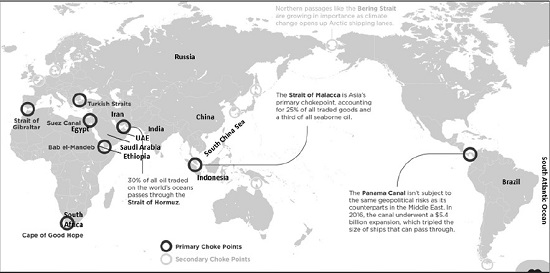
There is no escaping the truism that the oceans are vast, but maritime trade has to pass through Sea Lanes of Communication (SLOCs) and narrow straits or chokepoints. See map below:-
It would be interesting to note that half of the BRICS countries are situated around critical chokepoints and SLOCs.
Brazil's geostrategic location is dominant with respect to the South Atlantic Ocean. Russia's location makes it a critical player in the Black Sea, Caspian Sea and the fast-emerging sea routes and gateways in the Arctic Ocean.
China lays claims to the whole of the South China Sea (SCS) and, as such, threatens "freedom of navigation." India dominates the SLOCs in the North Indian Ocean and exerts geographical influence over the Malacca Strait.
Egypt controls the Suez Canal, through which, on average, 30,000 to 50,000 ships pass annually. The Canal is a great source of revenue for Egypt. Approximately 12 to 15 percent of total global trade volume normally passes through the Suez Canal.
Saudi Arabia straddles both the Red Sea and the Persian Gulf. Roughly 20 to 30 percent of global container shipping, about 10 percent of the world's seaborne oil supply and 8 percent of global LNG passes through the region. It accounts for approximately $1 trillion in merchandise and goods annually.
Ethiopia, too, is located near the southern entrance of the Red Sea. Iran's location with respect to the Persian Gulf and the Strait of Hormuz is strategically sensitive. Strategically, Iran has weaponised the Strait of Hormuz. Its proxy, the Houthis of Yemen, are weaponising the Red Sea.
Approximately 20 to 25 percent of the world's oil and 20 percent of LNG passes through the Strait of Hormuz. The UAE sits on the southern part of the Persian Gulf along with Saudi Arabia.
Indonesia's Sumatra is situated at the southern bank of the Malacca Strait, which at its narrowest point is just 2.8 km wide. It connects the Indian Ocean and the South China Sea. One-third of all global trade, worth approximately $3.5 trillion, passes through the Malacca Strait annually. Around 60,000 to 90,000 vessels navigate the narrow waterway every year. About 80 percent of the oil imports of China, Japan and the Northeast Asian economies are carried through this strait.
The most dominant country with regard to the Cape of Good Hope is South Africa. It is a crucial alternative maritime route for global trade when key passages such as the Suez Canal or the Strait of Hormuz face severe disruptions.
Rerouting around the Cape of Good Hope adds 3,500 to 4,000 nautical miles to a voyage.
If these BRICS countries, being located in such geographically commanding positions with regard to maritime routes and chokepoints, were to get their act together and ensure freedom of navigation, global trade would acquire unimaginable heights.
WEAPONISATION OF CHOKEPOINTS
The irony, however, is that if there is any country that has weaponised maritime chokepoints, it is Iran, which happens to be a BRICS country.
First, it weaponised the Red Sea through its proxy, the Houthis, and subsequently the Strait of Hormuz by mining the strait and targeting ships with missiles and drones. In the Strait of Hormuz, daily transits reportedly dropped from 130 ships to nil.
Over 10 percent of global trade and vital oil flows face severe threats and rerouting due to disruption in the Red Sea. Global container rates surged by 84 percent. Its squeezing impact on global oil was 25 percent, 19 percent on LNG and 30 percent on fertilisers.
BRICS accounts for 49.5 percent of the world's population and approximately 40 percent of global GDP. Its share in global trade is 26 percent; however, intra-BRICS trade is just 5 percent.
The member countries of BRICS, unlike the countries of the European Union, are dispersed all over the globe. Hence, intra-BRICS trade cannot grow without secure SLOCs and maritime chokepoints.
India and China, the two big BRICS members, are suffering on the energy front because of the weaponisation of chokepoints by Iran. Had it not been for Russia, another BRICS country, the crisis could have been worse.
The teaser, therefore, is: why cannot there be solidarity amongst BRICS countries on the vital issue of uninterrupted flow of energy?
CONCLUSION
One takeaway was unmistakable from the BRICS Summit: Prime Minister Modi has sought to place India in a pivotal position in the grouping. His role in bringing contending and warring parties within BRICS towards a consensus declaration was unparalleled.
It revealed the diplomatic heft that India has acquired in the international arena. In him lies the potential and possibility to forge solidarity amongst BRICS with regard to "freedom of navigation" and energy security of the respective member countries and the world at large.
(The content of this article reflects the views of writer and contributor, not necessarily those of the publisher and editor. All disputes are subject to the exclusive jurisdiction of competent courts and forums in Delhi/New Delhi only)





















Comments (1)
Well balanced prognosis