



Manoj Dubey
BRICS began as BRIC, a term coined by Goldman Sachs economist Jim O’Neill in 2001 to denote Brazil, Russia, India and China, highlighting their growing economic importance. The four countries held their first leaders’ summit in Yekaterinburg, Russia, in 2009. South Africa joined in 2010, forming BRICS. The grouping gradually broadened its agenda from economic cooperation to include trade, finance, development, health and global governance. In 2024, Egypt, Ethiopia, Iran and the UAE joined, significantly expanding the group. Indonesia became a full member in 2025. Currently, BRICS has eleven full member countries and ten partner countries. It aims to promote greater cooperation among emerging economies and to advocate reform of international institutions.
India’s Role
As a founding member and a major emerging economy, India has played a significant role in BRICS. It hosted the BRICS Summit in New Delhi in 2012, in Goa in 2016, and virtually in New Delhi in 2021. India has promoted cooperation across trade, investment, technology, health, education, and sustainable development. It has also supported greater representation of developing countries in institutions such as the UN Security Council, the IMF, and the World Bank. During its presidencies, India emphasised people-to-people cooperation, counter-terrorism, digital technology, and development. India views BRICS as an important platform for strengthening the Global South's voice.
Achievements
BRICS has emerged as an important platform for cooperation among major emerging economies. Its major achievement was the creation of the New Development Bank (NDB) in 2015, which finances infrastructure and sustainable development projects in member countries. The Contingent Reserve Arrangement (CRA) was also established to provide financial support during periods of balance-of-payments pressure. BRICS has deepened cooperation in trade, investment, science, technology, health, education and agriculture. Its expansion has strengthened the representation of developing countries and the Global South in international affairs. BRICS has consistently advocated reforms of global institutions, including the United Nations, IMF and World Bank, to make them more representative.
Prospects
BRICS has significant potential to become a more influential platform for emerging economies and the Global South. Its expansion has increased its economic, demographic and geopolitical weight. In the future, BRICS could strengthen trade in local currencies, deepen financial cooperation, boost investment and enhance the role of the New Development Bank. Greater cooperation in energy, food security, technology, artificial intelligence, climate change and health could further enhance its relevance. BRICS may also push for reforms in global institutions such as the UN, IMF and World Bank. However, differences among members on geopolitics and national interests remain challenges. Its future success will depend on consensus and practical cooperation.
Summit 2026
India assumed the BRICS Chairship on 1st January 2026 and hosted the 18th BRICS Summit in New Delhi on September 12-13, 2026. This marks the fourth time India has hosted the BRICS Summit. India’s 2026 presidency focuses on the theme “Building Resilience, Innovation, Cooperation and Sustainability.” The agenda aims to strengthen BRICS cooperation across economic and financial matters, technology, climate action, sustainable development and people-to-people exchanges. India is also placing particular emphasis on promoting reforms in international institutions.
The 2026 presidency is particularly significant because BRICS has expanded considerably since India last hosted the summit. The enlarged grouping offers India an opportunity to build consensus among diverse developing economies and to foster greater cooperation in trade, investment, energy, health, education, science and technology. In May 2026, the BRICS Young Diplomats Forum was held in New Delhi, bringing together diplomats from several member countries. The programme focused on political and security cooperation, economic and financial issues, and cultural and people-to-people exchanges.
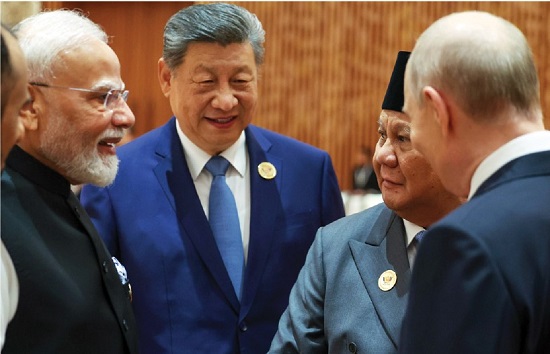
The 2026 summit offered India an important diplomatic platform to demonstrate its leadership among emerging economies, strengthen relations with BRICS members, and advance the interests of developing nations. It also showcased India’s capabilities in digital technology, innovation, sustainable development, and multilateral diplomacy. In essence, India’s 2026 BRICS presidency aimed to make BRICS more effective, inclusive, and development-oriented, while giving greater weight to the concerns and aspirations of the Global South. The 18th summit, marking two decades since the group’s formation, brought together the heads of all 11 member nations, providing an opportunity for multilateral deliberations and significant bilateral engagements. India hosted over 350 meetings across 30 cities.
Joint Declaration
The 140-point declaration was adopted unanimously by the member countries. It strongly condemned terrorism in all its forms and manifestations. It also addressed cross-border terrorism and called for international cooperation to counter terrorist financing and recruitment. For India, the reference to terrorism and the Pahalgam attack was particularly significant. BRICS called for a more representative and inclusive international system. It supported reform of the United Nations and the UN Security Council, with greater representation for developing countries. It also advocated reforms to the IMF, the World Bank, and other international institutions.
The declaration reaffirmed commitment to multilateralism, international law, and the UN Charter. BRICS stressed that global decisions should not be dominated by a small number of countries. BRICS continued efforts to strengthen financial cooperation, including greater use of local currencies in trade and investment. The BRICS Payment Task Force is examining interoperability across payment and messaging systems. The declaration called for the peaceful resolution of international conflicts and expressed concern about ongoing wars and humanitarian crises. It also stressed the importance of protecting commercial shipping and seafarers amid instability in West Asia. The declaration recognised that fossil fuels will continue to play an important role, particularly for developing economies during the energy transition. It opposed measures such as the EU Carbon Border Adjustment Mechanism (CBAM) when applied in ways that could disadvantage developing countries. The declaration also referenced technology and innovation, climate and sustainable development, agriculture and food security, and health and people-to-people cooperation. The declaration concluded by expressing full support for China's BRICS Chairship in 2027 and for the holding of the 19th Summit in China.
Some political leaders criticised the declaration for not mentioning Pakistan's name in relation to the Pahalgam terror attack, for not condemning the attack on Gaza, and for serving only a vegetarian meal to the guests.
Conclusion
India's year-long consultations helped bridge differences among an increasingly diverse BRICS membership. The New Delhi Declaration 2026 seeks to strengthen BRICS as a platform for Global South cooperation while avoiding the character of a formal military or anti-Western alliance. Its principal challenge now is implementation, translating broad commitments on trade, finance, technology, energy, peace, and institutional reform into concrete, measurable results. The bilateral meetings with Russia, China, and Iran were significant in the prevailing geopolitical context. India needs to be extremely cautious when dealing with an unreliable China, work to restore peace and tranquillity along the border, and improve bilateral trade. Trump’s tariff policy may bring India and China closer.
Overall, the Summit was a success, with all invited members attending and adopting a declaration unanimously despite differences among members. All important issues, including terrorism, the war in the Middle East, and the expansion of the UNSC, were addressed. In such a multilateral forum, the name of any country is normally not mentioned. The coming together of China, India, and Russia may mark the beginning of a new world order.
(The content of this article reflects the views of writer and contributor, not necessarily those of the publisher and editor. All disputes are subject to the exclusive jurisdiction of competent courts and forums in Delhi/New Delhi only)





















Comments (4)
A
Beautiful observation Sir.
N
Mr. Manoj Dubey’s article offers a comprehensive overview of India's leadership during the 2026 New Delhi BRICS Summit, highlighting its role in uniting the expanded Global South around economic reform, counter-terrorism, and multilateralism. While acknowledging the political nuances and geopolitical friction among member nations, the piece effectively illustrates how India balanced complex diplomatic dynamics to cement BRICS as a pivotal force in the evolving global order.
S
ब्रिक्स 2026 समिट का मुख्य परिणाम और निष्कर्ष इस प्रकार रहा - 1.व्यापार निपटान के लिए 'स्थानीय मुद्राओं के उपयोग को बढ़ावा 2.NDB के जड़िए बुनियादी ढांचा परियोजनाओं को समर्थन 3.पश्चिमी -प्रधान संस्थाओं को तोड़ें बिना वैश्विक शासन में सुधार 4.मध्य-पूर्व और युक्रेन के मुद्दों पर अलग -अलग विचारों के बावजूद आपसी सहमति 5.भारत चीन के बीच द्विपक्षीय चर्चा 6.डिजिटल पब्लिक इंफ्रास्ट्रक्चर को वैश्विक विकास माॅडेल के रूप में पेश करना। लेखक द्वारा दिए गए विस्तृत जानकारी सराहनीय है।
A
Nice coverage of the summit i