


The battle for Ayodhya is acquiring a fresh political dimension as the BJP and Samajwadi Party (SP) sharpen their positions over the legacy of Lord Ram and the future of the temple town. SP chief Akhilesh Yadav's promise to transform Ayodhya into a global destination for Sanatan pilgrimage has drawn a sharp response from the BJP, which has questioned his party's historical position during the Ram Janmabhoomi movement. With the 2027 Uttar Pradesh Assembly elections approaching, Ayodhya is once again emerging as a significant centre of political contest, with competing claims over religious heritage, development and public trust.
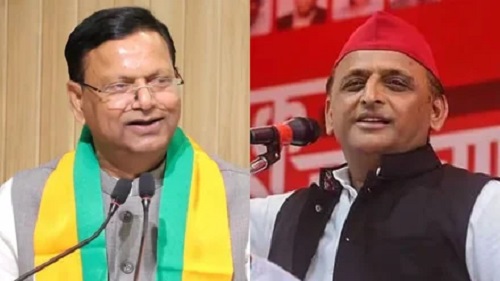
Uttar Pradesh BJP president Pankaj Chaudhary on Tuesday launched a pointed attack on Akhilesh Yadav, questioning the sincerity of his proposed visit to the Ram Temple on December 12. Chaudhary alleged that the SP chief was invoking Lord Ram for electoral advantage rather than expressing genuine respect for the religious sentiments associated with Ayodhya. He also referred to the firing on Kar Sevaks in 1990, during the Ram Janmabhoomi movement, and demanded that Yadav apologise for the incident.
Chaudhary argued that if Yadav's proposed temple visit represented genuine remorse, he should visit the shrine on December 6 instead of December 12 and acknowledge what the BJP describes as the historical wrong committed against Ram devotees. In a strongly worded statement, he said that visiting the temple could not erase the political and historical controversies surrounding the SP's past. His remarks were intended to challenge the credibility of Yadav's renewed outreach to the Hindu religious community.
Uttar Pradesh Deputy Chief Minister Brajesh Pathak also joined the criticism, suggesting that the SP's latest statements reflected a change in its political approach. He remarked that the party had at least begun mentioning Ayodhya, alleging that its leaders had earlier been uncomfortable with references to the holy city and Lord Ram. Pathak further claimed that Yadav was now attempting to enter political territory traditionally associated with the BJP.
The BJP's criticism followed Yadav's announcement that an SP government, if elected in 2027, would work towards establishing Ayodhya as a global capital for Sanatan pilgrimage. In a post on X, the former Uttar Pradesh chief minister presented a broad vision combining religious tourism, civic development, economic revival and transparent temple administration. He claimed that the number of devotees visiting Ayodhya had been declining and attributed the alleged trend to public dissatisfaction over controversies surrounding the Ram Temple and land transactions in the city.
Yadav promised to introduce a transparent management mechanism for the temple to rebuild public confidence. He also spoke of developing world-class infrastructure and strengthening the city's economy so that the benefits of religious tourism would reach ordinary residents. His emphasis was not limited to the development of pilgrimage facilities; he sought to present Ayodhya as a place where religious heritage and the economic interests of local communities could advance together.
The SP chief also attempted to connect his political pitch with the everyday concerns of economically weaker sections. Referring to an incident in which people collecting oil were allegedly subjected to humiliation and beaten with a cane, he promised that a future SP government would ensure dignity and protection for poor women and children. He proposed including edible oil and ghee in the public distribution system to improve access to essential nutritional items.
Another element of his proposed development agenda was the promotion of traditional boating on the Saryu, with the objective of improving the livelihoods of local boatmen. Invoking the relationship between Lord Ram and Nishadraj, Yadav sought to underline the importance of traditional communities in Ayodhya's cultural and religious history. The proposal also reflects an attempt to link the city's spiritual identity with employment generation and local economic opportunities.
The political exchange comes amid continuing allegations and counter-allegations over land transactions and alleged irregularities in Ayodhya. These issues are becoming increasingly important as political parties prepare to frame their narratives ahead of the next Assembly election. The BJP is likely to emphasise its association with the Ram Temple movement and the construction of the temple, while the SP is attempting to broaden the debate towards governance, transparency, tourism and the welfare of local residents.
For Akhilesh Yadav, the challenge will be to convince voters that his party's new emphasis on Ayodhya represents a credible political and developmental commitment rather than an election-season repositioning. For the BJP, the task will be to defend its record while ensuring that its association with the temple translates into wider confidence in the development of the city.
Ayodhya, therefore, is no longer merely a subject of religious symbolism in Uttar Pradesh's political discourse. It is becoming a test of competing political claims over faith, historical responsibility, governance and development. As the 2027 election approaches, the contest over who can best represent Ayodhya's aspirations is likely to intensify.

















Leave Your Comment