


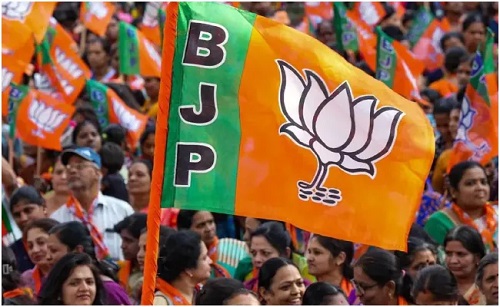
The Bharatiya Janata Party (BJP) has reinforced its political dominance in Gujarat’s capital, Gandhinagar, by retaining control of the Gandhinagar Municipal Corporation (GMC) with 38 of the 44 seats in the October 13 civic election results. While the outcome confirms the party’s commanding position, its reduced tally compared with 2021 suggests that electoral dominance cannot be measured by victory alone. The Congress, despite remaining far behind, improved its representation from three to five seats and swept all four seats in Ward 6. Meanwhile, the Aam Aadmi Party (AAP), which had sought to establish itself as an alternative to the two established parties, failed to win a single seat. The verdict therefore presents a mixed picture: a decisive BJP victory, a limited but noteworthy Congress recovery, and a setback for AAP’s expansion strategy.
The BJP secured 38 seats, comfortably crossing the majority mark in the 44-member municipal corporation. Its victory across eight wards, where it won all four seats in each, demonstrated the party’s organisational strength and continued electoral appeal in the state capital. It also won three seats each in two additional wards, although Ward 6 emerged as a complete exception to the broader trend.
In Ward 6, the Congress defeated all four BJP candidates, producing the election’s most striking local outcome. The result demonstrated that the BJP’s overall dominance did not translate into uniform support across every ward. Local political considerations, candidate appeal and constituency-level dynamics can influence municipal elections even where one party enjoys a substantial statewide advantage.
The comparison with the 2021 election is particularly significant. The BJP had won 41 seats in the previous polls, meaning its representation has declined by three seats. This reduction does not threaten its control of the corporation, but it provides a reason for the party to examine the areas where its support has weakened.
The BJP’s continued majority nevertheless gives it considerable political room to pursue its municipal agenda. The party can retain the civic administration without depending on other political groups, allowing it to focus on urban governance, public services and infrastructure in the capital.
However, the next test will be whether the party can convert its electoral mandate into visible improvements in citizens’ everyday lives. In a capital city, expectations concerning roads, sanitation, drainage, water supply, traffic management and planned urban development remain central to the public’s assessment of the ruling party.
The Congress won five seats, improving on its tally of three in 2021. Although this remains a modest representation in a corporation dominated by the BJP, the gain indicates that the opposition has retained pockets of support and found an opportunity to challenge the ruling party at the local level.
The party’s most consequential performance came in Ward 6, where Hansaben Lalitkumar Ninama, Meghnaben Rajubhai Desai, Mehulkumar Aravindbhai Rathod and Karmjitsinh Virendrasinh Vaghela won all four seats. The complete sweep distinguishes this ward from the wider electoral picture and gives the Congress a concentrated base of representation within the corporation.
The result should not, however, be interpreted as evidence of a citywide political realignment. The BJP’s 38 seats against the Congress’s five establish a substantial difference in electoral strength. The Congress has improved its numbers, but the scale of the gap suggests that it still faces a difficult task in building a broader challenge.
The Aam Aadmi Party failed to win any seats despite fielding 32 candidates. The outcome represents a setback for its effort to establish a meaningful presence in Gandhinagar’s municipal politics.
AAP’s performance is particularly notable because the party has sought to position itself as an alternative to the BJP and Congress in several electoral contests. Yet the Gandhinagar results show that contesting a significant number of seats does not automatically produce electoral representation.





















Leave Your Comment