


India rarely announces its turning points with drama. More often, they arrive quietly, hidden inside campaign speeches, roadshows, welfare promises, local grievances, and the persistent hope of ordinary voters. The Assembly elections of 2026 in Assam, West Bengal, Tamil Nadu, Kerala, and Puducherry belong to that category of political moments that look regional on the surface yet carry unmistakably national consequences underneath.
Taken together, these contests cover 824 Assembly seats across five different political worlds: Assam with 126 seats, West Bengal with 294, Tamil Nadu with 234, Kerala with 140, and Puducherry with 30. They bring millions of voters into motion across tea gardens, industrial belts, coastal communities, crowded cities, university campuses, and welfare-dependent villages. In each place, the vocabulary may differ, but the underlying concerns remain recognisable: jobs, prices, dignity, social peace, efficient delivery of welfare, and confidence in leadership.
For the Bharatiya Janata Party, these elections are not one battle but five different tests of political maturity. In Assam, the party must prove that stability can be renewed. In West Bengal, it must show that a challenger can keep growing into a governing alternative. In Tamil Nadu, it must persuade voters that national ambition and regional pride need not be enemies. In Kerala, it must convert patient presence into durable relevance. In Puducherry, it must demonstrate that alliance governance can still produce coherence and trust.
That is why these elections matter beyond the arithmetic of seats. They are an early reading of the road to 2029, but they are also something deeper: a test of how India’s diversity will negotiate its future. Will the country move through converging pathways of development, or through political geographies that complicate national momentum? The answer will emerge state by state, story by story, and verdict by verdict over a consequential election season.
Assam: Stability Meets the Demand for Renewal
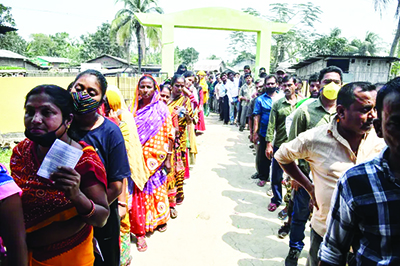
Assam is the one state among these five where the BJP does not enter as an aspirant searching for footing. It enters as the incumbent architect of a changed political climate. Over the past decade, the state has moved from an atmosphere once dominated by insurgency, uncertainty, and uneven connectivity to one marked more visibly by administrative control, roads, bridges, welfare delivery, and a stronger sense of state capacity. That transformation is neither complete nor beyond criticism, but it is real enough to shape the mood with which voters approach the 126-seat contest.
Chief Minister Himanta Biswa Sarma remains central to this story. His public style is direct, politically sharp, and interventionist. Supporters see him as decisive and energetic; critics see centralisation and overreach. For the BJP, that personal leadership capital matters because Assam is now asking a harder question than in previous elections. The issue is no longer simply whether the party brought stability. It is whether it can convert stability into the next generation of prosperity.
That is where the pressure lies. Floods remain a cruel annual reminder that state capacity still has limits. Youth employment is a growing concern in towns and among educated families. The Congress and its allies will try to turn these anxieties into a coalition of fatigue. Yet the BJP retains structural advantages that cannot be ignored. Its organisation is deeper, its narrative is clearer, and its claim to having integrated state and central welfare delivery is stronger. The party can point to infrastructure, policing, peace agreements, and a broader sense that Assam now matters more in India’s strategic and economic imagination than it once did.
The likely verdict still leans towards continuity. The majority mark is 64. What lies ahead for the BJP in Assam, however, is not merely another term. It is a transition from a politics of reassurance to a politics of expectation.
SWOT:
• Strengths include leadership clarity, organisational depth, and a visible governance record.
• Weaknesses include anti-incumbency, flood management fatigue, and pressure on jobs.
• Opportunities lie in logistics, tourism, and Northeast integration.
• Threats lie in climatic shocks, opposition micro-consolidation, and the danger of complacency.
If the BJP wins comfortably, Assam will reinforce its claim that governance can reshape difficult regions over time.
West Bengal: Contesting Power, Contesting Identity
West Bengal has become the most emotionally charged theatre in this electoral cycle, a state where politics does not simply unfold but performs itself. Here, every campaign is also a contest over memory, identity, grievance, language, symbolism, and the legitimacy of power. The 294-seat Assembly election is therefore not just a race between parties. It is a struggle over who gets to narrate Bengal to Bengalis.
Mamata Banerjee and the Trinamool Congress continue to enjoy formidable advantages. Her welfare model is not abstract policy; it is lived political contact. Women beneficiaries, students, rural families, and local social networks have all contributed to making the TMC far more than an election machine. Mamata’s personal political persona, combative yet intimate, still carries strong emotional resonance.
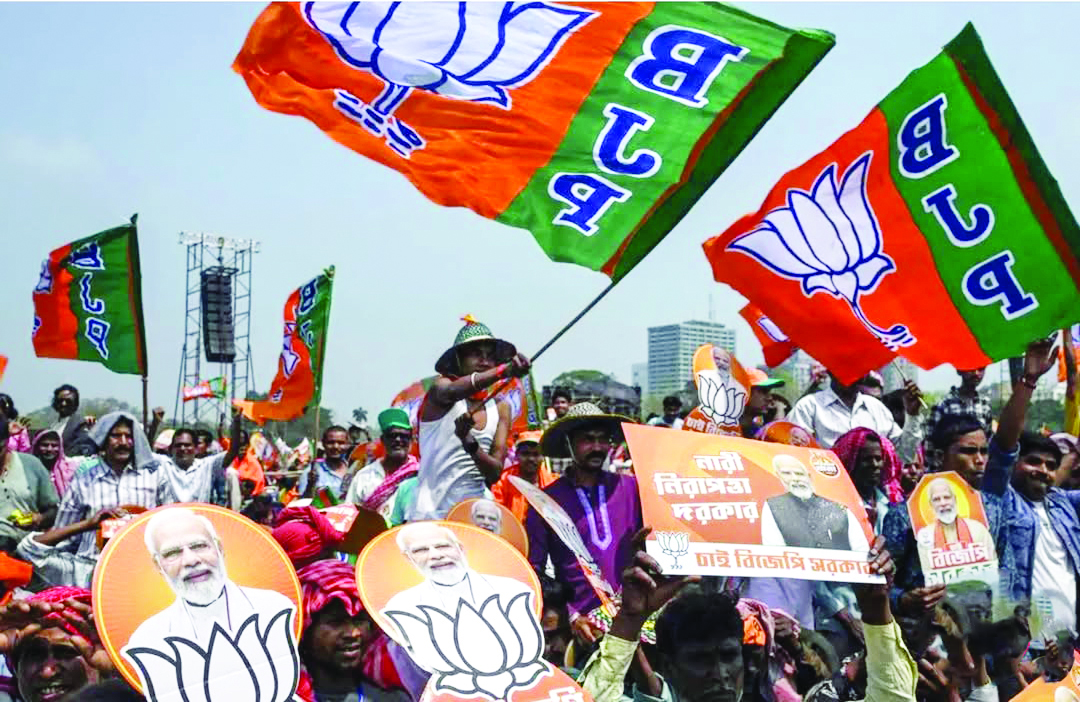
And yet, the BJP has changed Bengal irrevocably. It is no longer an outsider making occasional noise. It is the principal challenger, the main pole around which anti-TMC politics is now organised. The party has built cadre strength in large parts of the state, especially where grievance against local corruption, violence, or exclusion has hardened into anger. It has created a second vocabulary in Bengal: governance instead of patronage, accountability instead of syndicate power, aspiration instead of managed dependence.
Still, Bengal remains difficult terrain for the BJP. The party’s national appeal does not automatically resolve the cultural question. To govern Bengal, or even convincingly aspire to govern it, one must speak to its intellectual inheritance and anxieties about external domination. This is where the BJP’s challenge remains unfinished.
The majority mark is 148 in the 294-member House. Whether or not the BJP reaches it this time, Bengal could remain the central eastern battleground of Indian politics through the run-up to 2029.
SWOT:
• The BJP’s strengths lie in expanding organisation, strong leadership appeal, and anti-incumbent energy.
• Its weaknesses lie in incomplete cultural embedding and uneven demographic reach.
• Its opportunities lie in urban dissatisfaction, youth aspiration, and governance fatigue.
• Its threats lie in welfare loyalty, identity consolidation, and the TMC’s proven instinct for survival under pressure.
The most plausible near-term outcome is not immediate regime change but deeper bipolarity. Every additional gain for the BJP reduces the distance between challenger and incumbent. That psychological shift is the BJP’s real prize.
Tamil Nadu: Between Identity and Economic Aspiration
Tamil Nadu has long been the state where Indian national politics must humble itself before regional memory. For decades, Dravidian ideology, linguistic pride, welfare politics, and charismatic regional leadership have shaped a political culture with its own grammar. National parties can enter the debate, but they cannot simply overwrite the script. That is what makes Tamil Nadu one of the most difficult, and strategically important, frontiers for the BJP.
The 234-seat contest unfolds in a state that is economically confident, socially self-aware, and politically disciplined. Tamil Nadu is not resisting change; it is interrogating who gets to define it. The BJP’s opportunity lies precisely there. A younger electorate increasingly thinks in terms of jobs, industry, startup ecosystems, infrastructure, education, and investment. Tamil Nadu’s economic identity is strong enough that developmental language matters as much as ideological language in many urban and semi-urban segments.
The NDA’s strategy therefore rests less on dramatic conversion and more on calibrated expansion. Alliance politics becomes crucial. The BJP on its own is still building depth, but within a coalition it can shape messaging and create the impression of a broader anti-incumbent alternative. That matters in a polity where perception often precedes breakthrough.
Yet the barriers remain real. For many voters, the BJP still carries the image of a party insufficiently attuned to Tamil anxieties about language, federal autonomy, and cultural pride. The DMK and its ecosystem know how to activate these anxieties effectively. Any national development pitch that appears insensitive to regional dignity can quickly become politically costly.
The House strength is 234, with 118 required for a majority. The most plausible outlook remains that the dominant Dravidian formation retains the edge, while the NDA attempts to improve its strike rate and political relevance.
SWOT:
• The BJP’s strengths lie in developmental messaging, urban resonance, and alliance utility.
• Its weaknesses lie in shallow historical roots and an outsider image.
• Its opportunities lie in youth aspiration, economic ambition, and fatigue with entrenched binaries.
• Its threats lie in identity mobilisation, regional suspicion, and fragmented opposition space.
What lies ahead for the BJP in Tamil Nadu may matter more than what happens in one election. A stronger vote share and a more credible alliance position would signal that the state is moving from impermeability to contestability. That alone would alter southern political calculations substantially.
Kerala: The Discipline of Gradual Expansion
Kerala teaches political patience. It is a state where literacy sharpens ideology, where public debate is unusually intense, and where two major coalitions have for decades structured electoral life so completely that third forces often find themselves visible yet boxed in. The 140-seat Assembly election is once again primarily a contest between the Left Democratic Front and the United Democratic Front. Within that bipolarity, the BJP is attempting something more subtle than immediate victory: it is trying to become structurally unavoidable.
That effort has been gradual, uneven, and often frustrating. The BJP has grown in visibility, improved its vote share in past cycles, and made itself part of the political conversation in a way that would have seemed improbable years ago. It has pockets of urban appeal, draws attention from younger aspirational voters, and benefits from national visibility that neither of the state’s dominant fronts can entirely dismiss. Yet that has not consistently translated into seats, because Kerala’s map is notoriously efficient at channelling discontent back into the LDF-UDF axis.
What, then, is the BJP fighting for in Kerala? Not merely seats, though seats matter. It is fighting for legitimacy in the minds of voters who may not yet support it electorally but are increasingly willing to listen to it as part of Kerala’s future. That is a slower kind of expansion, but potentially consequential if sustained.
Questions around employment, outmigration, youth opportunity, fiscal pressure, and administrative performance continue to animate debate. The BJP’s challenge is to frame itself not as a disruptive outsider to Kerala’s welfare ethos, but as a force that can complement social development with efficiency, entrepreneurship, and national connectivity.
The Assembly has 140 seats; 71 are needed for a majority. Few expect the BJP to approach that benchmark soon. But that is not the immediate measure of success.
SWOT:
• Its strengths lie in rising visibility, select urban appeal, and national connect.
• Its weaknesses lie in limited seat conversion and persistent ideological resistance.
• Its opportunities lie in governance fatigue, youth aspirations, and fresh political vocabulary.
• Its threats lie in bipolar squeeze, tactical voting, and resilient coalition identities.
What lies ahead for the party in Kerala is gradual institutionalisation: stronger booth networks, better local faces, and an expanding ability to convert visibility into representation. The BJP understands that logic.
Puducherry: Governance Through Alignment
Puducherry is small enough to be underestimated and politically important enough that it should never be dismissed. In national conversations, the Union Territory often appears as a footnote to larger state battles. But that is precisely why it matters. In a compact 30-seat Assembly, politics becomes intensely local, personalities matter greatly, alliance management is visible in real time, and the line between administrative delivery and electoral judgment is unusually short.
For the BJP, Puducherry is less a laboratory of ideological expansion than a test of cooperative power. It operates here within an alliance framework, and that reality brings both benefit and vulnerability. On the one hand, alliance governance allows the party to project Centre-linked administrative alignment, access to national schemes, and a capacity to move local priorities through a supportive federal channel. On the other hand, alliance politics means credit is shared, blame is diffused, and the BJP’s independent identity can remain underdeveloped.
This election is therefore about more than merely retaining influence. It is about whether the governing alliance can persuade voters that alignment with the Centre produces practical results: better infrastructure, tourism growth, jobs, smoother administration, and a stronger developmental roadmap. In a place like Puducherry, voters can be remarkably pragmatic. They are often less impressed by abstract ideological combat than by what works on the ground.
The opposition will try to convert local frustration, factionalism, and the natural wear of incumbency into momentum. In a small House, even minor shifts in mood can produce disproportionate outcomes. That keeps the contest competitive. But it also means disciplined alliance management can be decisive.
The Assembly has 30 seats, so the road to power is narrow and fluid. What lies ahead for the BJP depends on whether it can evolve from being merely a useful alliance partner into a more recognisable independent stakeholder in governance.
SWOT:
• Its strengths lie in incumbency within the alliance, access to central resources, and administrative coordination.
• Its weaknesses lie in dependence on partners and limited standalone identity.
• Its opportunities lie in showcasing tourism-led growth and efficient Centre-UT alignment.
• Its threats lie in anti-incumbency, alliance friction, and volatility in a small legislature.
If the alliance holds, Puducherry will show that smaller territories often reward administrative coherence over rhetorical excess.
Synthesis: Many Roads, One National Test
Seen together, these five elections do not tell one simple story. They tell five different stories about the present condition of Indian politics and one larger story about the future of the BJP. In Assam, the party is defending success and discovering the burden of expectation. In West Bengal, it is fighting to transform anger against incumbency into a durable alternative. In Tamil Nadu, it is learning the discipline of entering a state without presuming that national scale automatically confers local legitimacy. In Kerala, it is investing in the long game of normalisation and incremental growth. In Puducherry, it is testing whether alliance-era governance can build trust beyond coalition arithmetic.
This diversity matters because one of the most common analytical mistakes in Indian politics is to assume that parties contest every state with the same purpose. They do not. For the BJP especially, these five elections represent different stages of organisational evolution. That makes the overall result more complex than a simple win-loss ledger. The party may consolidate in one region, deepen in another, enter new social terrain elsewhere, and still fall short of power in places where its long-term strategic position nevertheless improves.
There is, however, a clear national pattern. The BJP’s strongest argument across these states remains governance fused with aspiration. It seeks to position itself as the force that can align welfare with growth, infrastructure with national integration, and local administration with a broader developmental horizon. Where that message is backed by visible delivery, as in Assam, it is electorally potent. Where it meets entrenched regional identities, as in Tamil Nadu or Bengal, it must adapt and localise itself. Where electoral systems are bipolar and disciplined, as in Kerala, it must accept slow accumulation over instant gratification.
The road to 2029 will be shaped by how successfully the BJP absorbs these lessons. If it treats each of these states as a distinct political civilisation rather than a mere extension of a national campaign, it can grow even where it does not immediately win. The broader democratic significance is equally important. These elections test whether India can sustain a developmental conversation across very different regional contexts without erasing those contexts.
Conclusion: The Direction of India’s Democratic Journey
The Assembly elections of 2026 are therefore not a single referendum but a layered national mood test conducted across five distinct theatres. In Assam, voters will decide whether continuity deserves renewal. In West Bengal, they will decide whether the challenger has moved close enough to power to make dominance permanently uncertain. In Tamil Nadu, they will weigh the old confidence of regional identity against a newer language of economic aspiration. In Kerala, they will reveal how much political patience can slowly reshape what once seemed fixed. In Puducherry, they will judge whether alliance governance can still feel coherent, practical, and trustworthy.
For the BJP, the central lesson may be that ambition is not enough; adaptation is everything. A party that seeks to shape India’s future must learn to speak not only in the language of national vision but also in the accents of regional memory. It must know when to lead with ideology, when to lead with delivery, when to rely on organisation, and when to cultivate patience. These elections reward that intelligence.
For India, the significance is larger still. The country’s democratic vitality lies not in uniformity but in its ability to produce different political answers to the same broad questions. Governments will be formed in five capitals. But something larger will also be decided: the shape of political confidence in a country still negotiating how to grow together without becoming the same. That is why these elections matter beyond headlines and television maps. They are part of the long argument over how India will travel towards 2047, and whether that journey will be marked more by convergence than by fragmentation.

















Leave Your Comment