


The BJP’s sharp attack on the Congress over the INDIA bloc’s street protest against Chief Election Commissioner Gyanesh Kumar has pushed the political confrontation into a more charged phase. BJP spokesperson Pradeep Bhandari accused Congress leader Rahul Gandhi and his party of attempting to create an atmosphere of “anarchy” through street politics, while alleging that the visuals from Wednesday’s protest showed Congress workers manhandling police personnel. The Congress, on the other hand, has projected its agitation as a democratic challenge to the Election Commission. The episode highlights a larger question: where should political protest end and institutional confrontation begin?
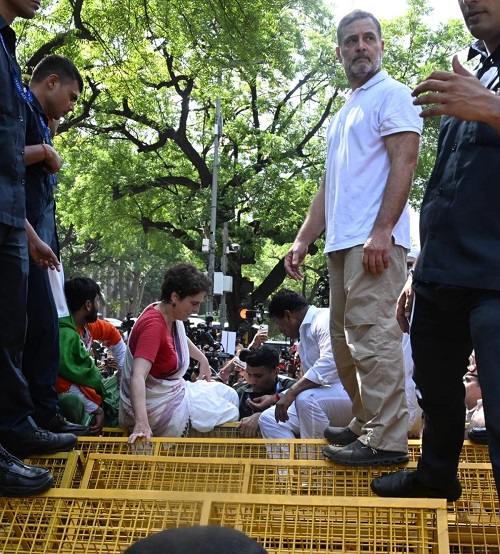
The BJP has sought to turn the Delhi protest into a broader argument about political conduct and institutional stability. Bhandari alleged that Rahul Gandhi, Priyanka Gandhi Vadra and Congress workers pushed or assaulted police personnel during the demonstration. Referring to video footage, he claimed that police officers were attempting to manage a large gathering and repeatedly asking protesters to maintain peace.
The BJP’s political messaging is clear: disagreement with constitutional institutions is legitimate, but confrontation with law-enforcement personnel cannot be presented as democratic resistance. By highlighting the alleged pushing and kicking of policemen, the party is attempting to shift the debate from the Election Commission controversy to the conduct of the protesters themselves.
Bhandari went further by comparing the Congress’s alleged strategy with “Nepal- and Bangladesh-like anarchy.” Such a comparison is politically loaded and reflects the BJP’s attempt to portray street mobilisation not merely as opposition politics but as a potential threat to public order.
At the same time, allegations based on selected video footage need to be evaluated in their complete context. Political parties routinely use visuals from protests to strengthen competing narratives. The larger issue is therefore whether the entire demonstration remained within the boundaries of peaceful democratic dissent.
The confrontation is also significant because it revolves around the Election Commission, one of the central institutions of India’s electoral democracy. Rahul Gandhi and INDIA bloc leaders have been protesting against CEC Gyanesh Kumar, making the issue a major opposition campaign.
Bhandari argued that because the Election Commission-related matter is already before the Supreme Court, street protests cannot influence judicial proceedings. His argument reflects the BJP’s position that political mobilisation should not be allowed to create pressure around matters under judicial consideration.
Yet, the existence of a judicial proceeding does not automatically eliminate the political right to protest. Opposition parties can raise concerns about institutions and electoral processes, provided their demonstrations remain peaceful and lawful. The important distinction is between questioning an institution and undermining its legitimacy, and between protest and disorder.
That distinction will increasingly matter as electoral issues become central to political competition. The Election Commission must retain public credibility, while political parties must also accept that institutional disagreement has constitutional limits.
The BJP’s charge that Rahul Gandhi is “desperate” to return to power is clearly part of a larger political narrative. The Congress, meanwhile, wants the protests to reinforce its claim that electoral institutions require greater scrutiny and accountability.
The most striking feature of the confrontation is therefore not merely the protest itself but the competing narratives surrounding it. For the Congress, street mobilisation demonstrates resistance. For the BJP, the same images represent political desperation and an attempt to create confrontation.
Bhandari’s reference to alleged “global international forces” adds another layer to the BJP’s argument, suggesting that external interests could be exploiting domestic political tensions. Such claims, however, require credible evidence and should not substitute for substantive political debate.
Ultimately, democracy is strengthened not by the absence of protest but by the ability to accommodate dissent without allowing disagreement to descend into disorder. The Congress has every right to question the Election Commission, while the government and BJP have every right to challenge the opposition’s methods. But neither side benefits if institutional disagreement becomes a contest in political escalation. The real test of India’s democratic maturity lies in whether fierce political competition can coexist with respect for institutions, law and peaceful protest.




















Leave Your Comment