


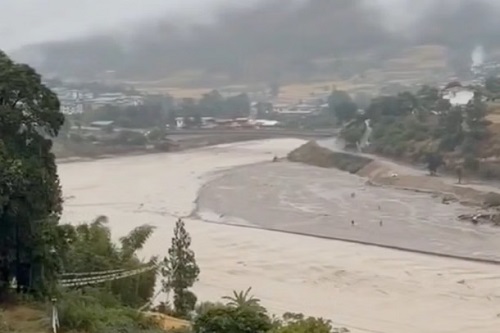
A sudden glacial lake outburst flood in northwestern Bhutan has triggered flash-flood warnings across vulnerable areas of West Bengal and Assam, highlighting the dangers posed by unstable Himalayan lakes and rapidly rising river levels. The flood, which struck on Thursday evening, completely destroyed facilities at the popular Gasa Tshachu hot springs along the Mo Chhu River. Although no casualties have been reported because the area was evacuated in advance, authorities on both sides of the border are monitoring the situation as floodwaters move downstream.
A glacial lake outburst flood (GLOF) at Shintaphu Lake in Bhutan has prompted emergency alerts in neighbouring Indian states, with authorities warning residents in vulnerable riverbank areas to remain cautious as water levels could rise suddenly.
Located at the source of the Mo Chhu River, Shintaphu Lake is among Bhutan's 17 potentially dangerous glacial lakes. The sudden release of water has caused extensive damage in the Gasa district, including the complete destruction of facilities at Gasa Tshachu, a popular natural hot spring situated close to the river.
The incident has revived memories of August 26, 2021, when a major flash flood caused the Mo Chhu River to change its course towards the hot spring, washing away its facilities. The latest disaster once again demonstrates the vulnerability of infrastructure located close to Himalayan rivers, where sudden changes in water flow can cause widespread destruction.
The floodwater has crossed Srigang in Kabesa Gewog, around eight kilometres from Punakha Dzong, raising concerns about its downstream movement. Bhutan has alerted the governments of West Bengal and Assam, as districts along the international border could face sudden increases in river levels.
In West Bengal, the Darjeeling hills, Alipurduar and Jalpaiguri are among the areas identified as potentially vulnerable. Assam's Dhubri district has also been placed on alert.
The Central Water Commission's Flood Forecast Monitoring Directorate, under the Union Ministry of Jal Shakti, has issued a special advisory warning of a possible sudden rise in water levels in Alipurduar and Dhubri.
According to the advisory, floodwaters originating in the upper reaches of the Punatsangchu river system, known as the Sankosh in India, could reach the Indian border within six to eight hours. Authorities in the affected districts have been advised to closely monitor the situation and take necessary precautionary measures.
In Cooch Behar, the district administration has specifically alerted people living along the banks of the Sankosh River. The river system originates in northern Bhutan, receives water from major upstream tributaries, including the Mo Chhu and Pho Chhu, and ultimately drains into the Brahmaputra in Assam.
Officials in West Bengal have urged residents to remain alert without giving in to panic. Amit Kumar Shaw, Superintendent of Police of the Alipurduar Police District, said the administration was on high alert and that relevant agencies were actively responding to the situation.
He appealed to the public to remain calm, adding that authorities were working to address difficulties arising from the developing situation.
The immediate priority is to monitor river levels, communicate timely warnings and prevent people from entering vulnerable riverbanks. Residents in low-lying areas should follow instructions issued by local administrations and move to safer locations if directed.
Even where the initial impact appears limited, sudden surges in Himalayan rivers can leave little time for evacuation. Continuous coordination between Bhutanese authorities and administrations in West Bengal and Assam will therefore be essential to reduce the risk to human life and property.
The flood has also damaged infrastructure in Bhutan. The Solar Irrigation Lifting System, installed earlier this year to address irrigation difficulties in the Dochhukha-Dzomlingthang-Ritsa Chiwog area under Guma Gewog in Punakha, has been partially damaged by the surge in the Mo Chhu River.
According to an official press release, the system has stopped functioning. The full extent of the damage is yet to be assessed.
Flood-borne debris has also covered part of the Punakha-Gasa Highway in the Dzomlingthang area, potentially disrupting transport and access to nearby communities.
The damage to the irrigation system illustrates how such disasters can affect more than settlements and tourism facilities. They can also disrupt agricultural activities, damage public infrastructure and impose additional costs on communities that depend on local water and transport networks.



















Leave Your Comment