


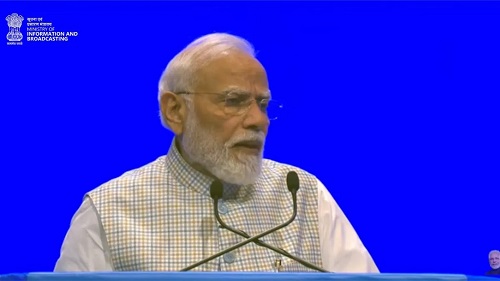
India’s telecom story is no longer merely about expanding mobile coverage; it is increasingly about building the digital infrastructure on which governance, commerce, entertainment and everyday life depend. Addressing the 10th edition of the Indian Mobile Congress 2026, Prime Minister Narendra Modi highlighted how rapidly the sector has evolved, from the rollout of 5G to the emergence of new opportunities in gaming, content creation and digital services.
The Indian Mobile Congress has itself become a marker of India’s telecom transformation. The 5G rollout was launched at the event in 2022, while the following year witnessed its wider expansion. The scale of that transformation is reflected in the fact that 5G connectivity has now crossed more than 5.5 lakh base stations.
The journey has also increasingly acquired a global dimension. In 2024, discussions around the International Telecommunication Union and global standards underlined India’s growing participation in shaping the rules of the digital economy. Last year, the emphasis shifted strongly towards “Make in India”, reflecting the government’s effort to move beyond being a large telecom market and become an important manufacturing and technology hub.
This progression—from connectivity to standards, and from consumption to domestic production—captures a broader change in India’s digital ambitions. The objective is no longer simply to connect more people but to create an ecosystem capable of supporting the next generation of technologies.
Modi also recalled how mobile and digital connectivity became indispensable during the Covid-19 lockdown in 2020. Schools continued teaching, families remained connected and remote work became possible because digital networks could substitute, at least partially, for physical mobility.
The more consequential transformation, however, has been in the relationship between citizens and the government. Digital connectivity has enabled welfare delivery to become quicker and more direct. The example of PM-KISAN illustrates this change: farmers receive financial assistance periodically and can be informed through their mobile phones when payments are credited.
The smartphone has therefore evolved from a communication device into a gateway to public services, financial transactions, education and commerce. Faster networks, greater tower density in remote areas and expanding fibre infrastructure can further reduce the digital divide and make data access more affordable.
The challenge now is to ensure that this expansion remains inclusive. Connectivity has real value only when people in villages, smaller towns and economically weaker communities can access and meaningfully use the digital ecosystem.
The spread of affordable smartphones and high-speed connectivity has also created entirely new economic and cultural possibilities. Modi highlighted the rapid growth of India’s gaming ecosystem, saying that more than 500 million people are now part of it, with substantial participation from Tier-2 and Tier-3 cities.
This is significant because the digital economy is increasingly being driven from outside traditional metropolitan centres. Young Indians are not merely consuming digital content; many are creating it, building businesses around it and turning smartphones into production studios.
The same connectivity has fuelled the growth of regional-language content on OTT platforms. Audiences can increasingly access entertainment in their own languages, while creators from smaller cities can reach viewers across the country and beyond. The content-creation industry, according to the figures cited by the Prime Minister, has grown to around Rs 1,000 crore.
Yet the digital expansion also brings a new responsibility. As smartphones become central to everyday life, cybercrime, fraudulent messages and deepfakes pose increasingly serious challenges. Greater connectivity must therefore be accompanied by greater digital literacy. Users need to distinguish authentic information from manipulated content and recognise online fraud before it causes harm.
India’s telecom journey is consequently entering a more complex phase. The next milestone will not simply be the number of towers or subscribers, but whether connectivity can translate into innovation, employment, inclusion and greater digital security. The Indian Mobile Congress reflects that changing ambition—from connecting India to enabling a digitally confident India.





















Leave Your Comment