


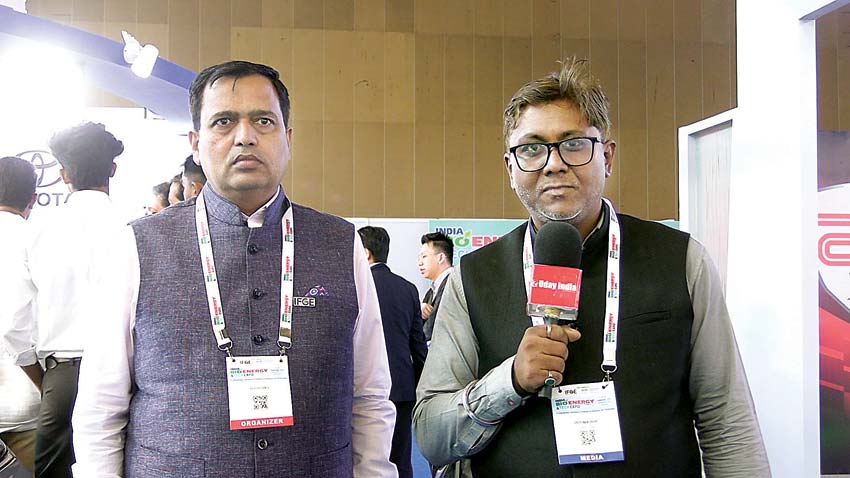
I, Anshuman Anand, am currently standing at the Yashobhoomi in Dwarka, Delhi, where the India Bio Energy Summit is underway. This is a huge and significant event. It's not just about the future of the country; the very foundation of the future is being laid here. But on what foundation is this event itself built? That foundation is standing with me, and he is Vaibhav Dange. Excerpts of the interview:
What was the inspiration, the driving force behind initiating this entire event?
Look, as you can see, the India Bioenergy and Technology Expo is happening here. We all know that our country is dependent on the world for our energy needs. We import about 80% of our energy, primarily crude oil. Therefore, for many years, since around 2002, there has been intense discussion in this country that we must promote biofuels. Through this, our domestic fuel production will increase, our country's energy capacity will grow, and our import bill will decrease.
I remember, it was first in 2002, during the government of the Honourable Atal Bihari Vajpayee, that the initial work began. At that time, discussions happened on biodiesel and the ethanol blending program, and some papers were made. I myself recall that when Dr. APJ Abdul Kalam was the Honourable President of India, he held a conference at his Hyderabad residence, the Rashtrapati Nilayam, where I got the first opportunity to present a paper on this subject. So, we have been discussing this in our country for 20 years.
But fortunately, in the last 10-11 years, since Prime Minister Modi's government came to power, PM Modi and Mr. Gadkari have very strongly pushed for biofuel and bioenergy. The impact of this is that our country has very successfully achieved 20% ethanol blending in the last 10 years. And we achieved this 20% blending target 5 years in advance. Our target was to achieve it by 2030; we are achieving it by 2025. Just today, the Indian government has given permission for the global export of 2G ethanol and has declared incentives for it; the announcements were made today itself.
So, I believe that where we were once talking about biofuels and bioenergy, where we used to import fuel from all over the world, today we have started giving permission to export our own fuel. I think this is a massive transformational paradigm shift—from importing fuel to talking about exports, especially the export of 2G ethanol from our country. And where is all this happening from? It's happening from your agricultural residue, from agricultural waste. The direct result of this is for our country's economy, which is agriculture-based.
We all say that the income of our farmers should be doubled. How will that happen? Unless we create value addition in agricultural produce... Unless we generate value from everything on a farmer's field, how can we double their income?
PM Modi has said two things: 'Waste to Wealth' and 'Double Farmers' Income'. It seems to me that the event you have organized fulfills both these purposes. Am I right?
Absolutely. The path to both these visions—doubling farmers' income and 'Waste to Wealth'—goes through biofuel. Biofuel is the only way forward for this. And today, you must have seen here, whether it's ethanol, Compressed Biogas (CBG)... CBG is produced from municipal solid waste. CBG is produced from the waste from our sugar factories, the press mud. CBG is produced from our agricultural waste. Today, Delhi faces a pollution problem; there's a big issue of stubble burning. This stubble can be used to produce our CBG. If CBG is made from stubble and the farmer starts benefiting from selling it, why would he burn it? He will sell it, and he will get value from it. So, I believe that 'Waste to Wealth' and energy security, self-reliance, both are connected through bioenergy.
Whenever we talk about bioenergy, one term that comes up is FFV—Flex-Fuel Vehicles. Please tell us about it.
Look, in the last few days, you must have seen, especially on social media, a very manipulated discussion happening in this country, claiming that due to ethanol blending, vehicles in our country are being damaged or consumers are facing losses. I felt that nothing could be farther from the facts.
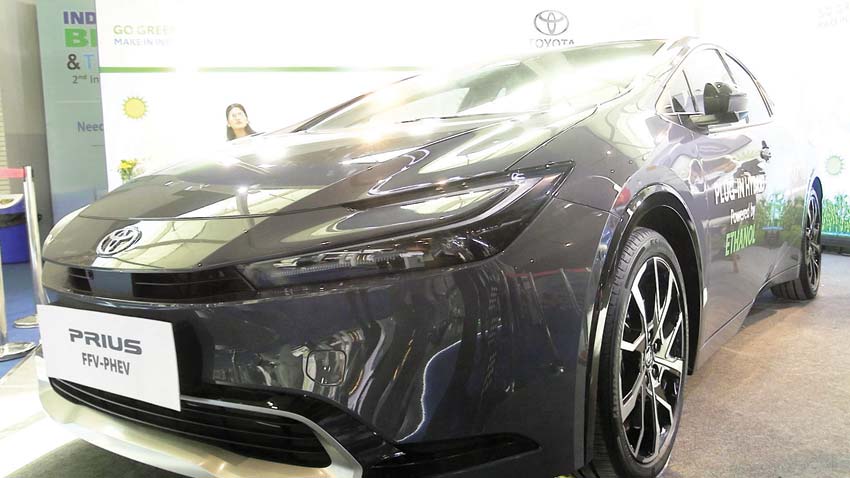
You must have seen that in our country, this car we are looking at here is from Toyota. Toyota manufactures Flex-Fuel Vehicles worldwide. Now, what is a Flex-Fuel Vehicle? It is a vehicle that can run on 100% ethanol, and the same vehicle can also run on blended petrol. So, the consumer will have the right to use 100% ethanol or 100% petrol. Brazil has shown this. They have been doing it for the last 40 years. In Brazil, 27% blended ethanol is used. And at Brazilian fuel stations, there is a dispensing unit for ethanol and one for petrol. If the price of ethanol is low, I buy ethanol. If the price of petrol is low, I buy petrol. But this right is the consumer's. And today, we need to move in that same direction.
That is why we specifically requested Toyota to display the Flex-Fuel Vehicle, so that our country's policymakers, scientists, engineers, and media can see it. This Flex-Fuel Vehicle is a world-class car. My suggestion is that you should definitely see this car from the inside as well. It is a world-class car. I was fortunate when I went to Brazil; I drove this car myself. And it drives so smoothly, just like any normal car.
And the biggest advantage of Flex-Fuel... just now, in the debates on ethanol, people were repeatedly saying that the consumer should have the right, and if ethanol is cheaper and they can save money, the consumer should get that benefit. What could be a bigger example than this?

You said that this car standing in front of us will dispel the myth that ethanol affects the engine. That myth is cleared. But please tell us, what will be the price difference between ethanol and petrol if this car is used?
Look, today ethanol is selling in our country for around ₹70-71 per litre. And in the coming days, besides ethanol... Petrol today sells for about ₹100 per litre here. So, if we run the car on pure ethanol, we will run the car at ₹70-72 per litre. If we run the car on ethanol, it will cost that, and if on petrol, it will be ₹100 per litre. So, directly, there is a difference of about ₹30 per litre. Plus, this car is a plug-in hybrid. So, you can also charge it if needed. So, it is partially electric as well. So, you can sometimes charge it, and when the car runs, its battery also charges from the mechanical energy. So, it is a plug-in hybrid.
I believe the world is moving in a very different direction in the coming days, and therefore we must move in that direction. We will have to make our mobility more sustainable. We will have to make it pollution-free. Only then, by advancing in this direction, will our country and our cities be saved from pollution. More than 17% of the pollution in our Delhi is vehicular pollution. The only way to reduce that is to bring in these kinds of hybrid cars, sustainable cars, plug-in hybrids, ethanol-based flex-fuel vehicles. Along with this, the right will be with the consumer to decide whether to use petrol or ethanol. Because I will decide: if petrol is cheaper today, I will use petrol. If ethanol is cheaper, I will use ethanol.
These cars are in the premium segment, and PM Modi's entire focus is also on providing relief to our middle class, the lower and middle classes. What things are available for them?
Now, look, when hybrid cars first started coming into our country... smaller models like Brezza and different models from several companies have also come, which are hybrid cars. So, when this market grows, all these things come.
But just as the government gave different types of incentives to promote electric cars, to promote electric vehicles, we will have to give similar incentives for hybrid vehicles as well. Whether it's on registration... because this will definitely reduce pollution in our country. Our consumers will get the right. As you are seeing this TVS vehicle. This is a TVS vehicle that runs on 100% ethanol.
That vehicle runs 100% on electric. Now, all of these are very significant for our country's sustainable mobility. And if vehicles run on ethanol, we have a very large sugar cane belt—whether it's Western Uttar Pradesh, Uttar Pradesh, Karnataka, or Maharashtra, where there are sugar factories—if those sugar factories themselves start dispensing their own ethanol, then the two-wheeler users in that area will use ethanol, which will save them money, reduce pollution, and control our emissions. So, its impact is so vast.
And it's not that as the market grows, companies will bring more models, then for the common man... ultimately, the market drives itself. If the market is created, companies will bring products. But the market is never driven by companies just bringing products. So, we will have to get out of this chicken-and-egg situation a bit. And for that, the government will have to rationalize the laws a lot. I'm not saying the government should give financial assistance, but...
Just as an electric car reduces pollution, a hybrid car reduces pollution. So, the benefit that will accrue due to the reduced carbon emissions from hybrid cars should be passed on to the consumer. If we reduce the registration cost for hybrid cars... the government has already taken a big initiative on GST. By pushing in this way, non-polluting, sustainable mobility will come to our country.
Until now, we relied on energy obtained from mines. Now, from what I see of the government's plan, we will convert the energy and carbon that can be obtained from the fields into fuel. So, will this have any impact on our food security?
No, absolutely not. Look, a few years ago, when we started producing ethanol from grain... we have corn in our country. Its market price was not good; it was getting ₹1200-1300. Today it is selling for ₹2600. And the production of corn in our country, which was happening, has now increased almost one and a half times in the last 4 years. So, our production has increased, and with increased production, the farmer is also getting a better price.
So, I don't think so... Also, in grains, whether it's rice or wheat, only that grain is being used which has spoiled in FCI's storage, which is called rotten rice or rotten grain; only that is being used for making ethanol. So, any food item is not being used. I think this is a bit of a misperception among people. There are myths in people's minds. There are some misconceptions, and perhaps a little bit of an intentional effort to spread such confusion.
Because logically, if we cannot argue against biofuels and bio flexible/flex-fuel vehicles, then people resort to spreading myths. I think we have no need for energy security? Today, the wheat and rice that the government buys at MSP, its utilization is not happening fully throughout the year. The pressure on the government to buy the produce made by farmers is increasing. The government is giving subsidy upon subsidy for that.
The production of grains, especially wheat and rice, is such that the government is unable to procure it all, and pressure comes on the government. It is better if multiple uses are created for it; then the farmer will get a good price. We only want that the farmer should grow and get a good price for it, and it should be sold. Absolutely.
So, I think this is a dilemma. People have this mental block. We have to come out of it. And our farmer can become not just the provider of food, but also the provider of energy. And in this direction, I think the country has now advanced a lot, and those who are still in that mindset or try to spread such small myths must now understand that the country has moved far ahead.
Today, the country has an ethanol production of 17,000 crore litres. We have a surplus of about 600 crore litres of ethanol, which can be exported, from which we can get additional revenue. And if we bring flex-fuels, people can use them and save money. So, I think the opportunities are there... the sky is the limit. I think we need to move in that direction.
You yourself told me that you have had a driving experience; you drove these cars in Brazil. So, what about the car's pickup and race? Because the younger generation is very particular about this.
Look, all the testing agencies in this country—the Automotive Research Association of India (ARAI), CIRT, ICAT, all the testing agencies, all our premier institutes in the country—everyone has tested this in every way. Due to ethanol-blended petrol or 100% ethanol, no effect comes on the engine because the engines made after 2021 have been tuned to be used for ethanol. The engines that are flex-fuel engines are specially designed for flex-fuels.
Therefore, neither its performance is affected, nor its pickup is affected, nor its mileage is affected, nor is the engine damaged. So, let us completely remove this myth from our minds. Only those people are spreading this myth. There's a famous English phrase: "If you cannot convince, confuse people." I think it's nothing more than that.
Sustainable mobility for this country is not a luxury, it's not a choice, it's a necessity. The way pollution is increasing in our country, our import bill has reached 22 lakh crore today. If we save even 1 lakh crore, that same 1 lakh crore we can invest in our farmers. That same 1 lakh crore we can invest in education. That same 1 lakh crore we can invest in health. That same 1 lakh crore we can give as a subsidy to the consumer. So, the country's benefit lies in that. There is no benefit in importing and using more petrol.
E Tell us about two-wheelers running on ethanol.
Look, Hero has also made a flex-fuel engine, which is 97% on ethanol. So, that's a technical phrase—hydrous, anhydrous ethanol. So, in simple language, this is a motorcycle that runs on 100% ethanol.
Now, this is available to our farmers who are growing sugarcane, who are growing corn, who have ethanol filling nearby. If the ethanol-producing company itself dispenses ethanol there, then in our villages and towns, two-wheelers can run on ethanol. And today's market price of ethanol is ₹72. Petrol is ₹100. So, imagine, I don't need rocket science to explain it to people. It's simple math, a matter of common sense.
Therefore, pollution will be less. Our emissions will be reduced. Second, it is renewable energy. Our farmer will grow, we will make fuel, use it, and then use it again. So, this will save our foreign exchange. Foreign exchange will be saved. Our farmers will get more benefit. Just because of the ethanol blending program, ₹96,000 crore has been passed on to the farmers. Can you imagine? We will never be able to double farmers' income until the farmer gets his value.
And in any country, in anything, only when we create value does the farmer benefit. Now, the CBG I was telling you about, Compressed Biogas, which is made from biowaste or agri-waste... after that, the waste that remains is called Fermented Organic Manure (FOM). Now, this FOM is the best manure one can use for agriculture. So, the waste we have left can also be used as manure.
And you tell me, what could be better than this? "Aam ke aam, guthliyon ke daam". What could be closer to nature than this?
Today, all over the world, we are talking about being environmentally friendly, being sustainable. What is sustainability? Recycle, Reuse, and Reduce. Reduce your consumption. Recycle whatever waste, and then again reproduce, reuse it further. What could be a bigger cycle than this? What could be a bigger cycle for the benefit of the Earth?
So, I think people and the country's public have started understanding this now. Some people will always spread misconceptions, but they will always remain a minuscule minority. We should not worry too much about them. Now, you can see, investments worth lakhs of crores are happening in this sector. Lakhs of people are getting jobs. You just saw here, there are more than 200 exhibitors. In this three-day conference, more than 150 speakers are deliberating on this.
Now, this is not a joke. Many states, you must have seen their stalls... state governments have made their policies on this. The states are expecting massive investment on this. In this country, the government has a target to install 5000 Compressed Biogas units by 2030. Who will do that? The private sector will do it. If the private sector installs 5000 units, employment will be generated. Who will get the employment? The youth of our country will get it.
So, I think, nothing could be more than the phrase you used—"Aam ke aam, guthliyon ke daam"—for this country. I believe that for making this country self-reliant, no formula could be bigger than this.

By Anshuman Anand



















Leave Your Comment