


India has called for a new global approach to outer space based on cooperation, sustainability and inclusion, asserting that the future of space exploration must serve all of humanity rather than become another arena of confrontation. Speaking at the first International Space Summit in Paris, Prime Minister Narendra Modi thanked French President Emmanuel Macron for the initiative and highlighted India’s growing role in shaping a peaceful, secure and sustainable space ecosystem.
For centuries, space remained a source of human curiosity and imagination. Today, however, its influence extends deep into everyday life on Earth. Satellite technologies support weather forecasting, agriculture, navigation, communications, disaster management and the monitoring of oceans and climate.
With space becoming increasingly crowded and technological capabilities advancing rapidly, India has argued that nations must make responsible choices. The guiding principles, according to Modi, should be cooperation rather than confrontation, sustainability instead of short-term gains, and inclusion over exclusion.
India’s philosophy is rooted in the ancient principle of Vasudhaiva Kutumbakam—“One Earth, One Family, One Future.” New Delhi believes this idea should extend beyond the boundaries of Earth and guide international conduct in outer space as well.
India supports a safe, secure, peaceful and sustainable space environment founded on international law, dialogue and multilateral cooperation. It has also emphasised that scientific information and space-based data should be used transparently and with integrity for the benefit of the global community.
At the centre of India’s space story is the Indian Space Research Organisation (ISRO), whose achievements have earned international recognition. Over the decades, the organisation has developed a reputation for technological excellence, reliability and cost-effective missions.
The impact of India’s space programme goes well beyond scientific exploration. ISRO’s capabilities help farmers monitor crops, assist fishermen, improve weather forecasting, strengthen disaster response and provide navigation services.
India has also emerged as a reliable launch partner for other countries. More than 430 satellites belonging to 34 countries have been launched into space aboard Indian rockets, demonstrating the confidence placed in the country's launch capabilities.
Behind these achievements lies the contribution of generations of Indian scientists, engineers and technicians. Their sustained efforts have transformed India from a developing space programme into one of the world's important spacefaring nations.
India's recent missions have further strengthened its position in global space exploration.
The Chandrayaan-3 mission marked a historic achievement when India became the first country to successfully land near the lunar south polar region. The Aditya-L1 mission has opened a new chapter in India's study of the Sun, providing opportunities to deepen scientific understanding of solar activity and its impact on space weather.
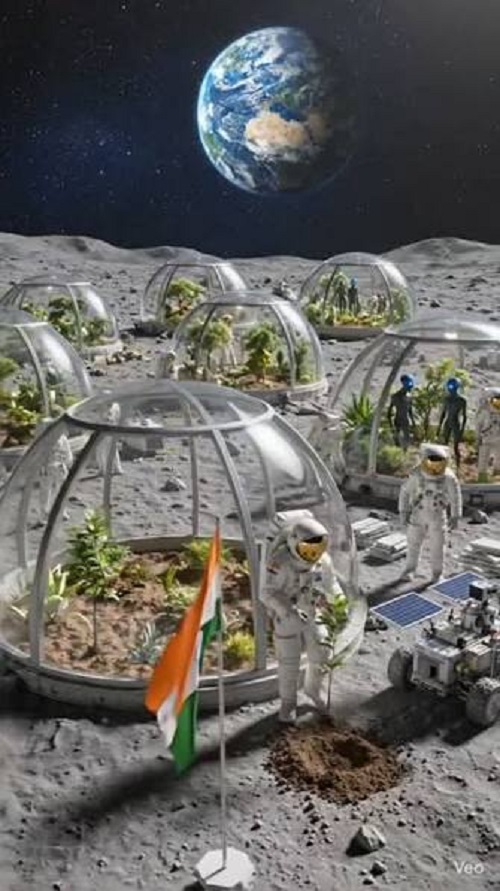
India's human-spaceflight ambitions are also expanding. An Indian astronaut's visit to the International Space Station marked another significant milestone. Looking ahead, India has set ambitious targets, including establishing an Indian space station by 2035 and sending an Indian astronaut to the Moon by 2040.
Yet, India's stated ambition is not simply to achieve national milestones. The broader objective is to ensure that the benefits generated by space technology and exploration reach humanity at large.
The transformation is not limited to ISRO. India's private space industry has emerged as an increasingly important force, bringing entrepreneurial energy, innovation and new investment into the sector.
The combination of ISRO's experience and the capabilities of private enterprises is creating a wider ecosystem for launch services, satellite manufacturing, space applications and advanced technologies. This expansion is expected to strengthen India's role in the global space economy.
France occupies a particularly important place in this journey. The two countries have maintained space cooperation since the early years of India's programme, including the formative period at Thumba in the 1960s.
Today, India-France cooperation extends across areas such as Earth observation and advanced space technologies. The partnership reflects a broader effort to combine scientific expertise with practical applications that can improve life on Earth.
The message emerging from Paris is that the next phase of space exploration cannot be shaped by competition alone. As more countries and private companies enter the sector, the need for responsible behaviour, international rules and sustainable use of orbital resources will become increasingly important.
India is positioning itself as a partner in this emerging global framework. Its invitation to France and other nations to become “co-travellers” in its next space frontier reflects an ambition to combine national capabilities with international cooperation.
The first International Space Summit, therefore, carries significance beyond scientific discussions. It offers an opportunity for the global community to define how humanity should explore, use and protect the space environment.
India's message is clear: space should remain a frontier where nations explore together, innovate together and protect together. The ultimate measure of success, in this vision, will not merely be how far humanity travels into space, but how responsibly those achievements are used for generations to come.





















Leave Your Comment