


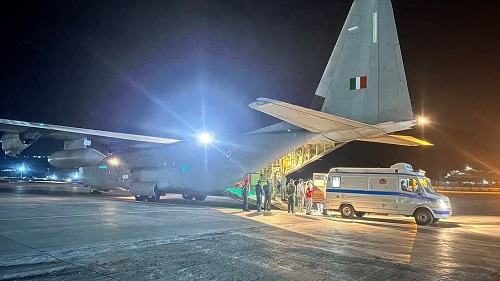
In a time-critical humanitarian mission, the Indian Air Force (IAF) airlifted a critically ill 30-year-old civilian from Leh to Palam late at night, ensuring that the patient could receive advanced medical treatment without delay. The emergency evacuation was carried out by an IAF C-130J aircraft amid darkness and challenging weather conditions, highlighting the importance of operational preparedness, professional coordination and rapid decision-making in life-saving situations. Following the flight, the patient was transferred to the All India Institute of Medical Sciences (AIIMS) for further treatment.
The Indian Air Force has once again demonstrated its ability to respond swiftly to humanitarian emergencies, undertaking a short-notice medical evacuation from Leh to Delhi under difficult operational conditions.
The mission involved transporting a critically ill 30-year-old civilian patient from Leh to Palam late at night. An IAF C-130J aircraft was deployed for the evacuation, enabling the patient to reach Delhi for further medical care. After landing at Palam, the patient was transferred to the All India Institute of Medical Sciences (AIIMS).
The operation was particularly demanding because it was conducted in darkness and challenging weather conditions. Such circumstances require careful operational planning, coordination among personnel and the ability to execute a mission within a limited timeframe. In a medical emergency, where delays can have serious consequences, the timely mobilisation of an aircraft and the smooth execution of the evacuation become especially significant.
Leh's high-altitude location presents distinct logistical challenges for emergency medical transportation. When a patient requires specialised treatment that cannot be adequately provided locally, air evacuation can serve as a crucial link between remote regions and advanced medical facilities in major cities. The IAF's mission ensured that the patient could be transported to Delhi for continued treatment at AIIMS.
The C-130J, a tactical transport aircraft operated by the IAF, plays an important role in missions requiring flexibility and access to challenging operating environments. Its use in this evacuation underscores the broader utility of military aviation beyond conventional defence operations.
The mission also highlights the humanitarian dimension of the Indian Air Force's responsibilities. While the service is primarily tasked with safeguarding the country's airspace and maintaining combat readiness, its capabilities can also be mobilised during medical emergencies, disaster-response operations and other situations requiring urgent assistance.
Such operations depend not only on aircraft availability but also on the preparedness of personnel and effective coordination throughout the mission. From responding to the emergency at short notice to transporting the patient and facilitating onward medical care, each stage is critical to the success of a medical evacuation.
The successful transfer of the patient to AIIMS illustrates how military aviation assets can help bridge geographical barriers to specialised healthcare. For people living in remote and difficult terrain, rapid air connectivity can be particularly valuable when time-sensitive medical intervention is required.
The late-night evacuation from Leh therefore represents more than a transportation mission. It demonstrates the IAF's capacity to respond to urgent civilian needs while operating in demanding conditions. By combining operational readiness with a humanitarian commitment, the force continues to serve an important role in providing assistance when rapid intervention can make a vital difference.


















Leave Your Comment