



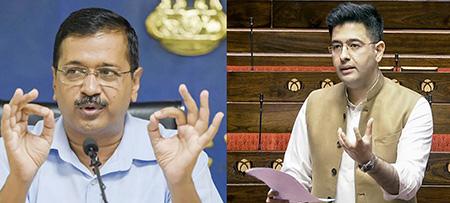
Not long ago, Raghav Chadha, the bright and young Aam Aadmi Party (AAP) Member of Parliament in Rajya Sabha, was one of the blue-eyed boys of the party supremo Arvind Kejriwal. But something has gone wrong, and Chadha has been removed by Kejriwal as the party’s Deputy Leader in the Rajya Sabha.
This morning, Chadha released a video alleging that this was an attempt to stop him from speaking in Parliament and asked whether it was a 'crime' to raise public issues in Parliament. He has also said, “I am silenced, not defeated”.
There are many theories doing the rounds why the rift between Kejriwal and Chadha occurred, including the one that the latter may switch over to the BJP.
In any case, of the ten MPs that the AAP has in the Rajya Sabha, Chadha is now the second one after Swati Maliwal, another Kejriwal-favourite in the past, who has fallen from grace.
Incidentally, the phenomenon of high-profile departures from the AAP has become a recurring theme in its decade-long political journey.
Born from the 2011 anti-corruption movement, the party initially attracted a diverse group of idealistic professionals, activists, and intellectuals. However, as it transitioned from a grassroots movement to a governing entity, it has seen a steady exit of several founding members and senior leaders, raising questions about its internal democracy and evolving character.
In fact, the trend began early in the party's life and has continued through various phases of its growth. In 2015, following a bitter internal rift, founder members Yogendra Yadav and Prashant Bhushan left the party.
Soon, well-known sociologist and Professor of JNU Anand Kumar followed suit. The subsequent list of eminent persons who quit the AAP by alleging concerns over a lack of transparency and the concentration of power within a small "coterie" included Shazia Ilmi, Ashutosh and Kumar Vishwas.
Similarly, several high-profile entrepreneurs, professionals, and corporate leaders—particularly from Mumbai and Bangalore—left the AAP following internal disputes, ideological differences, or dissatisfaction with the party’s central leadership. Anjali Damania, a former banker and anti-corruption crusader who led the AAP in Maharashtra, resigned, expressing disillusionment with the party's internal conflicts and allegations against the leadership. Meera Sanyal, former CEO of Royal Bank of Scotland, who had joined AAP and contested the Mumbai South Lok Sabha seat in 2014, has now completely distanced herself from the party. So also V. Balakrishnan, former CFO of Infosys and a high-profile addition to the party in 2014, who had contested for AAP from Bangalore Central.
More recently, the party has faced new waves of desertions, particularly surrounding major elections. In early 2025, several sitting MLAs—including Madan Lal, Bhavna Gaur and Naresh Yadav —resigned just days before the assembly polls in Delhi. Former AAP minister Kailash Gahlot also did the same.
What explains all this? There are many reasons, it is said. One is that the party as being run by a small group around Arvind Kejriwal, leaving little room for dissent or independent political bases for second-tier leaders.
Second, which I think is more important, is the “Ideological Drift”. The AAP was born anti-corruption foundations, but as the Chief Minister of Delhi practiced sheer opportunistic politics based on "populism" or "freebie politics". His lifestyle did not reflect that of as Aaam Admi – his fleet of cars and a palatial residence costing the exchequer nearly 100 cores of rupees.
Of course, Kejriwal has proved himself to be a highly astute political communicator who has successfully disrupted the traditional binary of Indian politics, but his long-term impact on institutional governance is highly negligible. No wonder why he is embroiled with so many corruptions –cases and why his erstwhile colleagues are deserting him disenchanted.


















Leave Your Comment