


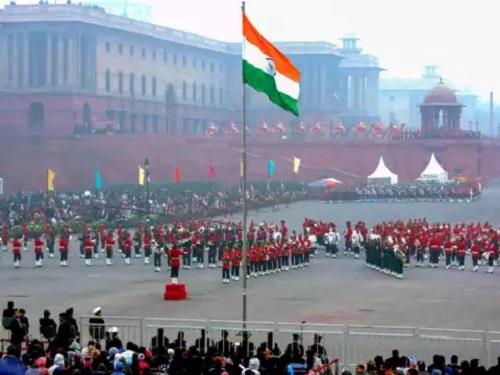
The Beating Retreat ceremony, traditionally held on January 29th at Vijay Chowk in New Delhi, has long been an integral part of India’s Republic Day celebrations. Originally a British military tradition, the event was introduced to India during colonial rule as a symbolic conclusion to the Republic Day festivities. Over the decades, while India continued to honour this practice, it remained largely rooted in colonial-era customs. However, under the leadership of Prime Minister NarendraModi, the ceremony has undergone significant transformations, embracing India's rich cultural heritage and shifting away from its colonial past. These changes not only reflect India's commitment to decolonizing its traditions but also strengthen national pride by incorporating indigenous elements.
One of the most notable transformations in the Beating Retreat ceremony has been the replacement of British military tunes with Indian compositions. Previously, the ceremony prominently featured Western martial music, including pieces like "Abide with Me," a hymn believed to have been a favourite of Mahatma Gandhi. While the hymn was deeply respected, its presence in a national event underscored India's lingering colonial influence. In recent years, the Modi government has introduced Indian classical and folk tunes, including patriotic compositions and instrumental renditions of iconic national songs. This shift represents a conscious effort to celebrate India's musical diversity while ensuring that the event resonates more deeply with the Indian populace.
The inclusion of traditional Indian musical instruments has further reinforced the cultural revival of the ceremony. Earlier, the event was dominated by Western military bands featuring instruments such as trumpets, bugles, and bagpipes. Now, Indian musical elements, including the sitar, tabla, and other indigenous percussion instruments, have been incorporated into the performances. These additions have given the ceremony a uniquely Indian identity, offering audiences a mesmerizing blend of classical and contemporary Indian sounds. The integration of these instruments highlights India's vast musical heritage and showcases the country’s artistic evolution.
In addition to musical changes, the ceremony’s visual presentation has also been enhanced to reflect India's cultural splendour. The traditional lighting of RashtrapatiBhavan, North Block, and South Block has been further enriched with synchronized drone shows and laser projections, adding a contemporary yet culturally resonant touch to the celebrations. These technologically advanced displays often depict India's journey from ancient civilization to modern superpower, weaving a narrative that connects India's historical glory with its aspirations for the future.
Another significant change has been the emphasis on Indian martial traditions. While the ceremony continues to honour the military’s discipline and grandeur, it now integrates elements that pay homage to India’s indigenous warrior traditions. For instance, performances featuring war drums from various Indian states, including Nagaland and Punjab, have been introduced to symbolize the valiant spirit of India's indigenous warrior communities. The inclusion of these elements ensures that the ceremony does not merely remain a remnant of colonial military discipline but instead evolves into a celebration of India's own martial history.
Beyond music and performance, the Beating Retreat ceremony now serves as a broader canvas for celebrating India’s cultural diversity. The themes of the event increasingly highlight India's pluralistic traditions, incorporating folk dances, regional attire, and narratives from different parts of the country. This inclusivity ensures that the ceremony is not just a tribute to the armed forces but a reflection of the nation’s rich and varied heritage.
The transformation of the Beating Retreat ceremony under PM Modi aligns with his broader vision of decolonizing India's institutions and traditions. By replacing colonial-era practices with indigenous elements, the event now stands as a testament to India's self-reliant and culturally confident identity. It reaffirms the nation’s commitment to preserving and promoting its historical and artistic legacy while embracing modernization in a way that honours its roots.
As India moves forward, the evolution of the Beating Retreat ceremony symbolizes a shift towards reclaiming and celebrating its unique identity. No longer a mere vestige of colonial influence, it has become a grand spectacle of Indian music, martial tradition, and technological innovation, reflecting the spirit of a New India—one that respects its past while confidently embracing its future.


















Leave Your Comment