



Nilabh krishna
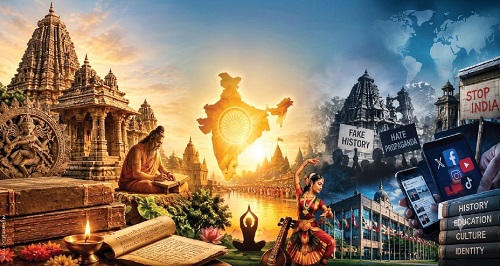
India's civilisational identity is far older than the modern nation-state, its political institutions and the boundaries that define its contemporary geography. Rooted in thousands of years of philosophical inquiry, spiritual exploration, cultural exchange and social evolution, the Indian civilisation has survived successive waves of political upheaval, foreign invasions, colonial rule and ideological transformations. At its centre lies the Hindu civilisational tradition, an expansive and diverse body of beliefs, practices, philosophies and cultural expressions that has shaped the subcontinent's understanding of life, society, nature, knowledge and spirituality. Yet, in contemporary times, this inheritance faces a complex set of challenges. These range from the erosion of traditional knowledge and the neglect of heritage institutions to ideological contestation, selective historical interpretations, organised campaigns of misinformation and the growing politicisation of religious identity. The challenge is not merely about protecting temples, festivals or religious practices. It is about safeguarding the intellectual, cultural and historical foundations of a civilisation while ensuring that its pluralistic character remains intact.
The first difficulty lies in understanding the nature of Hindu civilisation itself. Unlike religions organised around a single founder, a centralised ecclesiastical authority or one universally binding scripture, Hinduism developed through multiple philosophical schools, regional traditions, devotional movements and systems of worship. The Vedas, Upanishads, Puranas, Ramayana, Mahabharata, Bhagavad Gita, Agamas and numerous other texts represent different dimensions of this intellectual and spiritual inheritance. The traditions of Shaivism, Vaishnavism, Shaktism and several other schools have coexisted, debated and influenced one another over centuries. Its philosophical landscape encompasses Advaita, Vishishtadvaita, Dvaita, Yoga, Samkhya, Nyaya and other schools of thought. This diversity is a source of strength, but it also creates a challenge: a civilisation without a single institutional authority can find it difficult to develop a coordinated response when its traditions are misrepresented, marginalised or attacked.
One of the most consequential challenges has been the historical representation of India. Colonial historiography frequently interpreted Indian society through European categories and assumptions. British administrators, missionaries and scholars often described Indian traditions through the framework of religious superstition, social backwardness and civilisational stagnation. The colonial construction of Indian history also encouraged rigid religious divisions, particularly through the categorisation of historical periods as Hindu, Muslim and British. While modern historians have substantially revised these interpretations, their influence continues to be visible in popular debates, educational narratives and international perceptions of India.
The problem is not that colonial interpretations should be rejected in their entirety. Historical scholarship must remain open to evidence, competing explanations and critical examination. The problem arises when complex historical developments are reduced to simplistic narratives that deny the achievements of Indian civilisation or treat its religious and intellectual traditions as insignificant. Ancient India's contributions to mathematics, astronomy, medicine, metallurgy, linguistics, philosophy and architecture deserve serious academic examination. The work of scholars such as Panini, Aryabhata, Brahmagupta and Bhaskaracharya, alongside the philosophical contributions of the Upanishadic thinkers, demonstrates the extraordinary intellectual diversity of the subcontinent. These achievements should neither be exaggerated through nationalist mythology nor dismissed through ideological prejudice.
The politics of historical memory has consequently become an important battleground. Questions surrounding the destruction of temples, the transformation of religious sites, the treatment of Hindu institutions under medieval political regimes and the historical circumstances surrounding major monuments remain contentious. There is considerable historical evidence of temple destruction and appropriation in different periods, often involving political power, military conquest and religious considerations. There is equally substantial evidence of patronage, cultural exchange and cooperation across religious communities. A responsible understanding of history must acknowledge both realities. Selectively remembering historical suffering or suppressing uncomfortable episodes for contemporary political convenience does little to strengthen national unity. Equally, using historical grievances to justify hostility towards present-day communities is neither morally defensible nor historically responsible.
A related challenge concerns the representation of Hindu traditions in educational institutions. Textbooks are not simply repositories of historical information; they influence how successive generations understand their society and civilisation. Changes to school curricula, the treatment of ancient Indian knowledge systems and disagreements over historical interpretations have repeatedly generated political controversy. A 2022 study published in India Review by researchers Kusha Anand and Marie Lall examined how political ideologies and competing understandings of national identity have influenced textbook debates in India. The study highlighted the relationship between political power, educational institutions and the construction of historical narratives. This demonstrates that the debate is not confined to one political establishment. Different governments and ideological groups have attempted to influence the interpretation of history through educational policy.
The way forward is not to replace one ideological version of history with another. India needs academically rigorous history education that gives appropriate recognition to its civilisational achievements while acknowledging historical conflicts, social inequalities and cultural interactions. Students should learn about the Vedas and Upanishads alongside the development of Buddhism, Jainism, Sikhism and other traditions. They should understand the achievements of ancient universities such as Nalanda and Takshashila, the contributions of Indian mathematicians and scientists, and the intellectual debates that shaped Indian philosophy. A civilisation confident in its heritage does not need to fear historical scrutiny.
Another significant challenge is the growing tendency to conflate Hinduism with contemporary political movements. The distinction between Hindu religious traditions, Hindu cultural identity and Hindutva as a political ideology is frequently overlooked in international discussions. These are related but not interchangeable categories. Hinduism encompasses a broad range of religious and philosophical traditions, while Hindutva represents a particular political understanding of national and cultural identity. Criticism of a political organisation, government policy or ideological position is legitimate in a democratic society. However, when such criticism extends into the generalisation that Hindu religious beliefs, symbols or cultural practices are inherently associated with intolerance, it crosses into religious stereotyping.
This distinction becomes particularly important in international academic and political discourse. Hinduism is sometimes discussed through narrowly constructed categories that fail to capture its philosophical complexity and internal diversity. Concepts such as Dharma, Karma, Moksha, Ahimsa and Vasudhaiva Kutumbakam are often detached from their intellectual contexts and reduced to simplistic interpretations. Defending Hindu civilisation cannot mean denying social problems within Hindu society. Rather, its reformist traditions, from the Bhakti movement to the teachings of Swami Vivekananda, Sri Narayana Guru and numerous other thinkers, provide important resources for addressing these challenges.
The international dimension of this contestation is increasingly visible through diaspora politics, academic debates, media narratives and incidents involving Hindu places of worship. Millions of people of Indian origin have established Hindu temples, cultural centres, educational institutions and community organisations across North America, Europe, Australia, Africa and Southeast Asia. These institutions are important not only as places of worship but also as centres of cultural transmission, language learning, philosophical discussion and community engagement. Yet Hindu communities abroad have occasionally faced intimidation, vandalism and targeted hostility.
Several incidents involving the vandalism of Hindu temples in Canada and the United States have raised concerns among diaspora communities. In March 2024, a group of American lawmakers of South Asian descent wrote to the US Department of Justice expressing concern over increasing incidents of vandalism at houses of worship, including Hindu temples, and seeking information about investigations and law-enforcement coordination. Hindu temples in California, New York and other locations have been targeted with anti-India and anti-Hindu graffiti. In Canada, attacks and vandalism involving temples in British Columbia and Ontario have also generated concern. Some incidents have included pro-Khalistan slogans, although the identity and motivation of perpetrators must be established through proper investigations rather than assumed in every case.
These incidents should not be dismissed as isolated inconveniences. A temple is not merely a building. It represents the collective religious and cultural identity of a community. Targeting a place of worship with hateful messages creates an atmosphere of insecurity among ordinary devotees, including children and elderly people. Governments in countries with significant Hindu populations must ensure that such incidents are investigated impartially and that religious institutions receive equal protection under the law. Equally, diaspora organisations must document incidents responsibly, distinguish verified evidence from speculation and avoid turning individual crimes into accusations against entire communities.
The international information environment presents another challenge. Social media platforms have made it possible for misleading claims, selectively edited videos and decontextualised historical material to circulate across borders within minutes. Religious symbols and practices can become subjects of online ridicule, while complex political and historical disputes are often reduced to emotionally charged slogans. The same digital platforms, however, also provide opportunities for Hindu communities to share their traditions, explain their philosophical heritage and challenge misinformation. The issue is therefore not technology itself but the manner in which it is used.
There is also a need to address the problem of what may broadly be described as anti-Hindu prejudice, sometimes referred to as Hinduphobia. It can manifest through derogatory stereotypes, hostility towards Hindu religious symbols, the justification of vandalism against temples or the assumption that Hindu identity is inherently incompatible with pluralism. However, the term must be used carefully. Not every criticism of Hindu practices, Indian government policy or Hindu nationalist politics constitutes hostility towards Hindus. The distinction between legitimate criticism and religious discrimination is essential if the issue is to be addressed credibly. A serious response must be grounded in documented incidents, transparent research and consistent standards of religious freedom.
Within India, the challenges are equally complicated. Hindu traditions face pressures arising from urbanisation, changing lifestyles, declining knowledge of classical languages, weakening traditional institutions and the gradual disappearance of local customs. In many parts of the country, younger generations are increasingly disconnected from the oral traditions, regional literature, temple architecture, classical performing arts and ritual practices that once formed an integral part of community life. Sanskrit, although central to a vast body of Indian philosophical and literary knowledge, faces the challenge of limited everyday engagement. Several traditional crafts, temple arts and indigenous knowledge systems survive because of a small number of dedicated practitioners.
The protection of temples is another major issue. Hindu temples are repositories of architecture, sculpture, inscriptions, music, ritual traditions and historical records. They are also living institutions that sustain local economies and community networks. Yet many historic temples face problems involving inadequate conservation, encroachment, poor financial management and the loss of traditional knowledge. The debate over state regulation of Hindu religious institutions, particularly temple administration, has raised questions about institutional autonomy, accountability and the protection of religious endowments. These issues require a balanced approach. Transparency in financial administration is indispensable, but so is respect for the religious and cultural autonomy of institutions. The objective should be to ensure that temple resources are protected, properly audited and used for religious, charitable and heritage-related purposes.
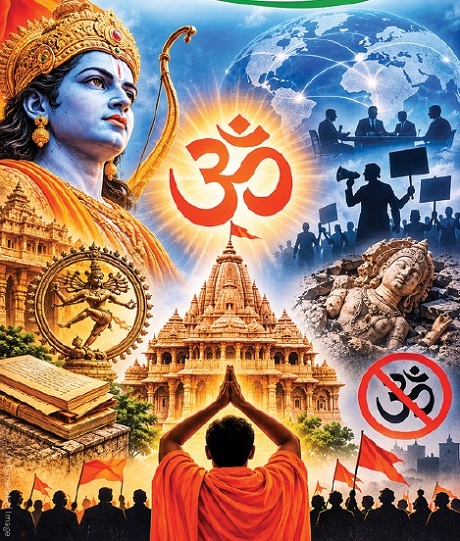
The Constitution of India provides an important framework for this discussion. Articles 25 and 26 guarantee freedom of conscience, religious practice and the right of religious denominations to manage their religious affairs, subject to constitutional limitations. Article 29 protects the right of any section of citizens possessing a distinct language, script or culture to conserve it. Article 49 directs the State to protect monuments and objects of national importance. These provisions establish that religious freedom, cultural preservation and heritage protection are not merely political demands; they are integral to India's constitutional framework. At the same time, constitutional guarantees apply equally to all communities and must be upheld without discrimination.
The preservation of Hindu civilisation must also confront internal weaknesses. Caste-based discrimination, untouchability, social exclusion and inequalities affecting women have historically undermined the ideals of dignity and equality. These practices cannot be defended in the name of cultural preservation. Hindu society has produced powerful reform movements and intellectual traditions that challenged social injustice, and their contributions must be recognised as part of the civilisation's continuing evolution. The teachings of the Bhakti saints, the reformist work of Swami Dayananda Saraswati, the social interventions of Sri Narayana Guru and the efforts of numerous other reformers demonstrate that internal criticism and renewal have always been important features of Indian society. Protecting a civilisation does not mean freezing it in time. It means preserving its enduring values while addressing practices that contradict human dignity.
There are, nevertheless, encouraging developments in the recognition of India's intangible cultural heritage. UNESCO's Representative List of the Intangible Cultural Heritage of Humanity includes several Indian traditions, such as Vedic chanting, Ramlila, Kumbh Mela, Yoga, Durga Puja in Kolkata and Garba of Gujarat. In December 2025, Deepavali was also inscribed on the list, becoming India's sixteenth element on UNESCO's Intangible Cultural Heritage lists. This recognition is significant because it acknowledges that civilisations are sustained not merely through monuments and archaeological sites but also through living traditions transmitted from one generation to another. Rituals, festivals, music, dance, oral literature, craftsmanship and community practices are all essential components of cultural continuity.
India's civilisational heritage also extends beyond Hindu religious traditions in the narrow sense. Buddhism, Jainism and Sikhism emerged from the broader intellectual and cultural landscape of the subcontinent, while India's regional traditions have developed through centuries of interaction among different communities. The country's cultural identity cannot be reduced to a single language, region or religious practice. Its civilisational strength lies in its ability to accommodate multiple philosophical traditions and cultural expressions within a larger historical continuum. Consequently, the preservation of Hindu heritage should reinforce, rather than undermine, the protection of India's wider cultural diversity.
The government, educational institutions, civil society organisations, religious trusts and private philanthropies all have important roles to play. Heritage conservation requires sustained investment in archaeological research, restoration of historic structures, protection of temple lands, digitisation of inscriptions and manuscripts, and training of specialists in traditional architecture and conservation. Universities should establish stronger programmes in Indian knowledge systems, Sanskrit, regional languages, classical philosophy and traditional sciences. Such programmes must be supported by peer-reviewed research and open academic debate rather than political claims. Digital archives can make rare manuscripts, temple records and historical documents accessible to researchers and the general public, reducing the risk of their permanent loss.
The role of families and local communities is equally important. Civilisational continuity cannot be ensured entirely through government schemes or institutional declarations. It begins when children learn the stories associated with their festivals, understand the significance of local temples, become familiar with regional languages and develop an appreciation of traditional music, literature and art. Religious organisations must invest in educational programmes that explain the philosophical foundations of Hinduism rather than limiting their activities to ceremonial celebrations. They should also encourage intergenerational dialogue and make traditional knowledge accessible to younger audiences through responsible digital initiatives.
Internationally, India must become more proactive in presenting its civilisational history through credible scholarship, cultural diplomacy and institutional partnerships. Indian universities, museums, research centres and cultural organisations should engage more actively with international academic institutions. The objective should not be to manufacture a favourable image of India but to ensure that its history and intellectual traditions are represented accurately. Indian scholars must participate in global conversations about religion, philosophy, heritage conservation and cultural identity. Similarly, the Indian diaspora can contribute by establishing cultural archives, supporting language education, organising academic conferences and creating platforms for meaningful engagement with host societies.
Ultimately, the preservation of India's civilisational identity is not a battle against modernity, diversity or legitimate criticism. Nor should it become an excuse for hostility towards other religions or communities. It is a responsibility to protect a remarkable intellectual and cultural inheritance from neglect, distortion, discrimination and deliberate destruction. The most effective defence of Hindu civilisation will come not from slogans or confrontation but from knowledge, institutional strength, historical honesty and the confidence to engage with the world.
A civilisation that has survived thousands of years does not need to prove its worth through constant political confrontation. It needs to understand its own history, preserve its institutions, encourage critical inquiry and transmit its knowledge to future generations. India's civilisational ethos, reflected in the ideas of Vasudhaiva Kutumbakam and Sarve Bhavantu Sukhinah, offers a vision that places human welfare, coexistence and collective responsibility at its centre. These ideas should not remain confined to ceremonial speeches or philosophical texts. They must inform public life, education, cultural policy and social conduct.
The real challenge, therefore, is to ensure that India's civilisational inheritance remains a living force rather than becoming a collection of monuments, museum exhibits or political talking points. Hindu traditions have endured because successive generations interpreted, debated, practised and renewed them. Preserving that legacy requires the same intellectual courage and cultural commitment today. The future of India's civilisational identity will ultimately depend on whether the country can combine pride in its ancient inheritance with constitutional values, social reform, academic integrity and an inclusive vision of national belonging.
(The content of this article reflects the views of writer and contributor, not necessarily those of the publisher and editor. All disputes are subject to the exclusive jurisdiction of competent courts and forums in Delhi/New Delhi only)





















Leave Your Comment