


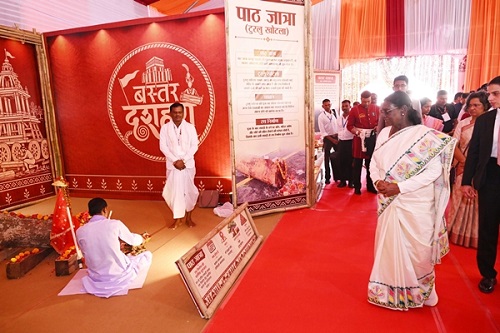
President Droupadi Murmu has said that Chhattisgarh is moving towards a new phase of development after overcoming the challenge of Naxalism through the coordinated efforts of the Centre and the state government. Addressing the Bastar Dussehra Festival 2026 in Jagdalpur, she highlighted the importance of tribal empowerment, inclusive growth and environmental conservation, expressing confidence that tribal youth would play a significant role in building a developed India by 2047.
President Droupadi Murmu has described Chhattisgarh’s progress beyond the challenge of Naxalism as an important step towards peace, stability and development, crediting the combined efforts of the central and state governments. Speaking at the Bastar Dussehra Festival 2026 at Lalbag Maidan in Jagdalpur, she emphasised that the region’s future would depend on inclusive development, greater economic opportunities for tribal communities and the active participation of its youth in the national growth story.
The President expressed confidence that young people from tribal communities would contribute meaningfully to India’s journey towards becoming a developed nation. Her message placed particular emphasis on ensuring that the benefits of development reach communities that have historically remained distant from mainstream economic opportunities.
The transition from conflict to development, she indicated, must be accompanied by tangible improvements in people's lives. Peace and security create the conditions for progress, but sustainable transformation also requires education, employment, entrepreneurship and access to markets. For Bastar, strengthening these foundations will be essential to translating improved stability into lasting economic and social gains.
President Murmu appreciated the initiatives aimed at providing financial facilities to tribal entrepreneurs and connecting their products and enterprises with wider markets. She said such measures could contribute to the objective of building a developed India by 2047 through equitable development.
Economic empowerment is particularly important for tribal regions, where traditional knowledge, forest-based products, handicrafts and local cultural practices can provide opportunities for sustainable livelihoods. Access to finance can help entrepreneurs establish and expand their businesses, while market linkages can enable local producers to reach customers beyond their immediate surroundings.
However, the success of these initiatives will depend on their ability to create durable economic opportunities. Better access to credit, skill development, infrastructure, digital connectivity and fair market prices can help tribal entrepreneurs participate more effectively in the wider economy. Development must also preserve the distinct cultural identities and community traditions that give Bastar its unique character.
The President’s remarks underscored the principle that national progress cannot be measured solely through aggregate economic growth. It must also be assessed by whether communities across different regions have meaningful opportunities to improve their living standards and participate in the country's development.
Alongside economic development, President Murmu called upon people to protect the forests and hills of their region. She stressed that these natural resources provide food, water and other essentials necessary for life, making environmental conservation a fundamental responsibility of every community.
The appeal carries particular significance for Bastar, where forests and natural landscapes are closely connected with tribal livelihoods, cultural practices and traditional knowledge. Protecting these resources is not merely an environmental concern; it is also essential for safeguarding the long-term well-being of local communities.
As development activities expand, the challenge will be to ensure that economic progress and ecological protection advance together. Responsible management of natural resources, community participation in conservation and the preservation of traditional practices can help maintain this balance.
The President’s message highlighted the importance of treating nature as a shared inheritance that must be protected for future generations. For a region whose identity is deeply rooted in its natural surroundings, environmental sustainability must remain an integral part of its development strategy.
President Murmu’s address brought together three closely connected priorities: overcoming violence, strengthening tribal livelihoods and protecting the natural and cultural heritage of Bastar. Her remarks suggested that the region's development must go beyond improved security to encompass economic opportunity, environmental responsibility and the preservation of community identity.
The vision of a developed India by 2047 will require progress across regions and social groups. In Bastar, this means ensuring that peace creates opportunities for young people, that tribal entrepreneurs can build sustainable enterprises and that local communities retain a meaningful role in decisions affecting their lives and surroundings.
The Bastar Dussehra Festival provided a fitting setting for this message, bringing together cultural heritage, community participation and aspirations for the future. As Chhattisgarh moves towards its next phase of development, the lasting measure of progress will be whether improved stability translates into greater prosperity, dignity and opportunity for the people of the region.





















Leave Your Comment