


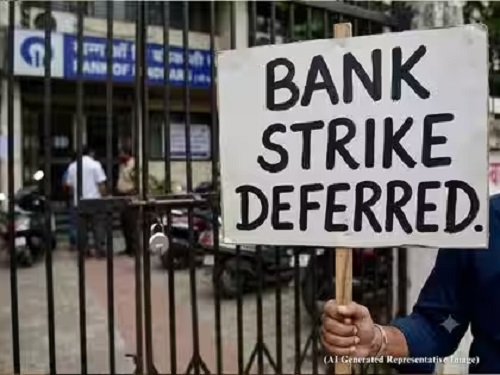
Bank customers across India can heave a sigh of relief as public sector bank branches will function normally on September 28, 2026. The United Forum of Bank Unions (UFBU) has deferred its proposed three-day nationwide strike after the Indian Banks’ Association (IBA) assured the unions that their key demands, including the long-standing demand for a five-day banking week, would be taken up for discussion.
September 28–30 strike has been put on hold after IBA assurance. The decision comes at a crucial time because the proposed strike was scheduled from September 28 to 30, coinciding with the half-yearly closing of bank accounts. Had the strike gone ahead, it could have disrupted branch operations and affected customers as well as businesses dealing with time-sensitive banking transactions.
The UFBU, an umbrella organisation representing seven bank employees’ and officers’ unions, decided to suspend the planned agitation following discussions with the IBA. At the centre of the discussions is the demand to declare the remaining Saturdays as holidays for bank employees, effectively paving the way for a five-day workweek.
According to the UFBU, a high-level committee comprising representatives of the IBA and UFBU will be constituted immediately to examine the issue. The committee is expected to explore different alternatives, consult stakeholders and work towards a solution that takes into account the interests of bank employees as well as customers.
The five-day workweek has been a longstanding demand of bank unions. While employees have argued that a reduction in working Saturdays would improve work-life balance and bring banking schedules closer to those followed in several other sectors, any change also has implications for customer access and the functioning of financial services. The proposed committee will therefore have to consider these competing requirements before arriving at a solution.
Another issue discussed during the negotiations concerns the Performance Linked Incentive (PLI) scheme applicable to Scale IV and above officers. The UFBU said discussions could begin with the IBA on possible modifications, which could subsequently be proposed to the government after taking into account concerns raised by unions and associations.
The two sides will also take up residual issues mentioned in the minutes of discussions dated March 8, 2024. The UFBU said these matters would be discussed with the objective of resolving them expeditiously.
Following the assurances received from the IBA, the UFBU decided to defer the proposed agitation as well as the three-day strike. This means that customers who were preparing for possible disruptions between September 28 and September 30 can continue to access public sector banking services according to the normal schedule.
The development has also been reflected in customer communication from State Bank of India (SBI), the country's largest public sector bank. SBI has advised customers that its branches and banking services will continue to operate normally following the postponement of the proposed UFBU strike.
The Centre had earlier appealed to bank employees to withdraw the strike call, arguing that several of their concerns had already been addressed through negotiations and welfare-related measures. The government had also highlighted the timing of the proposed agitation, pointing out that a shutdown during the half-yearly account-closing period could have caused operational difficulties for banks, customers and businesses.
For customers, the immediate outcome is clear: there will be no three-day nationwide public sector bank strike from September 28 to 30 as originally planned. However, the larger issue surrounding the five-day workweek remains under discussion. The proposed high-level committee will now play a key role in determining whether a mutually acceptable arrangement can be reached.
The postponement therefore represents not the end of the dispute, but a shift from confrontation to negotiations. For the banking sector, the coming discussions will determine how employee demands, operational requirements and customer convenience can be balanced while addressing the issues that led to the proposed strike in the first place.






















Leave Your Comment