


In a move that has been largely welcomed by domestic agricultural stakeholders, the recently concluded Interim Trade Agreement between India and the United States is being praised for its nuanced approach to a notoriously sensitive sector. While trade pacts often trigger anxiety among farming communities fearing an influx of cheaper foreign produce, this agreement appears to have struck a delicate balance by keeping the nation’s most politically sensitive commodities off the negotiating table.
The ‘Exclusion’ that Saved the Deal
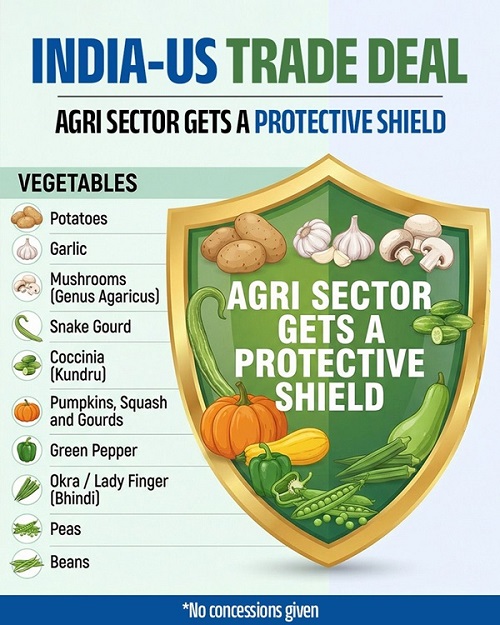
According to media reports, Dr Arun Raste, Managing Director of the National Commodity and Derivatives Exchange Limited (NCDEX), has shed light on the strategic wisdom behind the agreement’s framework. Dr Raste noted that key agricultural staples—specifically wheat, rice, dairy, and poultry—have been explicitly excluded from the pact.
This exclusion is not a mere omission; it is a deliberate policy intervention aimed at insulating the livelihood of millions of small and marginal farmers. India’s dairy and poultry sectors, in particular, operate on razor-thin margins and are dominated by smallholders. Exposure to highly subsidized American produce could have destabilized domestic markets. By red-lining these items, New Delhi has ensured that the "small farmer first" approach remains sacrosanct, even as it pursues broader trade liberalization.
The 18 Per Cent Advantage
While the agreement shuts the door on certain imports, it appears to have opened a significant window for exporters. Dr Raste highlighted the "major advantage" of the pact: the imposition of an 18 per cent duty on total exports. Contrary to the common perception of duties as a barrier, in this specific trade context, this provision is being interpreted as a leveler that benefits Indian exporters.
Industry experts suggest that this duty structure creates a predictable tariff regime, replacing ad-hoc trade measures with stability. For Indian exporters of processed foods, fruits, vegetables, and other non-excluded commodities, this predictability reduces the risk premium associated with cross-border trade, allowing for better pricing strategies and long-term contracts with American buyers.
A Trifecta of Benefits
Dr Raste elaborated that the combined effect of these calibrated provisions makes the agreement "significant for exporters, small industries and farmers."
For exporters, the removal of policy uncertainty regarding tariff treatment allows them to scale up operations and explore new supply chains. For small industries, particularly those involved in value-added agricultural products, the agreement provides a gateway to the deep-pocketed US consumer market. For farmers growing commercial crops outside the protected list, the increased export demand is expected to translate into better price realizations at the mandi level.
Market Sentiment and Forward Linkages
The positive reception from the leadership of NCDEX is significant, given the exchange’s role as a price discovery mechanism for farm commodities. A stable Indo-US trade relationship is likely to reduce volatility in commodity derivatives, encouraging greater participation from agri-entrepreneurs and hedgers.
Conclusion
The Interim Trade Agreement serves as a case study in how emerging economies can navigate free trade negotiations without sacrificing domestic welfare. By shielding subsistence agriculture while creating an enabling environment for export-oriented growth, the agreement has managed to do what is often considered impossible: make everyone feel heard.
As Dr Raste’s analysis suggests, this is not just a trade deal; it is a confidence-building measure. It signals that India is open for business, but not at the cost of its annadata. For the agriculture sector, that distinction makes all the difference.


















Leave Your Comment