


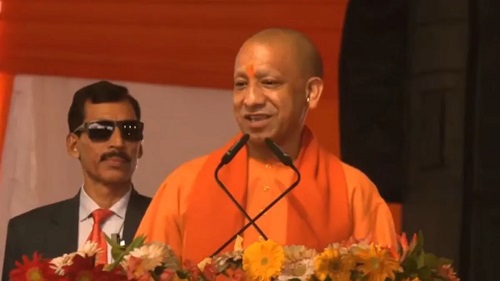
The long-awaited dream of millions has finally found its foundation in stone and faith. Uttar Pradesh Chief Minister Yogi Adityanath, on Wednesday, delivered a powerful address hailing the construction of the Ram Temple in Ayodhya, marking what he termed the culmination of a struggle spanning five centuries.
Speaking with palpable emotion, the Chief Minister framed the moment as a historic rectification, a closing of a tumultuous chapter in India’s civilizational narrative. "After the struggle of 500 years, the construction of the grand temple of Lord Ram in Ayodhya is underway," he stated, underscoring the profound historical and spiritual significance of the event.
In his remarks, Adityanath reserved particular emphasis for August 5, 2020, a date he declared as "an important and historic" milestone. On that day, Prime Minister Narendra Modi performed the Bhoomi Pujan or the foundation stone-laying ceremony for the grand temple, an event that was watched by millions across the nation and the diaspora. The Chief Minister credited Prime Minister Modi’s leadership for transforming a decades-long societal and legal aspiration into a tangible reality.
"Under the leadership of Prime Minister Narendra Modi, the work for the construction of the grand temple began," Adityanath said, linking the event to a broader narrative of national resurgence and cultural reaffirmation.
The construction of the Ram Temple follows a landmark Supreme Court verdict in November 2019, which settled a protracted title dispute and paved the way for the temple's construction on the site. The ruling also mandated the allocation of an alternative plot for a mosque, a judgment aimed at fostering a new chapter of harmony.
For Adityanath, whose tenure has been closely associated with a strong stance on Hindu cultural issues, the temple's rise is not merely an architectural project but the symbolic restoration of Ayodhya’s ancient glory as the sacred birthplace of Lord Ram. He envisions the city transforming into a global spiritual and cultural destination, with the temple as its centrepiece, driving economic development and pilgrimage tourism in the state.
The Chief Minister’s statements resonate deeply with a significant section of the populace for whom the temple movement was a core article of faith. His hailing of the "500-year struggle" directly references a popular narrative that traces the dispute to the 16th century.
However, the project is also viewed with cautious hope by many as an opportunity to move forward. The state government has embarked on a massive infrastructural overhaul of Ayodhya, building new roads, airports, and railway stations to accommodate the expected influx of devotees and tourists from around the world.
As the majestic shikharas (spires) of the temple rise against Ayodhya's skyline, Chief Minister Yogi Adityanath’s words capture a prevailing sentiment: a centuries-old wound is being healed, a divine promise is being fulfilled, and a new era for a ancient city is being consecrated, brick by sacred brick. The journey from struggle to sanctuary, as he underscores, has found its pivotal moment in history.



















Leave Your Comment