



RSN Singh
Demonstrations and agitations are intrinsic parts of democracy, but these democratic options have to be exercised within constitutional parameters and public norms. Permission has to be sought from designated authorities because, ultimately, it is the government that is responsible to both the protesters and the public, i.e., protection for the protesters and administrative convenience for the public. Ensuring that protests do not mutate into uncontrollable mobs or become weaponised as tools of violence and anarchy is also the responsibility of the government. The ultimate arbiter of the constitutional right to protest and demonstrate is the judiciary.
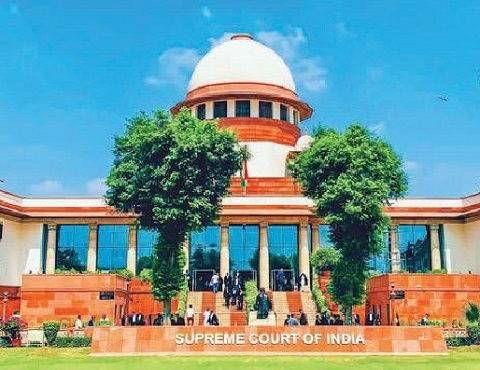
In all cases, such as Bangladesh, Nepal, Sri Lanka, and Ukraine, where protests mutated into mobs on the rampage, resulting in coups, it was primarily because of the omissions and commissions of the judiciary. Once the judiciary is compromised, the country collapses. In our country, Rahul Gandhi and other anti-national elements have physically breached the hallowed portals of the Supreme Court (SC). The worst is yet to follow.
SC DOORS OPEN FOR WHOM?
The Honourable Chief Justice of India (CJI) said that the SC's doors are open to one and all. Indeed, they should be open, but for genuine litigants. That is what the constitutional provision of equality before the law enjoins. It cannot be extended to political mobs with an anti-national agenda. Had it been merely a political agenda, the purpose could have been better served by filing a petition in the prescribed manner. But certainly, the objective in this case was to intimidate and create a breach. This breach, if not plugged now, is only going to widen.
In the post-Independence political and geopolitical trajectory of India, there have been many trying and challenging moments, such as the Emergency, the agitation by sadhus against cow slaughter, the insurgency in Punjab, the Anna agitation, Shaheen Bagh, the Delhi riots, and the so-called farmers' agitation. There have been attempts to assault Parliament and the Red Fort, but the sanctity of the SC was never violated.
A NEW PARADIGM
The My Lords have allowed, or rather invited, a new precedent with regard to protests and agitations. A new paradigm has been introduced into the practice and culture of protests in India. This will not stop here. It will have a cascading effect. The High Courts may face worse, and the lower courts, which are in every nook and corner of the country, may face even worse consequences.
There was a majesty associated with the Supreme Court. Its premises were inviolate and served as the biggest deterrent. It was a hallowed portal. There was an aura about it, which has suffered a huge dent.
The pillars of the judiciary include lawyers as well. Unfortunately, they too were part of Rahul Gandhi's assault on the SC, the very institution that provides them with their livelihood. Is this new paradigm of lawyers—i.e., argument inside the court and assault from outside—acceptable?
HOW DID INDIA ARRIVE AT THIS JUNCTURE?
The nature of protests in India that borders on anarchy and coups has its progenitor in Sonia Gandhi. Bereft of the innate democratic ethos of a Bharatiya, which philosophically treats political power and the role of the opposition as two sides of the same coin, she has displayed ruthlessness in power and hatred for democracy in opposition.
It was actually the love of political power that brought her to India. When she married Rajiv Gandhi, Mrs Indira Gandhi was in power. It was certain that her younger son, Sanjay Gandhi, would succeed her. Sanjay Gandhi, however, was killed in an air crash in January 1980, and his wife, Maneka Gandhi, left Mrs Gandhi's residence in March 1982 following a bitter episode. It was now clear that Rajiv Gandhi would be Mrs Gandhi's political successor.
It was then that Sonia Gandhi decided to take Indian citizenship in April 1983, after 15 years of stay in India. After the tragic assassination of Rajiv Gandhi, Narasimha Rao succeeded him. She was keen to exercise parallel power, which the erudite and intellectual Narasimha Rao did not brook. She had to wait for Manmohan Singh for that to happen. Anyone who challenged her authority was ignominiously shown the door.
The old Congress stalwart Sitaram Kesri was physically picked up in the AICC office and thrown out. To avenge herself against Narasimha Rao, she waited until he died and eventually ensured that, after his death, his body was not allowed to be cremated in Delhi.
It is, therefore, an ineluctable conclusion that Mrs Sonia Gandhi does not subscribe to the electoral route to power and finds it stifling to sit in the opposition. For her, there is no India without power, even if it entails the street route to regime change by force.
NO FAITH IN THE ELECTORAL ROUTE
The apprehension about the electoral route to power had begun to bedevil Mrs Sonia Gandhi ever since the fluke victory in 2004. With 149 seats, the Congress cobbled together a government, but it was tenuous throughout. A drastic reconfiguration of the Hindu collective psyche became imperative, through the creation of self-doubt, demoralisation, and a sense of guilt. Hence, a series of blasts were carried out all over the country, allegedly with help from Pakistan, to finally culminate in 26/11, a Hindu terror ploy.
Meanwhile, there were tentative efforts to explore the electoral route to power as well. In that pursuit, Rahul Gandhi began to wear the sacred Hindu thread and even declared himself a Brahmin. His temple visits were orchestrated to garner publicity. But these gestures found no buyers because they were devoid of credibility.
Having failed on the electoral route, he returned to the street route with a vengeance to capture power. During his march to the Supreme Court, he was unambiguous about his intent to hound the Modi government out of power. One of his associates, a [word unclear in the original], went to the extent of prescribing regime change through a bloodbath. This is sedition, an open rebellion, a call to arms against the nation, and yet the judiciary is unmoved. Its ambivalence has only emboldened the anti-India forces.
This phenomenon, if not arrested, will turn India into a banana republic. Why is the judiciary so hamstrung in dealing with anti-nationals and India-baiters? It is because it is yet to liberate itself from the stranglehold of the Gandhi family.
WHO SUBVERTS THE JUDICIARY?
During and in the aftermath of the Emergency, the judiciary began to suffer from paranoia vis-à-vis the Gandhi family. Mrs Gandhi had ensured that there would be no Jagmohan Lal Sinha in the future. He was the judge at the Allahabad High Court who had ruled against Mrs Indira Gandhi in June 1975 for electoral malpractice.
Thereafter, every aspiring lawyer with the ambition of joining the Bench had to prove himself in the crucible of a fierce loyalty test to the Gandhis. Sonia Gandhi inherited the judicial system assiduously set up by Mrs Gandhi.
Because of her strong leaning towards the Soviet Union, Mrs Indira Gandhi appointed many judges steeped in communist ideology. Sonia Gandhi went even further and appointed judges with strong Maoist, jihadi, and Church leanings. One of the judges with Maoist leanings was B. Sudarshan Reddy, who, after retirement, became the vice-presidential candidate of the I.N.D.I.A. alliance.
Over five decades or so, the judiciary became a dynastic and incestuous body, with judges paving the way for their sons and nephews to join the Bench. Those left out by choice became members of the Bar, with clandestine access to the Bench. Sonia's lawyer was caught on camera asking for amorous favours in lieu of a promised elevation from the Bar to the Bench.
Over a period, an entire ecosystem, or rather a mafia, evolved, beholden to the Gandhi family.
In 2014, under the new National Democratic Alliance (NDA), a National Judicial Appointments Commission (NJAC) Bill was passed by Parliament, vesting the government with greater powers in the appointment of judges. Displaying total disdain for the Constitution, the Supreme Court outrageously rejected the NJAC in favour of continuing the collegium system.
This is a system wherein a few judges have the power to override the needs, aspirations, and imperatives of millions of voters, their elected representatives, and Parliament.
However, given Sonia's stranglehold, the judiciary would have accepted the NJAC as a fait accompli without a whimper.
CONCLUSION
The judiciary has no option but to sit quietly over her alleged constitutional misdemeanours, her disdain for the electoral route, and her alleged weaponisation of jihadis and Maoists to capture power. The judiciary has no option but to remain silent on pending open-and-shut cases concerning the Gandhi family.
The son, Rahul Gandhi, has inherited the supplicant judiciary from his mother. In his march to the Supreme Court with the jihadis, Maoists, and the Dimagi Naxals, the judiciary seems to be an accomplice. This was a sort of invitation to the 'tukde-tukde' gang.
Who will save Bharat from the judiciary?
(The content of this article reflects the views of writer and contributor, not necessarily those of the publisher and editor. All disputes are subject to the exclusive jurisdiction of competent courts and forums in Delhi/New Delhi only)




















Leave Your Comment