


At a time when geopolitical conflicts are disrupting international stability, threatening trade routes and imposing a growing economic burden on developing nations, India has called for diplomacy to take precedence over military confrontation. Reiterating New Delhi’s commitment to peaceful conflict resolution, External Affairs Minister Dr S. Jaishankar has emphasised that military action alone cannot address complex global challenges. He also underlined the urgent need to protect international shipping routes and civilian seafarers, warning that attacks on maritime traffic are inflicting disproportionate damage on countries of the Global South.
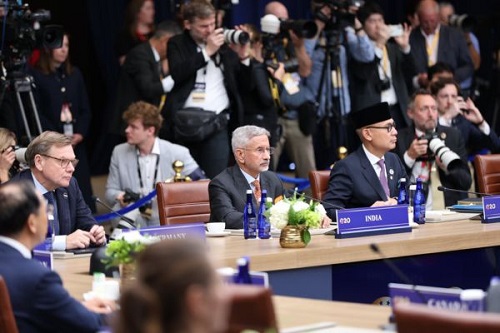
India has reiterated its position that lasting solutions to international conflicts cannot emerge through military means alone and that diplomatic engagement must be given sufficient opportunity. External Affairs Minister Dr S. Jaishankar conveyed this message during the first plenary session of the G20 Foreign Ministers’ Meeting in Atlanta, United States, where he highlighted the importance of dialogue, international cooperation and respect for established global norms.
His remarks assume particular significance against the backdrop of continuing geopolitical turbulence, including the Russia-Ukraine war and mounting tensions in West Asia. With regional conflicts increasingly affecting international commerce, energy supplies and economic stability, India has sought to draw attention to the wider consequences of prolonged military confrontations.
Dr Jaishankar placed particular emphasis on preserving freedom of navigation and bringing an end to attacks on civilian shipping and seafarers. He stressed that maritime security must be protected in accordance with international law, especially the United Nations Convention on the Law of the Sea (UNCLOS). The convention provides the internationally recognised legal framework governing the use of the world's oceans and establishes important principles relating to navigation and maritime activities.
India's concern is not limited to the security of individual vessels or shipping companies. The uninterrupted movement of commercial vessels is essential for maintaining global supply chains, particularly for countries that depend heavily on maritime transportation for energy, agricultural inputs and other essential commodities. Any disruption in these routes can quickly translate into higher prices, supply shortages and economic uncertainty across continents.
The External Affairs Minister pointed out that countries of the Global South are bearing a disproportionate share of the consequences of attacks on civilian vessels and seafarers. Such incidents are threatening the availability of essential commodities, including fuel, food and fertilisers, while pushing up their prices. Developing economies, which often have limited financial resources to absorb external shocks, face particularly difficult circumstances when international trade routes become unsafe.
The human cost of the West Asian conflict has also emerged as a serious concern for India. At least 22 Indians, including 14 seafarers, have lost their lives in the region since the conflict began in February this year. These casualties underline that geopolitical confrontations are not merely matters of territorial disputes or strategic calculations; they directly affect ordinary people, workers and families whose livelihoods depend on peaceful international engagement.
Before attending the G20 meeting, Dr Jaishankar, who arrived in Atlanta on Thursday, held discussions with foreign ministers and representatives from several countries. These interactions provided an opportunity to exchange perspectives on international developments and explore areas of cooperation amid growing global uncertainties.
His Atlanta engagements will also include participation in a QUAD Foreign Ministers’ Meeting alongside counterparts from Japan, Australia and the United States. The meeting is expected to provide an opportunity for the four countries to discuss shared regional and international priorities, including cooperation in the Indo-Pacific.
The G20 diplomatic engagement is also significant in the run-up to the G20 Leaders’ Summit, which the United States is scheduled to host in Miami on December 14 and 15. As the grouping brings together major developed and emerging economies, its deliberations offer an important platform for addressing challenges that transcend national boundaries.
Following his engagements in Atlanta, Dr Jaishankar will travel to St John's, Antigua and Barbuda, to lead India's delegation to the Commonwealth Heads of Government Meeting, scheduled from November 1 to 4.
India's message at the G20 reflects its broader diplomatic approach: international disputes require sustained dialogue, respect for international law and collective responsibility. At a time when military confrontations are increasingly spilling over into global economic and humanitarian concerns, protecting civilian lives, securing maritime trade and keeping diplomatic channels open are essential. For India, the priority is not merely managing individual crises but strengthening an international environment in which disagreements can be resolved through negotiation rather than prolonged confrontation.




















Leave Your Comment