


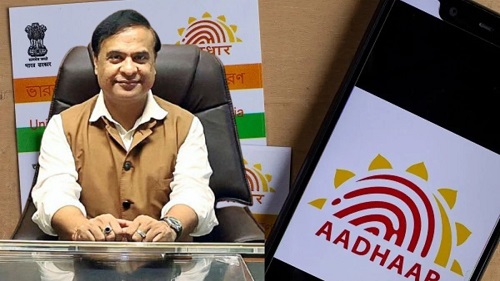
In a significant move directly linking citizen documentation to national security, Assam Chief Minister Himanta Biswa Sarma announced on Thursday that the state will temporarily suspend the issuance of Aadhaar cards to most citizens above 18 years of age. The decision, announced after a state cabinet meeting, is explicitly aimed at preventing illegal immigrants from acquiring the crucial identity document.
The new policy, which will be in effect for one year, carves out exceptions for members of the Scheduled Tribes (ST), Scheduled Castes (SC), and tea garden communities, who will continue to be eligible for enrolment.
A Decision Rooted in Border Security
Chief Minister Sarma directly connected the suspension to ongoing concerns about illegal immigration from Bangladesh, a long-standing and politically sensitive issue in Assam.
“We have continuously pushed back Bangladeshi nationals along the border,” Sarma stated. “We want to take protection that no one (illegal foreigner) can obtain an Aadhaar card from Assam by entering into the state and claim to be an Indian citizen. We have completely closed that way.”
This move underscores the state government's strategy to use the Aadhaar card, a primary document for accessing government subsidies, bank accounts, and other services, as a tool for citizenship verification. By restricting its issuance, the government aims to create a high barrier for those who cannot prove their Indian citizenship.
A Final Window and Strict Scrutiny
Recognizing that many legitimate Indian citizens may not yet have enrolled, the Chief Minister announced a final opportunity for application.
“People from other communities who are yet to get Aadhaar will be given a final chance to apply in September. We will allow them to apply within the month of September,” he said. This one-month window in September is intended to be the last chance for eligible individuals from non-exempted communities to enrol without extreme hassle.
Post-September, the process will become exceptionally stringent. Chief Minister Sarma clarified that any enrolment after the window closes would be subject to intense scrutiny and would require the personal authorization of the District Commissioner (DC).
“In rare and rarest case, the District Commissioner will be the authority to issue an Aadhaar card after completion of the window period,” Sarma explained. “The DC will have to check SB (Special Branch) report, Foreigners Tribunal report before issuing Aadhaar card.”
This effectively makes the DC the final gatekeeper, relying on police intelligence and rulings from tribunals specifically set up to determine citizenship status before any Aadhaar card is issued.
Implications and Analysis
The decision has immediately sparked debate. Supporters see it as a necessary and bold step to secure the state's demographic landscape and protect the rights of indigenous communities. They argue it will plug a loophole that could be exploited by illegal immigrants.
However, critics and rights activists may raise concerns about the potential exclusion of vulnerable populations who, due to poverty, lack of awareness, or bureaucratic delays, might miss the narrow September window. They may also question the creation of a two-tier system where certain communities retain access while others face a near-complete freeze on this essential document.
The announcement marks Assam’s continued assertive approach to implementing the National Register of Citizens (NRC) and tackling the complex issue of illegal immigration, placing Aadhaar at the center of its citizenship verification mechanism.




















Leave Your Comment