


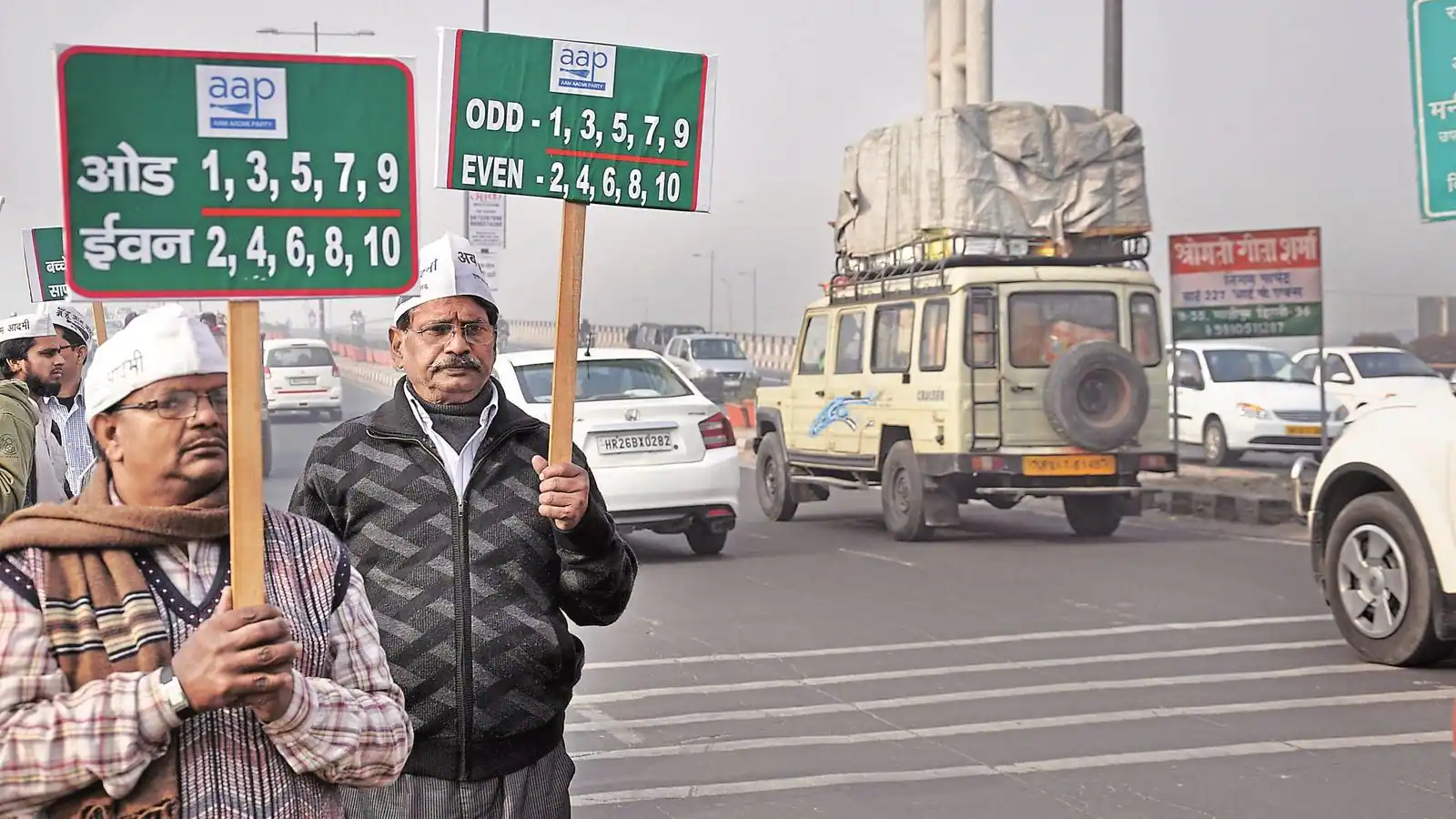
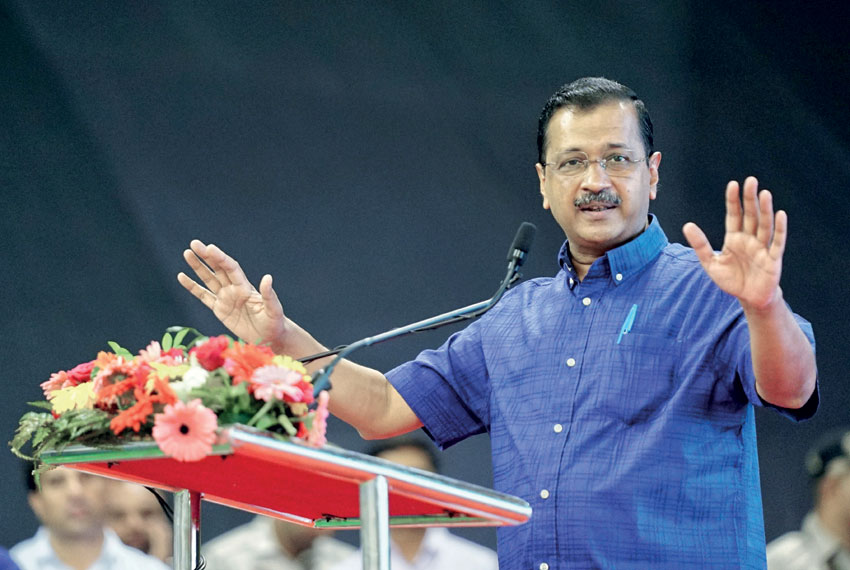
Arvind Kejriwal, an IIT-Kharagpur alumnus and a former civil servant turned social activist commenced campaigning against corruption long ago. In 2006, he resigned from his position as the Joint Commissioner of Income Tax to start ‘Parivartan’, a grassroot movement for transparency in government. He was awarded the Ramon Magsaysay Award for his involvement with this movement. In 2010, he protested against corruption in Commonwealth games and argued that the Central Vigilance Commission (CVC) did not have powers to take action against the guilty. In 2011, Kejriwal joined several other activists including Anna Hazare, Kiran Bedi, Prashant Bhushan, Yogendra Yadav, Baba Ramdev and Manish Sisodia to form India Against Corruption (IAC) group demanding enactment of Jan Lokpal Bill, which would result in strong Ombudsman. The campaign evolved into 2011 India anti-corruption movement, popularly known as Anna Aandolan, intended to establish strong legislation and enforcement against perceived endemic political corruption. As an activist, Kejriwal had initially maintained that he would ‘never join politics’, but in 2012, the Aam Admi Party (AAP) was launched and Kejriwal was elected as its National Convener. The formation of AAP caused a rift between Kejriwal and Anna Hazare. In 2013, Delhi Legislative Assembly elections, AAP won 28 seats in the house of 70 members and formed the government with the support of Congress. Kejriwal defeated the incumbent Chief Minister Sheila Dixit of Congress from New Delhi Constituency. He was sworn in as the Chief Minister of Delhi, and in 2014, he resigned after failing to table the Jan Lokpal Bill in the Assembly and recommended the dissolution of the Assembly. In 2015, Kejriwal led AAP won 67 seats, leaving BJP with 3 seats and Congress with none. He took office as Delhi Chief Minister on 14th February 2015 for the second time. In the 2020 elections, AAP won with massive majority and Kejriwal became the Chief Minister for the third time. He substantially improved education and health services, and his schemes to provide free electricity and water to the poor people made him popular in Delhi. Recently AAP formed the government in the state of Punjab also.
The liquor policy introduced by the AAP government in 2021 aimed at significant reforms in the excise sector, including privatization of liquor stores and adjustments in licencing criteria, with the aim to increase the revenue for the state government. However, the policy encountered vehement opposition with allegations of corruptions, favouritism and procedural irregularities that marred its implementation, leading to its eventual rollback. The Delhi Lieutenant Governor recommended CBI probe. Deputy Chief Minister Manish Sisodia was accused of bending the rules and providing undue benefits to liquor vend licensees. The CBI filed the case against Sisodia, who helmed the excise department, and other people involved in the process of fraud and bribery. The investigation involved property searches and the ED accused some AAP leaders of benefitting from the scheme. This eventually led to Sisodia’s legal trouble and arrest. He was denied bail by the High Court and the Supreme Court dismissed his appeal, saying that the tentative money trail was established.
Sanjay Singh, a sitting Rajya Sabha member from AAP was arrested by the ED in connection with a money laundering case linked to the liquor scam. He was allegedly involved in creating a special purpose vehicle to launder ‘proceeds of crime’ that would have been generated from the business arising out of the changes in Delhi excise policy, the ED has contended before the High Court. The ED submitted that Singh was involved in acquiring, possessing, concealing, dissipating and using the proceeds of the crime generated from the scam. It further said that Singh is a key conspirator in the alleged scam and closely associated with a number of accused or suspects in this case. Sanjay Singh was denied bail by the court.
K Kavitha, a prominent BRS leader and daughter of former Telangana Chief Minister KCR was arrested by the ED for her alleged involvement with a ‘South Group’ lobby of liquor traders seeking influence over the now-scrapped Delhi excise policy. The South Group secured undue favours in establishing liquor business in Delhi. As per the probe agency, one of the accused in the case, Vijay Nair, received kickbacks to the tune of Rs 100 crores from this group, allegedly controlled by Sarath Reddy, Kavitha and others, on behalf of AAP leaders. Earlier, Satyendra Jain, a minister in Kejriwal’s cabinet was also arrested by the ED in money laundering case in May 22.
And finally, the ED sent 9 summons to Kejriwal, and the last one was to appear on 21st March, to join the money laundering probe. Kejriwal termed the summons illegal and informed the agency his willingness to appear via video conferencing. ED approached the court on account of non-compliance of summons by Kejriwal. The court ruled in favour of the agency. Kejriwal also did not get any relief from the High Court. He was arrested on 21st March late evening and produced to court the next day. The ED submitted before the court that Kejriwal was directly involved in the formation of Delhi excise policy 2021-22, which was scrapped last year. Kejriwal was the key conspirator in liquor scam along with other ministers and leaders of AAP. He demanded Rs 100 crore from some accused of the south group for contesting Punjab elections and the trail showed that Rs 45 crore kickback used in Goa elections came from hawala routes, ED informed the court. Hearing the arguments from both the sides, the court granted seven days custody of Kejriwal to ED.
Kejriwal has decided not to resign and intends to run the government from custody, a move viewed by many as unethical. It is imperative for him to tender his resignation to allow AAP to elect its new leader, and co-operate fully with the investigating team to uncover the truth. Kejriwal formed the AAP to transform the politics of the country, but his recent entanglement in corruption allegations raises concerns. The connection with the corruption in the political system needs urgent attention and it is essential for all stakeholders to work together to eradicate this menace. It is a general feeling that the investigating agencies (IT, CBI and ED) are targeting the opposition parties only, thereby indicating that there are no corruption cases against the leaders of the ruling party. The elections to the Lok Sabha are going to be held soon. All of us should come out to vote to elect the honest people.
By Manoj Dubey
Principal (Retd.)
Delhi Public Schools
(The content of this article reflects the views of writers and contributors, not necessarily those of the publisher and editor. All disputes are subject to the exclusive jurisdiction of competent courts and forums in Delhi/New Delhi only)

















Leave Your Comment