


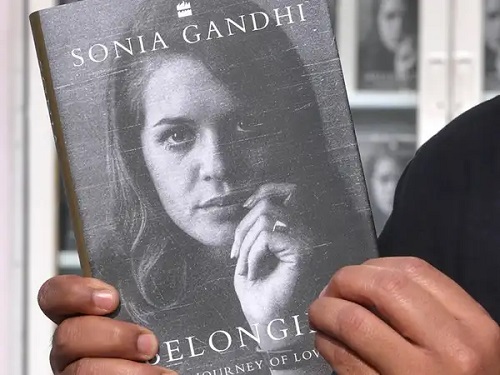
Congress veteran Sonia Gandhi's memoir, Belonging: A Journey of Love, released on November 10, has generated considerable interest for its personal revelations about the Nehru-Gandhi family and her years in Indian politics. However, the book has also landed in a factual controversy, with readers identifying three apparent historical inaccuracies concerning the Anna Hazare-led anti-corruption movement, the founding year of the Rashtriya Swayamsevak Sangh (RSS), and the death of senior Congress leader Ahmed Patel. The discrepancies have raised questions about the accuracy of the historical references in a memoir that seeks to document an important chapter of India's political history.
The first apparent discrepancy concerns the timeline of the India Against Corruption movement, which became one of the biggest political challenges for the Congress-led United Progressive Alliance (UPA) government. In Chapter 33, page 461, Sonia Gandhi attributes the emergence of the movement and Anna Hazare's role as its leading figure to 2012. The memoir describes Hazare, a social activist from Maharashtra, as the face of a campaign that adopted the name India Against Corruption.
However, the movement had already gathered nationwide momentum in 2011. On April 5 that year, Hazare began an indefinite hunger strike at Delhi's Jantar Mantar, demanding the introduction of a stronger anti-corruption law through the proposed Jan Lokpal Bill. The protest attracted widespread public support and brought several prominent personalities into the anti-corruption campaign, including Arvind Kejriwal, Kiran Bedi and Baba Ramdev. The agitation subsequently developed into a major political issue, intensifying public dissatisfaction with the UPA government. Placing its emergence in 2012 therefore creates a discrepancy in the chronology of an important political movement.
The second apparent error relates to the founding year of the Rashtriya Swayamsevak Sangh (RSS). In Chapter 24, page 338, Sonia Gandhi writes that the organisation was founded in 1921. She also offers a critical assessment of its ideological vision, arguing that its concept of a Hindu nation stands in opposition to constitutional principles of equality, pluralism and secularism.
Historical records, however, establish that the RSS was founded on September 27, 1925, in Nagpur, Maharashtra, by Dr Keshav Baliram Hedgewar. A physician by profession, Hedgewar established the organisation with the objective of promoting Hindu social and cultural organisation. Over the decades, the RSS expanded its organisational presence and emerged as one of the most influential ideological movements in the country. The difference between the year mentioned in the memoir and the historically established date is therefore a significant factual discrepancy.
The third apparent inaccuracy concerns Ahmed Patel, one of Sonia Gandhi's most trusted political associates and a key figure in the Congress organisation for several decades. In Chapter 29, page 401, she recalls his political influence and describes the personal and organisational vacuum created by his death. However, the memoir refers to 2022 as the year Patel succumbed to Covid-related complications.
Patel actually died on November 25, 2020, at the age of 71. He had been undergoing treatment at Medanta Hospital in Gurugram after contracting Covid-19 and subsequently developed multiple complications, including multiple organ failure. His death was a major setback for the Congress, given his longstanding role as Sonia Gandhi's political secretary and his extensive experience in managing party affairs and political negotiations.
The three apparent discrepancies have brought an unexpected dimension to the release of Belonging: A Journey of Love. While memoirs inevitably reflect personal recollections and individual interpretations of events, historical dates and significant political developments are matters that can be independently verified. The questions raised over these references have consequently shifted some attention away from the book's personal revelations towards the reliability of its historical narrative.
For a memoir written by a political leader who occupied a central position in Indian public life for decades, accuracy assumes particular importance. Its accounts are likely to be examined not merely as personal memories but also as records of contemporary political history. The factual questions surrounding these three references may therefore remain an important part of the discussion generated by Sonia Gandhi's book.




















Leave Your Comment