


For Bengalis who can read and write, Bankim Babu is the author of Anandamath. The same is true even of those who cannot read or write. Father wrote numerous philosophical essays and letters, offered intellectual critiques, and composed a biography of Shri Krishna. Yet, in the popular imagination of Bengal, he is primarily remembered as the author of Anandamath. This is hardly surprising. The work that people remember most is often the one that encompasses, awakens, captivates or profoundly moves an entire community.
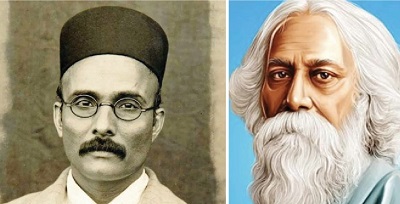
Consider the freedom fighter Vinayak Damodar Savarkar. His literary legacy is extensive and multifaceted, yet he is widely remembered for The Indian War of Independence of 1857. Ask children or adults about Rabindranath Tagore, whose mastery of language seemed boundless, and many will identify him as the author of Gitanjali. In much the same way, people remember Bankim Babu through Anandamath.
The novel was published several times during my father’s lifetime, although I cannot recall the exact number of editions. It was first translated into English under the evocative title The Abbey of Bliss, with Naresh Chandra Sengupta as its translator. Soon, translations began appearing in numerous Indian languages. From the southern regions of India to Bengal, Anandamath found new readers and admirers. Shri Kannambra Kunhunni Nair introduced it to Malayalam readers in 1919. Before independence, editions appeared in one language after another, and this process continued even after independence.
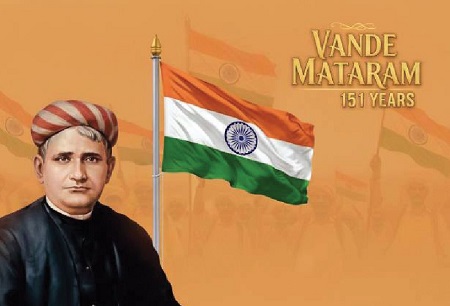
What a remarkable phenomenon! Even more than a century after its author’s death, new editions and interpretations of the work continue to appear. I know of few other literary works that have enjoyed such an enduring legacy, apart from the Ramayana, the Mahabharata and the Bhagavad Gita.
I pray that the finest literary works of every language in my motherland may enjoy a similar destiny. Whenever I think of my father’s Anandamath, I am reminded of the words of Parthasarathy: “The wise see the creation in me and me in the creation.” Such is the relationship between Anandamath and my father. My father lives in Anandamath, and Anandamath lives in my father. Readers continue to experience this relationship even today. The message of both my father and his immortal work continues to resonate in people's hearts.
My father began writing short stories at the age of twenty-six. His literary discipline continued until two years before his death. It is often said that a writer, storyteller or playwright both shapes and is shaped by society. The same was true of my father. He pursued literature at the crossroads of two historical eras. The mind that searched tirelessly for subjects for his stories was equally drawn to the turbulent histories preserved in old records and to the decaying structures of contemporary society.
My father’s first novel was Durgeshnandini, set during the reign of Emperor Akbar. Its geographical canvas extended from Delhi to Kalinga, encompassing Bengal. Love formed the central theme, while the fortunes and misfortunes of the characters shaped the narrative.
In Rajsingha, the author travelled to the age of Emperor Aurangzeb. Chanchalakumari, the daughter of the ruler of the small Rajput kingdom of Roopnagar, falls in love with Rana Rajsingha of Udaipur after seeing his portrait. In a moment of defiance, she writes a mocking letter to Aurangzeb and discards the portrait. The incident reaches the Mughal court and becomes a catalyst for conflict between the Rajputs and the Mughals. The confrontation eventually develops into a fierce battle in which the Mughal army is defeated. Where can love and wounded pride lead a person? Rajsingha offers an answer to this question.
Another novel, Chandrashekhar, is set against the political turmoil involving Bengal’s Nawab Mir Qasim and the Europeans. The story does not depend on spectacular battles or warships. Instead, it gives shape and expression to the human emotions suffocated by a troubled political environment.
Mrinalini carries its own messages and historical perspective. My father did not accept the account that Bakhtiyar Khilji conquered Bengal with the help of merely seventeen horsemen. He expressed his objections in several writings and believed that Khilji must have advanced with an army numbering tens of thousands. This understanding informed the historical framework of Mrinalini.
The novel is not simply a love story. It explores how treachery can destroy a nation, while drawing upon the strategic wisdom associated with Acharya Chanakya.
Khilji has conquered Hemachandra’s kingdom of Magadh, and Gaur is his next target. Shri Madhavacharya urges Hemachandra to liberate Magadh and protect it against attacks from Gaur. Hemachandra regards this appeal as his guru’s command. However, Mrinalini’s actions disrupt his life, even as Madhavacharya attempts to guide his courageous disciple towards the right path.
The betrayal by Pashupati, the chief minister of the ruler of Gaur, enables Khilji to enter with seventeen horsemen. The twenty-five thousand soldiers lying in ambush then join the attack. Is this not reminiscent of the many struggles in which betrayal has undermined the cause of our Bharat Mata? That is the painful lesson conveyed through Mrinalini.
It is said that a person’s character remains unchanged until death. My father was no exception in his abiding love for storytelling and his determination to investigate the histories behind his narratives. Yet no human being remains entirely unchanged. Although our fundamental nature may endure, maturity brings new experiences, fresh understanding and a broader perspective. Looking back today, I realise that the same process unfolded in my father’s life.
My father was nineteen when the first great uprising of the freedom struggle broke out in 1857. Independent newspapers did not exist, and the information available to him was largely shaped by the British authorities. Consequently, he initially understood the uprising through the colonial description of it as a “Sepoy Mutiny”.
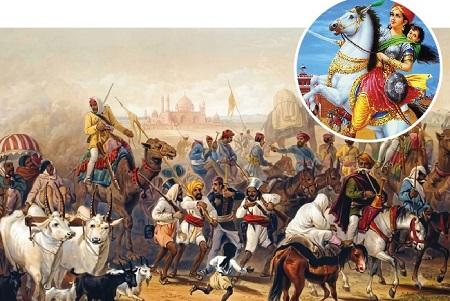
However, after entering government service at the age of twenty and spending several years in administrative positions, my father gained rare opportunities to examine confidential documents. These experiences gradually altered his initial understanding. He learnt more about Rani Lakshmibai of Jhansi, the indomitable heroine of India’s freedom struggle. In confidential records, he encountered descriptions of her as a brave and formidable warrior, comparable in courage and valour to any man.
His passion for history inspired him to contemplate writing a biography of Rani Lakshmibai. Unfortunately, he did not live to complete that ambitious undertaking.
When my father was transferred to Chinsurah in the Hooghly district, he became intellectually and ideologically close to the poet Bhudev. Their conversations may have inspired him to conceive a new story capable of awakening the spirit of freedom. The uprising of 1857 was one possible subject, but for reasons I cannot explain, he did not pursue that course.
Another episode deeply affected him and stirred his emotions. To the ordinary reader, it might have appeared to be merely a historical incident. To a writer and an inquisitive historian, however, it carried profound significance.
Vasudeva Balwant Phadke, who had challenged the British East India Company’s government through armed rebellion after the uprising of 1857, was captured in 1879. In 1880, he was deported to Aden and imprisoned there. He attempted to escape but was recaptured and imprisoned again. Eventually, he died of tuberculosis.
The news of his death, along with detailed accounts of his trial, appeared in Calcutta’s newspapers. A Bengali magazine also published the biography of this revolutionary martyr.
My father read these accounts and absorbed their significance deeply. The courageous life of this revolutionary, who was seven years younger than my father, left a profound impression on the accomplished storyteller. In Phadke, the writer discovered a heroic figure capable of inspiring a powerful literary creation.
My father had told me about a great-grandfather who lived to the age of 108. I cannot remember his name; after all, who remembers the names of great-grandfathers? He was a gifted storyteller, and it was from him that my father and my uncle, Poornachandra, first heard about an uprising of Sanyasis that had occurred in the distant past.
At the time, my father did not believe the story. When he expressed even the slightest doubt, my great-grandfather rebuked him: “Have you turned into an Englishman because of your education, you fool?”
Later, after entering government service and reading works such as Gleig’s Memoirs of the Life and Hunter’s Annals of Rural Bengal, my father realised that his great-grandfather’s account was not merely an old tale. The Sanyasi rebellion, which I mentioned at the beginning, had begun around 1762, approximately three-quarters of a century before my father was born.
Six years later, this long-forgotten episode returned to his mind. The ideas he had gathered from family memories, historical documents and the lives of revolutionary heroes gradually converged. Through the creative genius of a master storyteller, these fragments of history took the form of a compelling literary work. That work was Anandamath.
In Anandamath, one can discern Satyananda transforming into Phadke. One can see the Rani of Jhansi reappearing in the character of Shanti, who comes to her husband’s aid. The thirst for freedom that inspired the soldiers of 1857 also finds expression in the novel, alongside echoes of the Sanyasi rebellion.
In Anandamath, nationalism transforms apathy into dedication. Love, having withdrawn from worldly attachments, becomes purified and is transformed into Ananda—spiritual bliss. The novel thus offers guidance to those who enter the arena of national and social struggle. It provides direction to people submerged in servitude and reminds them of the moral and spiritual strength required to overcome it.
At its heart lies the spiritual philosophy expressed in the verses of the Bhagavad Gita, which held a special place in my father’s life.
Are there not those who, having attained the state of renunciation, have attained the state of meditation on the one and only yoga?
O Partha, let them be saved from the ocean of death and destruction.
Let those who cling to the idea of the existence of me, fix their minds on me, and fix their intellects on me.
If you cannot establish your mind on the doubt that it is not that, then try to attain me through the practice of yoga, Dhananjaya. (6-7-8.9/12)
One thing, therefore, becomes clear to me: my father wrote Anandamath in a spirit of submission to God.
It was through this Anandamath that my father lovingly took me by the hand and brought me into his world of ideas, history and spiritual reflection. Through the novel, he left behind not merely a literary masterpiece but also a lasting inheritance of patriotism, sacrifice and faith.
R Hari
(The article is excerpted from the book The Story of Vande Mataram, published for Prajna Pravah Pratishtan by Indus Scroll Press)
(The content of this article reflects the views of writer and contributor, not necessarily those of the publisher and editor. All disputes are subject to the exclusive jurisdiction of competent courts and forums in Delhi/New Delhi only)






















Leave Your Comment