


India has stepped up efforts to strengthen its military preparedness and reduce dependence on foreign defence technologies by signing two contracts worth approximately ₹4,106 crore for secure satellite communications and advanced underwater warfare capabilities. The agreements for the GSAT-7C satellite capability for the Indian Air Force (IAF) and Varunastra heavyweight torpedoes for the Indian Navy underline the strategic importance of indigenous technology in modern warfare.
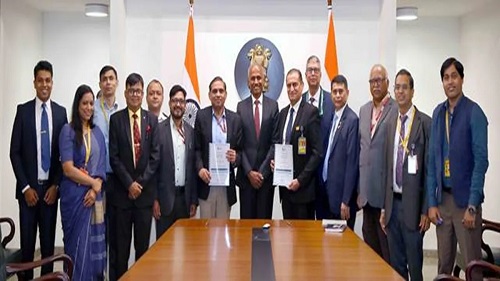
The Ministry of Defence signed the contracts in New Delhi on Thursday, October 15, in the presence of A Anbarasu, Additional Secretary and Director General (Acquisition) in the Department of Defence.
Under the first agreement, the ministry awarded a contract worth ₹2,563 crore to New Space India Limited (NSIL), Bengaluru, for the GSAT-7C satellite capability. The indigenously designed and manufactured system is expected to improve secure and uninterrupted communication among the Indian Air Force's assets.
Reliable communication is essential for coordinating operations involving aircraft and other military platforms. In modern warfare, the ability to exchange information securely and efficiently can influence response times, operational coordination and mission effectiveness. The GSAT-7C capability is therefore significant not merely as a space-based asset but as an investment in the IAF's communication infrastructure.
The second contract, valued at ₹1,543 crore, was signed with Bharat Dynamics Limited (BDL), Hyderabad, for the supply of Varunastra heavyweight torpedoes to the Indian Navy.
Developed by the Naval Science and Technological Laboratory, Varunastra is an indigenous, ship-launched anti-submarine weapon designed to engage hostile submarines. Its acquisition is expected to strengthen the Navy's underwater combat capabilities and improve its ability to respond to potential maritime threats.
The importance of this agreement extends beyond the addition of another weapon system. Submarines pose complex challenges because they can operate covertly and threaten naval vessels and maritime assets. Strengthening anti-submarine warfare capabilities is consequently essential to protecting India's maritime interests and maintaining operational readiness.
Analytically, the two contracts address different but complementary dimensions of national defence. The GSAT-7C capability focuses on secure communications, which underpin coordination and information-sharing, while Varunastra provides a specialised offensive capability against underwater threats. Together, they highlight the need to develop both the technological infrastructure supporting military operations and the weapons required to execute them.
The agreements also reinforce the government's Aatmanirbhar Bharat and Make in India initiatives. By placing orders with Indian defence and aerospace enterprises for strategically important capabilities, the ministry is supporting domestic manufacturing and strengthening the country's defence industrial base.
However, self-reliance in defence requires more than awarding contracts to domestic companies. Sustained progress will depend on timely delivery, reliable performance, continuous technological improvement and the ability of Indian manufacturers to meet the armed forces' evolving requirements. Indigenous production must translate into dependable operational capabilities to deliver its full strategic value.
The ₹4,106-crore investment thus represents a step towards a more capable and self-reliant defence ecosystem. By strengthening military communications and anti-submarine warfare, India is addressing two critical operational requirements while expanding the role of domestic industry in meeting the country's security needs.






















Leave Your Comment