


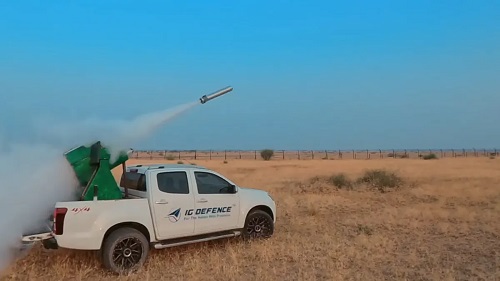
As unmanned aerial systems increasingly reshape the character of modern warfare, India is taking another significant stride towards strengthening its indigenous defence capabilities. The successful test-firing of JWALA MK-1, an autonomous counter-drone micro-missile system developed by Indian defence manufacturer IG Defence, at the Pokhran firing range in Rajasthan, signals an important advancement in the country's efforts to develop affordable, home-grown solutions against emerging aerial threats. With an operational range of up to five kilometres, the system seeks to address one of the most pressing challenges facing modern militaries: neutralising inexpensive hostile drones without exhausting costly conventional air-defence ammunition.
The successful test-firing of JWALA MK-1 is significant not merely because of the technology involved, but also because it reflects a shift in India's approach to battlefield preparedness. Drones have rapidly evolved from being primarily surveillance and reconnaissance platforms into weapons capable of conducting precision strikes, disrupting military installations and threatening critical infrastructure. Their relatively low manufacturing and operational costs have made them attractive instruments of asymmetric warfare. Consequently, even sophisticated military establishments are finding themselves confronted with an uncomfortable equation: neutralising a relatively inexpensive drone can sometimes require deploying an interceptor worth many times its cost.
Recent international conflicts, including the US-Iran confrontation, have brought this economic imbalance into sharper focus. The increasing use of low-cost unmanned attack platforms has demonstrated that conventional air-defence systems cannot always provide an economically sustainable response to every aerial threat. Repeatedly deploying expensive missiles against comparatively inexpensive drones can put pressure on ammunition reserves, operational readiness and long-term defence budgets. For a country like India, which faces a complex security environment and persistent threats of cross-border drone activity, developing affordable counter-unmanned aircraft systems is therefore a strategic necessity rather than simply a technological ambition.
According to IG Defence, JWALA MK-1 has been designed as an indigenous, autonomous and cost-effective counter-drone solution. With an operational range of up to five kilometres, the system combines micro-missile technology with an integrated mission autonomy architecture. It is designed to identify potential hostile drone targets, classify them and facilitate their neutralisation through an automated engagement process. This integration of target identification and interception capabilities is particularly important in an operational environment where the speed of response can determine the success or failure of an air-defence mission.
The missile incorporates a dual-pulse solid rocket motor, which provides propulsion, while aerodynamic fin controls help maintain flight stability and manoeuvrability. It is equipped with a pre-fragmented high-explosive warhead and a proximity fuse. Unlike conventional impact-dependent mechanisms, a proximity fuse enables the warhead to detonate when the missile approaches its intended target. This can increase the chances of destroying or disabling a hostile drone even without a direct physical collision.
The development also highlights the growing importance of specialised counter-drone weapons in India's defence planning. Traditional air-defence platforms remain indispensable against sophisticated aircraft and larger aerial threats, but the proliferation of small, low-flying and potentially autonomous drones requires more specialised responses. A dedicated micro-missile system could offer a complementary layer of protection, particularly where the economics of using conventional interceptors become difficult to justify. If its operational performance and cost advantages are established through further trials, JWALA MK-1 could become a valuable addition to India's expanding counter-drone capabilities.
The achievement also fits into the broader vision of Aatmanirbhar Bharat, under which domestic defence manufacturers are being encouraged to develop technologies that were traditionally dependent on foreign suppliers. Defence Minister Rajnath Singh has emphasised that India's journey towards self-reliance in defence is entering its second phase, often described as 'Aatmanirbharta 2.0'. The next stage, according to this vision, must move beyond manufacturing conventional equipment towards developing sophisticated, cutting-edge technologies that can meet the requirements of future warfare.
JWALA MK-1 represents an encouraging step in that direction. However, successful test-firing is only one milestone in the larger process of developing a dependable operational weapon system. Its effectiveness under different weather conditions, against varying drone profiles and in complex electronic warfare environments will be crucial in determining its eventual military utility. Nevertheless, the indigenous development of such technology sends a clear message: India intends to prepare for the changing nature of warfare through domestic innovation, technological competence and strategic self-reliance.






















Leave Your Comment