


I was in Kodapura yesterday, a small Santhal village tucked inside the forests of Binpur-II block, Jhargram district, West Bengal. I went there to see the work of our team. I left having understood something much larger about water, women and the forests above us.
Kodapura has 50 households. Of these, 35 now draw water for their homes and increasingly for their fields from a stream that is there almost a kilometre away and four metres higher up the slope. PRADAN’s Silda team designed the intervention under the Parivartan program of HDFC Bank’s CSR arm. They have done something deceptively simple: they ran a 110mm uPVC pipe from the stream to the village, by gravity alone, no pump, no electricity, no diesel.
Six outlets now serve domestic needs near the hamlet. Three more, just outside it, irrigate the fields. The whole system runs on nothing but the slope of the land and the patience of a small forest stream discharging perhaps 5 litres per second even in peak summer.
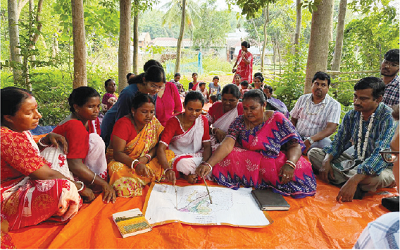
Women of Kodapura mapping their village resources, the planning that preceded the pipe.
For years, the villagers walked past that stream without seeing it as an answer. It looked too small, too far, too modest to solve anything. That is the quiet tragedy of so many forest-fringe villages in central India; the water exists, often year-round, but the distance and the meagre flow make it invisible as a resource. It takes a trained eye to look at a thin trickle of water in June and calculate that it is enough.
The diversion structure at the source, four metres above the village, where the stream is captured and sent on its journey
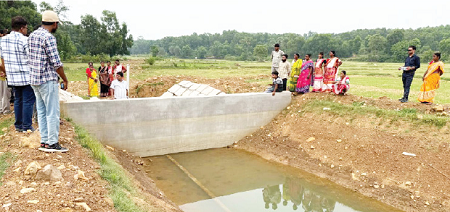
The diversion structure at the source, four metres above the
village, where the stream is captured and sent on its journey
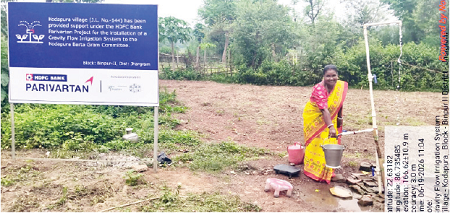
Round-the-day water, steps from home; one woman,
one bucket, one outlet that has changed her day
The arithmetic of a “meagre” stream
And the arithmetic, once you do it, is almost startling. Thirty-five families of five members each need about 9,625 litres a day, met entirely by a flow of just 0.11 litres per second. The stream at Kodapura gives forty-five times that. With a 4-metre head and a 4-inch pipe, that same modest source can carry up to 5 litres per second across a kilometre. It is not only enough for the domestic need, but also to irrigate up to half an acre per family and secure a second crop.
The pipeline reaches the field, villagers and the PRADAN team walk the line together as water runs into the agricultural outlet
The system was commissioned only in March this year, so the fields have barely felt its benefit yet. But the women have.
When I asked them if they were happy with the intervention, they said yes, immediately, without hesitation. I pushed back, gently: you haven’t even used it for irrigation yet, I said, so what is it that makes you this happy?
“You do not understand what difference it makes to the women of a household whose water problem is solved forever. Scarcity of water increases our workload manifold and it affects our education and our ability to take part in livelihood work too; because in our families, it is the women who must fetch every drop the household needs. We used to walk long distances for water, and in summer, it was unbearable.”
This is the driest stretch of the year. And every one of those 35 families is meeting its full domestic water need without that long, punishing walk.
Round-the-day water, steps from home; one woman, one bucket, one outlet that has changed her day
There was something else in that conversation worth holding onto. The women already understand why their stream still flows in June. It is the forest above the village that keeps it alive. That single fact has quietly become one of the strongest reasons for them to protect that forest and even to help it grow denser. When people feel the difference water security makes, protecting the forest stops needing a campaign. It becomes common sense.
What strikes me most is how replicable this is. Almost every forest-fringe village in this belt sits below some version of this same stream; small, easy to overlook, seemingly too far away to matter. These are also, overwhelmingly, the villages that the Jal Jeevan Mission’s piped-water push has struggled to reach, precisely because they are remote and scattered. A gravity-fed pipeline, sized correctly and laid with care, can close that gap at a fraction of the cost and complexity of conventional schemes.
Kodapura is one small pipe in one small village. But it is also an answer to a question that troubles forest-fringe India everywhere: how do we give women back the hours, the dignity and the choices that water scarcity quietly takes from them and how do we do it using what the forest is already giving us, for free, if only someone looks closely enough to see it?
Kodapura village, J.L. No.-144, Binpur-II Block, Jhargram District, West Bengal: Gravity Flow Irrigation System, supported by HDFC Bank Parivartan in association with PRADAN
Manas Satpathy
(The content of this article reflects the views of writer and contributor, not necessarily those of the publisher and editor. All disputes are subject to the exclusive jurisdiction of competent courts and forums in Delhi/New Delhi only)




















Leave Your Comment