


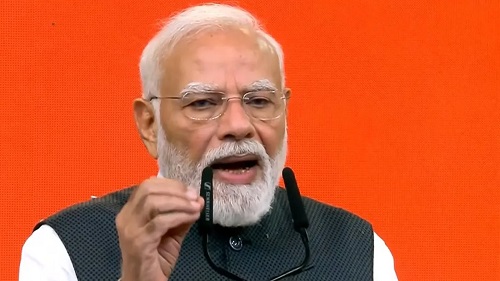
Prime Minister Narendra Modi’s completion of 25 years in public office is being presented not merely as a personal political milestone, but as a reflection of the durability of democratic mandate and the responsibilities that accompany it. Addressing the ‘Seva Jyoti’ event in Delhi, Modi placed the anniversary within the framework of India’s Constitution, democracy and public service, stressing that his long political journey was ultimately enabled by the repeated trust of citizens. His emphasis on service, collective responsibility and national ambition also sought to shift the focus from an individual milestone to a larger political and developmental project.
Prime Minister Narendra Modi’s completion of 25 years in public office marks an unusual milestone in Indian politics, but his message on the occasion was carefully framed around democracy, constitutional faith and public responsibility rather than personal achievement. Addressing the ‘Seva Jyoti’ event in Delhi, Modi said the people had repeatedly chosen him to serve them and paid tribute to India’s democratic system and Constitution.
The political significance of the milestone lies in the continuity of public trust. Modi’s journey from state-level leadership to the national stage has been marked by successive electoral mandates and an expanding political footprint. By describing 25 years of public life as a “tremendous asset”, he presented political experience as something that belongs not merely to the individual who accumulated it but to the nation that enabled it.
His remarks also underline the central philosophy through which he has sought to define his political career: governance as seva, or service. Modi said every citizen had the foremost claim on him and that the nation had given him much, creating an even greater responsibility towards it. The formulation is politically significant because it places legitimacy and accountability together—the authority to govern is presented as arising from public trust and, therefore, carrying a corresponding obligation to deliver.
Earlier in the day, Modi visited the Sri Vinayaka Temple and offered prayers for the nation, its 1.4 billion people and himself. His prayer for greater strength and capability to serve the country reinforced the service-oriented narrative running through the event.
The Prime Minister also highlighted the role of swayamsevaks and party workers in his journey. His assertion that he had never felt alone because of the countless volunteers dedicated to serving Bharat was an acknowledgement of the organisational ecosystem that has sustained his political movement. The emphasis on karyakartas also broadens the narrative from individual leadership to collective mobilisation.
The other major theme of the address was the future. Rather than treating 25 years as a point of culmination, Modi used it as a platform to renew national objectives. His repeated call of “We will do it” was designed to create a participatory political message, turning national ambitions into collective commitments.
The goals he outlined—Viksit Bharat by 2047, Aatmanirbhar Bharat, transforming India into a global manufacturing hub, hosting the Olympics and advancing the country’s space capabilities—represent different dimensions of the same aspiration: a more economically powerful, technologically capable and globally influential India.
The 2047 target is particularly important because it extends the political narrative beyond individual electoral cycles. It seeks to connect present-day governance with the centenary of Independence, making development a generational project rather than a short-term political promise.
Modi’s 25-year milestone, therefore, carries two simultaneous messages. The first is retrospective: a reminder of the democratic mandates and organisational support that have sustained his public career. The second is prospective: an attempt to convert accumulated political experience into renewed momentum for national transformation.
His central proposition was clear—the longer the journey in public office, the greater the responsibility. By portraying his experience as a national asset and repeatedly invoking service, Modi sought to transform a personal anniversary into a reaffirmation of his political contract with citizens. The “We will do it” refrain consequently became more than a slogan; it was an attempt to turn political continuity into collective confidence about India’s future.






















Leave Your Comment