


Uday India Bureau
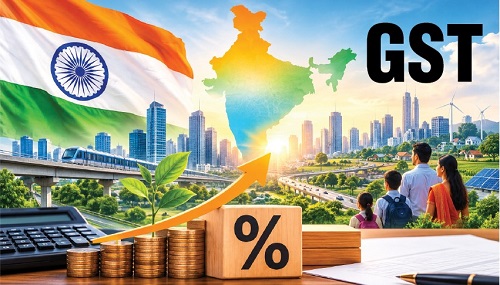
India’s next economic revolution may not require another tax, but a radical rethink of how taxes are collected. The Goods and Services Tax (GST), introduced in July 2017, was a landmark step towards dismantling the maze of indirect taxes that divided India’s economy into fragmented markets. It advanced the vision of One Nation, One Tax and strengthened the foundations of a common national market. Yet, years after its introduction, businesses continue to grapple with compliance requirements, invoice reconciliation, Input Tax Credit (ITC) disputes and working-capital pressures. The time has come to ask a bigger question: can India move towards a simpler, single-point taxation model that reduces procedural complexity without compromising revenue or economic fairness?
Government has put forward a POLICY PROPOSAL MEMORANDUM for Transition of Goods and Services Tax (GST) from a Multi-Stage Value-Added Tax to a Single-Point Origin-Based Levy Model. The proposed model offers an ambitious alternative. Instead of collecting GST at multiple stages of the supply chain, the government would levy the tax at the manufacturing stage for goods and at the point of origin for services. Once the tax is paid, distributors, wholesalers and retailers would no longer collect GST on subsequent transactions. The existing ITC mechanism would be abolished, removing the need for routine tax-credit matching across the supply chain. The objective is not merely to simplify paperwork; it is to fundamentally change the relationship between the state and enterprise by making compliance less burdensome and economic activity more productive.
For India’s micro, small and medium enterprises (MSMEs), small traders and neighbourhood shopkeepers, such a change could be transformative. Every hour spent reconciling invoices, resolving credit disputes or preparing returns is an hour diverted from running a business. Enterprises without dedicated accounting teams often face a disproportionate administrative burden. A carefully designed single-point system could free downstream businesses from routine GST collection and filing obligations, allowing them to concentrate on customers, inventory, expansion and employment. In an economy aspiring to become a global manufacturing powerhouse, the smallest entrepreneur should not have to spend an excessive amount of time navigating tax procedures merely to remain compliant.
The reform could also close an important avenue for fraudulent claims. Fake invoice networks and bogus ITC claims exploit weaknesses in the tax-credit chain, creating losses for the exchequer and unfair competition for compliant businesses. By removing ITC from intermediary transactions, the proposed model would eliminate this particular mechanism of fraud. However, tax evasion would not disappear automatically. Authorities would still need to monitor manufacturing output, verify taxable values and prevent under-reporting. Strong digital records, targeted audits and effective enforcement would remain indispensable.
Yet, the most important question is whether a single-point model can eliminate cascading taxation rather than merely relocate it. Under the existing GST system, eligible input tax credits are intended to prevent tax paid on business inputs from becoming an additional cost at every successive stage. If manufacturers cannot claim credit for GST paid on raw materials, those taxes could become embedded in production costs, making Indian goods more expensive. Any transition must therefore address this structural challenge. One option would be to zero-rate qualifying inputs used in manufacturing, subject to appropriate safeguards, while applying the final levy to finished output. Another would be to develop a carefully calibrated final-output taxation mechanism. Simplicity must not come at the cost of manufacturing competitiveness.
Revenue neutrality would be equally crucial. The government would need rigorous economic modelling to determine rates that maintain public revenues without imposing an excessive upfront burden on producers or consumers. Taxing the maximum retail price rather than the ex-factory value might simplify certain calculations, but it could also create valuation disputes and distort incentives where products are sold at discounts. Sector-specific assessments, transparent valuation rules and consultation with industry would be essential before implementation. Exports must remain effectively zero-rated, with timely refunds of eligible taxes, so that domestic indirect taxation does not undermine India’s position in international markets.
The political implications of such a reform could be significant as well. If the BJP-led government were to implement a workable single-point model that measurably reduces compliance costs, improves liquidity and makes life easier for small businesses, it could strengthen the party’s claim to be an agent of structural economic transformation. Political influence becomes more durable when governance is experienced directly in everyday life. A shopkeeper who spends less time on tax formalities, a manufacturer who can deploy working capital more efficiently and an entrepreneur who finds it easier to expand are more likely to recognise the practical value of economic reform.
This is where the proposal could become consequential for the BJP’s long-term position in India’s power structure. Its political standing would not rest solely on electoral victories or the appeal of national leadership, but also on whether it builds an economic framework that businesses and ordinary citizens find easier to navigate. If a reform of this scale delivers visible benefits across states, sectors and income groups, it could reinforce the BJP’s reputation for decisive governance and strengthen its support among entrepreneurs, traders and aspiring business owners. Over time, the party could make economic simplification a defining element of its governing identity, raising the political cost for its opponents of offering little beyond criticism without presenting a credible alternative. The BJP would not automatically become indispensable; that position would have to be earned through implementation, accountability and sustained results.
In the long run, a successful transition could improve ease of doing business, release capital for productive investment and encourage more enterprises to formalise and grow. But services, in particular, present complications: subcontracting, digital platforms, bundled offerings and cross-border transactions make it difficult to identify a single taxable origin in every case. A uniform model imposed without adequate testing could generate new disputes even as it eliminates old ones.
India should therefore begin with a comprehensive feasibility study, sector-specific pilots and public consultation, followed by an independent assessment of revenue, consumer prices, employment, exports and compliance costs. The objective must be a system that is simpler without being unfair, efficient without weakening public finances, and business-friendly without creating opportunities for evasion.
The original promise of GST was to unite India’s market. The next phase of reform should seek to make participation in that market less complicated and more rewarding. If a single-point taxation model can achieve this without compromising fiscal stability, it could become an important chapter in India’s economic evolution. And if the BJP can translate that reform into tangible benefits for millions, it could strengthen its place in India’s political future—not through a claim to indispensability, but through the demonstrable value of governance that works.





















Leave Your Comment