



Rakesh Kumar
The headlines of recent years paint a disturbing picture of the state of our nation
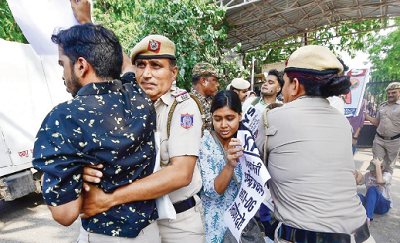
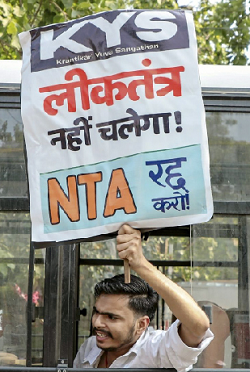
The NEET examination paper leak exposed a well-organized ecosystem of fraud. The obvious questions remain: who is buying leaked papers, and who is facilitating such crimes? Behind every leak lies not just a criminal network but also a societal willingness to cheat.
Former Presidents, Vice-Chancellors, and even recipients of the nation's highest honours have faced allegations of plagiarism. Those entrusted with advancing knowledge and intellectual integrity stand accused of violating the very principles they were expected to uphold.
Courts occasionally grant bail or parole to individuals convicted of heinous crimes. In some instances, beneficiaries have allegedly gone on to commit further offences. A judicial system burdened with millions of pending cases finds the capacity to hear certain matters at extraordinary hours, raising questions about priorities and consistency.
The discovery of large amounts of unaccounted cash at the residence of a judge shook public confidence in the judiciary. Yet Resignation came only after impeachment proceedings were initiated, and the larger questions of criminal liability remain unanswered.
Universities, which should be celebrated for groundbreaking research and academic excellence, increasingly find themselves in the news for incidents of violence, radicalization, and activities perceived as hostile to national interests. Institutions meant to nurture inquiry and responsible citizenship are often becoming arenas of division and confrontation.
A significant number of elected representatives continue to face criminal allegations. They are eager to change the demography by settling illegal migrants. Divide the society on caste, language and region.
The voters want everything free.
The media, instead of serving solely as a watchdog, often turns such controversies into spectacles that boost viewership and ratings.
The recurring scandals across politics, academia, bureaucracy, the judiciary, and business point toward a more fundamental failure.
The Crisis Is Not Corruption Alone—It Is a Failure of Education
Our education system has become increasingly focused on examinations, degrees, employability, and economic success, while neglecting its most important responsibility—the formation of ethical citizens. We have succeeded in producing engineers, managers, lawyers, administrators, and politicians. Yet we have not been successful in producing men and women guided by integrity, responsibility, and public spirit.
A society cannot legislate morality into existence. Laws can punish wrongdoing, but they cannot create character. That task belongs primarily to families, schools, universities, and the larger cultural environment.
The ancient Indian ideal, “Sa Vidya Ya Vimuktaye”—knowledge is that which liberates—envisioned education as a means of developing wisdom, self-discipline, and moral judgment. Today, education is too often reduced to a transaction: a degree in exchange for employment.
The issue is not merely one of governance or law enforcement but It is a crisis of character
The question before the nation is therefore not merely how to punish wrongdoing. It is how to build a generation that chooses not to engage in it in the first place.
For most students, education remains a race for marks, ranks, degrees, and jobs. From an early age, they are conditioned to seek the "right answer" rather than ask the right questions. Schools reward obedience, coaching centres reward memorisation, and universities reward the reproduction of established knowledge. Very little space is left for curiosity, experimentation, reflection, or dissent.
Education Without Liberation: Why We Are Failing the Spirit of “Sa Vidya Ya Vimuktaye”
India's education system has made remarkable progress in expanding access but has fallen short in delivering liberation.
The National Education Policy (NEP) 2020 rightly speaks of holistic development, critical thinking, creativity, multidisciplinary learning, and the integration of Indian knowledge traditions. The vision is inspiring. The challenge lies in implementation. The system continues to operate on assumptions inherited from the colonial era—producing compliant workers rather than enlightened citizens.
As a result, many educated individuals remain trapped in mental and social limitations. They may possess degrees but lack the confidence to challenge outdated beliefs. They may be technologically skilled yet vulnerable to misinformation. They may earn well but remain unable to manage stress, conflict, relationships, or ethical dilemmas.
This contradiction reveals a deeper problem. We have confused literacy with education and employability with enlightenment.
Educating Minds, Neglecting Citizens
The consequences extend beyond individuals. A society that rewards memorisation more than imagination will struggle to become a leader in research, innovation, and knowledge creation. This partly explains why India produces millions of graduates but relatively few globally influential researchers, inventors, or original thinkers.
The spirit of “Sa Vidya Ya Vimuktaye” also demands freedom from social divisions and prejudices. Yet schools often fail to cultivate empathy, civic responsibility, and respect for differing viewpoints. Moral education is treated as a peripheral subject rather than the foundation of character formation. Students learn formulas and algorithms but receive little guidance in understanding themselves and others.
Institutions lack direction
Educational institutions play a vital role in shaping the character and values of young people. They should foster intellectual curiosity, civic responsibility, respect for democratic processes, and commitment to the nation's progress. While dissent and debate are essential components of a healthy academic environment, there is a clear distinction between constructive criticism and activities that encourage disorder, hatred, or disregard for the rule of law.
Universities and colleges are meant to encourage critical thinking, debate, and the free exchange of ideas. However, when these freedoms are misused to promote violence, lawlessness, or actions that undermine social harmony, the very purpose of education is compromised.
The challenge lies in maintaining a balance between academic freedom and social responsibility. Institutions must create an environment where diverse viewpoints can be discussed openly while ensuring that campuses do not become platforms for activities that threaten public order or national interests.
The solution is not to suppress discussion but to strengthen value-based education, civic awareness, and ethical leadership. Students should be encouraged to engage with social issues through dialogue, research, community service, and democratic participation. Educational institutions must remain centres of learning, innovation, and nation-building rather than arenas for divisive or destructive activities.
India's future depends significantly on the quality of its educational institutions. They must continue to produce informed, responsible, and socially conscious citizens who contribute positively to society and uphold the values of democracy, harmony, and progress.
Economic liberation not forthcoming!
Another neglected dimension is economic liberation. Education should empower individuals to create value, solve problems, and generate employment. Instead, many graduates emerge dependent on government jobs or large corporations. Entrepreneurship, innovation, and problem-solving receive far less attention than examination success.
The solution does not lie in another policy document. It lies in transforming the culture of education:
Finally, education must help students discover purpose. A person liberated by knowledge does not merely seek a livelihood; he seeks a meaningful life.
When education encourages inquiry, critical thinking, and problem-solving, the results can be remarkable. An Indian scholar visiting a school in Boston was astonished to find students applying analytical and research skills that he himself had encountered only during his undergraduate studies. The experience highlighted the difference between an education system that emphasizes questioning and exploration and one that is primarily focused on examinations and memorisation.
The Day India Outgrows the Coaching Industry
If India aspires to become a global leader in research, innovation, and knowledge creation, one of the biggest obstacles to that transformation is its vast coaching industry.
Coaching centres have evolved into a parallel education system. Their success is measured in ranks, scores, and selections. Students are trained to recognize patterns, memorize shortcuts, and crack examinations. While these skills may help secure admission to prestigious institutions, they rarely nurture curiosity, creativity, independent thinking, or the courage to challenge accepted wisdom—the very qualities that drive scientific discovery and innovation.
Research begins where coaching ends. A researcher asks, “Why?” and “What if?” A coaching culture trains students to ask, “Will this come in the exam?” When success is defined by reproducing the correct answer, there is little incentive to discover a new one.
The dominance of coaching has also weakened schools and colleges. For many students, formal education has become secondary and coaching the primary source of learning. Classroom discussions, laboratory work, projects, sports, and independent inquiry are often sacrificed at the altar of examination preparation. Teachers, too, find themselves under pressure to teach for tests rather than for understanding.
The enormous financial stakes have created incentives that extend far beyond education. Whenever examination papers are leaked, attention usually focuses on administrators, invigilators, or officials. However, the real beneficiaries often lie elsewhere. The coaching ecosystem, publishers of guess papers, and those who profit from the examination industry have the greatest commercial interest in gaining an unfair advantage. When rewards run into hundreds of crores, the temptation to compromise security becomes difficult to ignore. Punishing a few officials without addressing the economic incentives behind the system is unlikely to produce lasting solutions.
The industry has become so profitable that coaching students for competitive examinations is, in many cases, more lucrative than practicing the professions those examinations are meant to serve. Some coaching entrepreneurs today enjoy greater public visibility and influence than accomplished academics, scientists, administrators, or professionals. A new class of educational influencers has emerged, capable of shaping public opinion, influencing political debates, and commanding enormous social capital.
Making coaching centres obsolete?
The cost is not merely academic. Millions of young people are pushed into years of relentless preparation during what should be the most formative period of their lives. Childhood, recreation, sports, and personal development are often replaced by endless hours of study. Yet the harsh reality remains that while millions compete, only a few thousand seats are available. For many students, the result is anxiety, burnout, depression, and, in tragic cases, suicide.
The cruelty of the system lies not only in its intensity but also in society's growing acceptance of it.
Meanwhile, the countries that lead the world in innovation follow a very different path. Their education systems reward questioning, experimentation, interdisciplinary thinking, and original research. Students spend more time in laboratories, libraries, collaborative projects, and creative pursuits than solving endless sets of multiple-choice questions.
The long-term solution is not merely to regulate coaching centres but to make them unnecessary. Entrance examinations should increasingly assess analytical ability, creativity, communication skills, and problem-solving rather than speed, repetition, and memorisation. Schools and universities must once again become places where learning itself is rewarding and where intellectual curiosity is encouraged rather than suppressed.
Conclusion
India suffers from no shortage of talent. What it lacks is an ecosystem that encourages young minds to explore the unknown instead of mastering test-taking techniques. The decline of coaching culture would not diminish excellence; it would redefine it. When students are freed from the tyranny of rankings, cut-offs, and repetitive drills, more of them will become inventors, scientists, scholars, entrepreneurs, and original thinkers.
Until education once again prioritizes values alongside skills, citizenship alongside careers, and character alongside competence, scandals will continue to dominate the headlines. We will keep producing successful professionals while struggling to produce trustworthy citizens.
The true measure of a knowledge society is not how many students it can coach to clear an examination. It is how much it can inspire to ask questions that have never been asked before—and to search fearlessly .
(The content of this article reflects the views of writer and contributor, not necessarily those of the publisher and editor. All disputes are subject to the exclusive jurisdiction of competent courts and forums in Delhi/New Delhi only)




















Leave Your Comment