


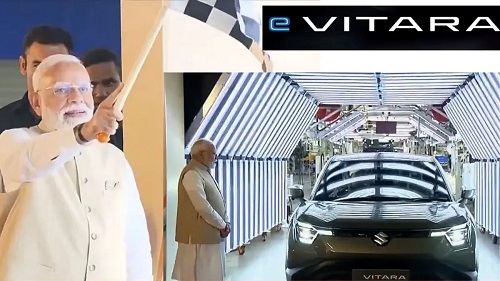
In a significant leap towards realizing its ambition of becoming a global hub for clean energy and advanced manufacturing, India marked a historic day in its automotive sector on Tuesday. Prime Minister Narendra Modi inaugurated the localised production of hybrid battery electrodes and flagged off the global exports of Maruti Suzuki's first electric SUV, the 'e-VITARA', from the Suzuki Motor Plant in Hansalpur, Gujarat.
This dual initiative underscores a strategic push towards self-reliance in the electric vehicle (EV) ecosystem, combining vehicle manufacturing with the domestic production of critical battery components.
e-VITARA: Made in India for the World
The highlight of the event was the ceremonial dispatch of the first consignment of the all-new e-VITARA. This battery electric vehicle (BEV), first showcased at the Bharat Mobility Global Expo 2025, is a landmark product for Maruti Suzuki, India's largest carmaker. More importantly, it is a testament to the "Make in India" initiative.
The e-VITARA will be manufactured at Maruti Suzuki's Hansalpur facility and exported to over 100 countries, including sophisticated automotive markets like Japan and Europe. This move officially establishes India as Suzuki Motor Corporation's global manufacturing hub for electric vehicles, leveraging the country's extensive production capacity and skilled workforce.
The company's robust export performance in FY25, with 3.32 lakh vehicles shipped, sets a strong foundation for the e-VITARA to lead a new chapter of India's automotive export story.
Powering Self-Reliance: Localising Battery Production
Complementing the vehicle launch, PM Modi inaugurated the production of hybrid battery electrodes at the TDS Lithium-Ion Battery Gujarat plant, a joint venture between Toshiba, Denso, and Suzuki. This is a crucial development for India's EV infrastructure.
Localising the production of these key battery components means that over 80% of the battery's value will now be manufactured within the country. This achievement is pivotal as it:
Boosts the Domestic EV Ecosystem: Creates a strong, local supply chain for battery technology.
Reduces Import Dependence: Cuts down the need to import expensive battery parts, conserving foreign exchange and enhancing strategic autonomy.
Lowers Costs: In the long run, local manufacturing is expected to reduce the overall cost of EVs for Indian consumers.
Aligning with a National Green Vision
Prime Minister Modi termed the day “special for India’s quest towards self-reliance and green mobility.” The events in Gujarat align perfectly with the government’s broader vision of promoting electric mobility, advanced manufacturing, and clean energy technologies.
In a further boost to the state's infrastructure, which supports such large-scale manufacturing, the Prime Minister also dedicated railway projects worth Rs 1,400 crore. This includes the doubling of the 65 km Mahesana-Palanpur railway line, enhancing logistics and connectivity for industries in the region.
The launch of the e-VITARA for a global audience and the indigenous production of battery electrodes represent more than just product launches; they are a powerful symbol of India's evolving manufacturing prowess and its determined stride onto the world stage of electric mobility.




















Leave Your Comment