


India and Canada are seeking to give their economic relationship a fresh direction through accelerated negotiations for a Comprehensive Economic Partnership Agreement (CEPA), with both sides targeting the conclusion of the proposed pact by the end of 2026. The latest round of discussions in Ottawa, followed by high-level ministerial engagement in New Delhi, signals a renewed emphasis on trade, investment and cooperation in emerging industries. With bilateral trade standing at $30.4 billion in 2025, Canada's ambition to raise the figure to $70 billion by 2030 reflects the considerable economic potential both countries hope to unlock. However, converting this ambition into reality will require more than a trade agreement; it will depend on sustained diplomatic engagement, improved market access and a willingness to address differences that have complicated bilateral relations.
India and Canada are intensifying efforts to expand economic cooperation, placing a proposed Comprehensive Economic Partnership Agreement at the centre of their renewed engagement. The objective is to complete negotiations by December 2026, creating a framework that could facilitate trade, encourage investment and strengthen commercial links between the two economies.
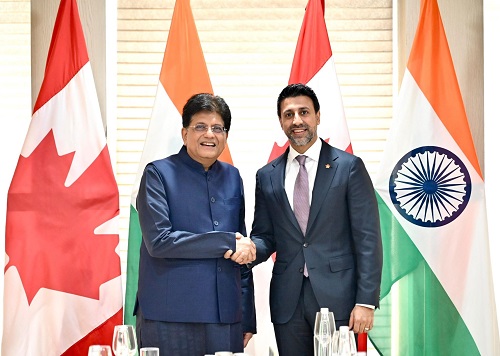
The fifth round of negotiations, held in Ottawa from October 5 to 9, provided an opportunity to advance discussions on the proposed agreement. The momentum continued in New Delhi, where Canadian International Trade Minister Maninder Sidhu met Union Commerce and Industry Minister Piyush Goyal during the ongoing Canadian trade mission to India. According to Global Affairs Canada, the ministers reviewed the progress of negotiations and explored ways to move the agreement forward.
The sequence of engagements suggests that both governments recognise the importance of economic cooperation in rebuilding a relationship that has faced diplomatic challenges. While political differences can complicate bilateral ties, commercial interests offer a practical avenue for renewed engagement, particularly when both countries see opportunities to diversify markets and attract investment.
Canada has set an ambitious goal of increasing annual bilateral trade with India to $70 billion by 2030, compared with $30.4 billion in goods and services traded in 2025. Achieving this target would require trade to more than double within five years, making the proposed CEPA an important instrument for expanding commercial activity.
The existing trade figures also reveal an imbalance in merchandise trade. Canada's exports to India stood at $3.9 billion in 2025, while imports from India amounted to $9.7 billion. These figures indicate that Indian goods already have a significant presence in the Canadian market, but they also underline the opportunity for Canada to expand its exports.
A comprehensive agreement could help address barriers to market entry, improve the predictability of trade rules and create more favourable conditions for businesses in both countries. For India, improved access to Canada could benefit exporters across a range of industries, while Canadian businesses could find new opportunities in India's large consumer market and expanding industrial base.
Nevertheless, the headline trade target should not be mistaken for a guaranteed outcome. Its achievement will depend on the agreement's final terms, the competitiveness of products and services, and the ability of companies to translate improved access into actual commercial transactions.
The Canadian trade mission to India, scheduled from October 12 to 17, brings nearly 300 delegates to Mumbai and Bengaluru to explore business and investment opportunities. Its focus on energy, critical minerals, aerospace, artificial intelligence and advanced manufacturing points to a relationship that could extend well beyond the conventional exchange of goods.
Critical minerals are particularly important as countries seek to strengthen supply chains for electric vehicles, batteries, renewable energy systems and advanced technologies. Greater cooperation in this field could help businesses explore investment opportunities and reduce dependence on concentrated sources of essential materials.
Energy presents another potential area of collaboration, while aerospace and advanced manufacturing could create opportunities for technology partnerships, industrial investment and specialised supply chains. Artificial intelligence, meanwhile, offers scope for cooperation in research, computing infrastructure and commercial applications.
India's growing industrial and technology sectors could provide Canadian companies with opportunities to participate in a rapidly expanding market. For Indian businesses, Canada could serve as a destination for exports, investment partnerships and access to specialised expertise. Such cooperation would be more durable if it generated productive investment, skilled employment and technological benefits rather than merely increasing the value of goods exchanged.
The renewed trade engagement also carries a broader diplomatic significance. Rebuilding economic ties requires a degree of continuity and mutual confidence, especially when businesses are considering long-term investments that depend on predictable policies and stable relations.
A trade agreement cannot, by itself, resolve every political disagreement. However, sustained engagement between governments, industry representatives and investors can create shared interests that encourage dialogue and make the relationship more resilient to future tensions.
For this reason, the success of the CEPA negotiations will depend not only on the speed of discussions but also on the quality of the eventual agreement. Both sides will need to settle differences over market access and ensure that the commitments made during negotiations can be implemented effectively.
The broader challenge is to ensure that the renewed economic engagement develops into a lasting partnership rather than remaining a series of diplomatic meetings and ambitious announcements. Clear rules, transparent procedures and consistent policy implementation will be essential to building business confidence.
The end-of-2026 deadline provides India and Canada with a concrete objective, but concluding negotiations will be only the first step. The agreement's real value will be measured by whether it expands exports, attracts investment, creates employment and strengthens cooperation in strategic sectors.
For India, closer economic engagement with Canada could support export diversification and create additional opportunities for domestic industries. For Canada, India's scale, demand and expanding manufacturing capabilities offer an important opportunity to broaden commercial partnerships in the Indo-Pacific.
The $70 billion trade ambition is therefore both an economic target and a test of the two countries' ability to convert renewed diplomatic engagement into measurable results. If negotiations produce a balanced and commercially meaningful agreement, CEPA could become a foundation for stronger bilateral ties. If implementation falls short, the ambitious target may remain more symbolic than substantive.
Ultimately, India and Canada have an opportunity to demonstrate that economic pragmatism can help rebuild confidence even when bilateral relations face difficulties. The immediate task is to turn negotiating momentum into a workable agreement; the larger challenge is to ensure that its benefits are visible to businesses, workers and consumers in both countries.






















Leave Your Comment