


The latest BrahMos procurement contract reflects India’s broader effort to strengthen naval firepower while reducing dependence on imported defence technology. Valued at ₹661.50 crore and carrying a minimum 68 per cent indigenous content, the agreement combines operational requirements with the strategic objective of building a stronger domestic defence-industrial ecosystem.
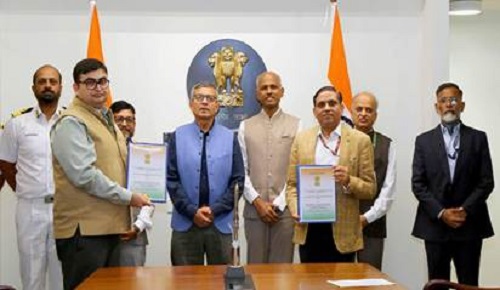
The Ministry of Defence on October 6, 2026 signed a ₹661.50-crore contract with BrahMos Aerospace Private Limited (BAPL) for the procurement of BrahMos Fire Control Systems and Launchers for Indian Navy ships. Signed in New Delhi in the presence of Defence Secretary Rajesh Kumar Singh, the agreement has been concluded under the Buy (Indian-IDDM) category, underscoring the government’s emphasis on indigenous design, development and manufacturing in critical defence systems.
The contract is significant not merely because of the equipment being procured, but because of what it represents for India’s maritime security strategy. The BrahMos weapon system has emerged as a key component of the Indian Navy’s offensive capabilities, and strengthening its fire-control and launch infrastructure will enhance the operational effectiveness of frontline warships.
The BrahMos system fitted aboard various Indian Navy warships serves as the Navy’s primary Surface-to-Surface Missile (SSM) system for maritime strike operations. Capable of engaging both land and sea targets from extended ranges, the missile combines supersonic speed with high precision. Such capabilities are particularly important in an increasingly contested maritime environment where speed, accuracy and the ability to respond rapidly can determine operational outcomes.
The new procurement will therefore contribute to maintaining the Navy’s readiness for both deterrence and combat operations. Modern fire-control systems and launchers are central to converting a missile’s inherent technological capabilities into effective battlefield performance. Their integration aboard naval platforms can improve the fleet’s ability to respond to emerging threats and conduct precision strikes.
Equally important is the contract’s indigenous character. With a minimum 68 per cent indigenous content, the project advances the government’s policy of reducing reliance on foreign defence supplies and developing domestic capabilities in sophisticated military technologies. The Buy (Indian-IDDM) category is particularly important in this context because it prioritises Indian-designed, developed and manufactured defence solutions.
The project is also expected to encourage participation from various Indian industries, including micro, small and medium enterprises. This creates opportunities for a wider network of domestic suppliers and technology partners to become part of the defence production ecosystem. Over time, such participation can help develop specialised manufacturing capabilities, strengthen supply chains and create a larger pool of skilled manpower.
The employment potential of the project over three years adds another dimension to its economic significance. Defence procurement is increasingly being viewed not simply as expenditure on military hardware, but as an instrument for generating industrial capacity, technological expertise and high-value employment within the country.
The contract also highlights the strategic importance of BrahMos to India’s maritime doctrine. The Indian Ocean Region remains central to India’s economic and security interests, with growing naval activity and competition making credible maritime deterrence increasingly important. A capable long-range, high-speed precision-strike system gives the Navy an important tool for safeguarding these interests.
At the same time, indigenous production of associated systems reduces vulnerabilities that can arise from dependence on external suppliers during periods of geopolitical uncertainty. Developing domestic capacity for critical missile components, launch systems and fire-control infrastructure strengthens India’s ability to sustain its defence preparedness over the long term.
The ₹661.50-crore agreement is thus more than a routine procurement decision. It brings together three strategic priorities—naval modernisation, maritime deterrence and defence indigenisation. By combining BrahMos’ proven operational role with greater domestic industrial participation, the project represents another step towards building a technologically capable and increasingly self-reliant Indian defence sector.






















Leave Your Comment