


For India’s maritime security architecture, 2026 is emerging as a year of accelerated naval expansion, with the Indian Navy preparing to induct or commission 18 warships. Defence Minister Rajnath Singh’s assessment that the year could prove historic goes beyond the number of platforms entering service: it reflects a broader transition in India’s naval capability, where indigenous shipbuilding, technological modernisation and operational readiness are increasingly being developed as interconnected pillars of maritime power.
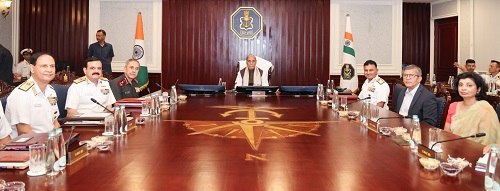
The induction of 18 warships in a single year would represent a significant milestone for the Indian Navy and, more importantly, underline the expanding capacity of India’s domestic defence-industrial base. Speaking at the second edition of the Indian Navy’s biannual Commander’s Conference 2026 in New Delhi, Defence Minister Rajnath Singh described the developments as evidence of the growing maturity of the country’s naval shipbuilding ecosystem.
The significance of this expansion lies not merely in fleet numbers. Modern naval strength depends on a combination of platforms, sensors, weapons, communications, logistics and the ability to sustain operations over long distances. A growing indigenous production base therefore has implications for both military preparedness and strategic autonomy.
According to Singh, warships commissioned recently have more than 75 per cent indigenous content. This is an important indicator of the changing character of Indian defence production. Greater domestic content can reduce dependence on external suppliers while strengthening Indian capabilities in design, engineering, manufacturing and maintenance.
The Navy’s shipbuilding programme also fits into the larger objective of self-reliance in defence. For a country with extensive maritime interests and a long coastline, the ability to design and produce major naval platforms domestically has consequences extending well beyond the defence sector. It can create industrial capacity, encourage technological development and deepen the connection between the armed forces and Indian manufacturing.
While additional warships will strengthen the Navy’s physical presence at sea, Singh’s emphasis on maritime surveillance highlights another increasingly important dimension of naval warfare.
The oceans are becoming more crowded and complex. Commercial shipping, fishing activity, offshore infrastructure, naval deployments and other maritime movements generate enormous quantities of information. Merely detecting vessels is no longer sufficient. Modern maritime security increasingly depends on the ability to collect, integrate and analyse information quickly enough to distinguish routine activity from potential threats.
This makes analytical capability as important as surveillance infrastructure itself. The Navy therefore faces the challenge of moving from a platform-centric approach towards an increasingly networked maritime-security architecture in which information from multiple sources can be integrated to provide a comprehensive operational picture.
Such a capability would have relevance not only during conflict but also during peacetime. Persistent maritime awareness can support responses to suspicious movements, protect vital sea lanes and strengthen India's ability to monitor developments across the wider Indian Ocean region.
Singh’s remarks also place naval modernisation within the broader strategic ambitions associated with Viksit Bharat 2047. For India, economic growth and maritime security are closely connected because a substantial share of international trade and energy supplies moves by sea.
The Navy consequently performs a role that extends beyond conventional military deterrence. Protecting sea lanes, safeguarding maritime commerce and maintaining stability in the surrounding region are central to the security environment in which India's economy operates..
India’s naval transformation, therefore, is not simply about adding ships. It is about creating an integrated maritime capability in which Indian shipyards, technology, surveillance networks and operational forces reinforce one another. If that momentum is sustained, 2026 could indeed mark an important stage in the Navy’s transition towards a more indigenous, technologically sophisticated and future-ready force.





















Leave Your Comment