


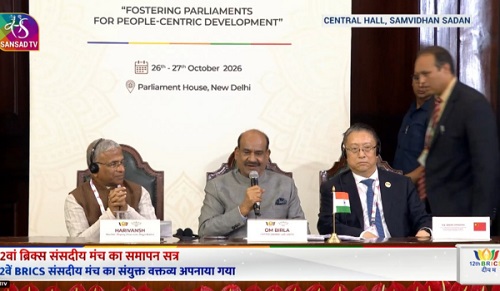
The 12th BRICS Parliamentary Forum concluded with the unanimous adoption of a Joint Declaration, reaffirming the member nations’ resolve to strengthen parliamentary cooperation, uphold international peace and promote inclusive development. Addressing the concluding session at Samvidhan Sadan, Lok Sabha Speaker Om Birla called for greater dialogue, mutual trust and collective action to navigate global conflicts, economic uncertainties and emerging technological challenges. The forum also handed over the chairship for 2027 to China, underlining the continuity of parliamentary engagement among BRICS nations.
The unanimous adoption of the Joint Declaration at 12th BRICS Parliamentary Forum marked the principal outcome of the two-day forum, which began with the theme “Fostering Parliaments for People-Centric Development”. The declaration reflects the shared priorities of BRICS countries under four key themes: Resilience, Innovation, Cooperation and Sustainability. These themes highlight the importance of strengthening democratic institutions, encouraging technological progress, deepening international partnerships and pursuing development that benefits people across societies.
On the second and final day, Birla proposed the adoption of the declaration, which received unanimous approval. He subsequently handed over the chairship of the BRICS Parliamentary Forum for 2027 to China, signalling the transition to the next phase of parliamentary cooperation within the grouping.
Delivering his valedictory address in the Central Hall of Samvidhan Sadan, Birla emphasised that constructive engagement among nations was essential to addressing the increasingly complex challenges confronting the international community. He observed that BRICS members may differ in their political perspectives, historical experiences and national circumstances, but they share a common commitment to human welfare, peace and prosperity.
The Speaker stressed that respect for national sovereignty, peaceful resolution of disputes and equitable development opportunities must remain central to international relations. At a time when geopolitical conflicts, regional instability and economic uncertainty are testing global cooperation, he argued that countries must strengthen dialogue rather than allow differences to deepen divisions.
Birla reiterated India's position that enduring solutions to international problems must be pursued through dialogue instead of conflict, peace instead of war, and cooperation instead of confrontation. He also underlined that peace should not be understood merely as the absence of armed conflict. Meaningful and lasting peace must ensure security, dignity and justice while creating opportunities for a better future, particularly for younger generations.
The Joint Declaration reinforces these principles by reaffirming the BRICS members’ commitment to the United Nations Charter, the sovereign equality of nations, mutual respect, non-interference in internal affairs and the peaceful settlement of international disputes. These commitments provide a common framework for engagement despite differences in national interests and political systems.
The declaration also strongly condemned all acts of terrorism and called for coordinated and concrete action against terrorists and terrorist organisations. The emphasis on collective action reflects the importance of international cooperation in confronting threats that extend beyond national borders and undermine peace and security.
Another significant area addressed by Birla was the growing influence of Artificial Intelligence. Recognising the potential of emerging technologies to transform economies and societies, he said their application must be guided by ethics, transparency, accountability and human welfare. Technology, he maintained, should serve humanity rather than operate independently of human values. The development and deployment of AI must therefore remain aligned with the broader objective of improving people's lives.
Birla further stressed that the success of BRICS should not be measured solely by the economic or institutional progress of its member countries. Its contribution must also be reflected in the positive impact it creates for the wider international community. In this context, he called for the aspirations and concerns of the Global South to receive due consideration in global decision-making.
The forum's emphasis on people-centric development also highlighted the role of parliaments in translating international commitments into policies that respond to citizens’ needs. Parliamentary institutions can contribute by encouraging dialogue, strengthening accountability and creating avenues for cooperation on shared challenges.
The unanimous declaration and the transfer of chairship to China provide a platform for continuing this engagement in 2027. As BRICS countries confront geopolitical uncertainty, technological transformation and demands for more representative global governance, parliamentary cooperation can help sustain communication and identify areas of common interest.
The concluding message of the forum was clear: international cooperation must be built on mutual respect, peaceful engagement and a shared commitment to human welfare. By placing resilience, innovation, cooperation and sustainability at the centre of their parliamentary agenda, BRICS members have reaffirmed their intention to pursue collective progress while ensuring that the interests of the wider global community, especially the Global South, remain part of the conversation.





















Leave Your Comment