


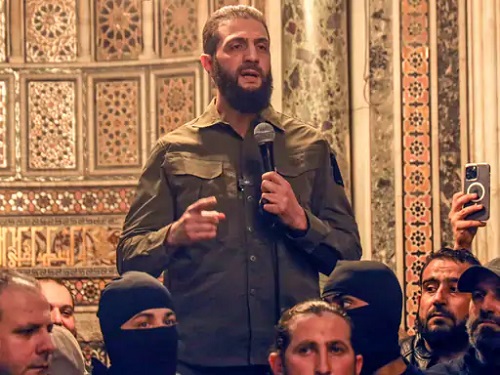
In a dramatic turn of events, Abu Mohammad al-Julani, leader of the rebel group Hayat Tahrir al-Sham (HTS), declared himself President in Damascus on Wednesday. This move comes amidst ongoing instability in the country, as reported by Syria's state news agency SANA.
Commander Hasan Abdelghani stated that al-Julani will remain as President until full stability is restored in the nation. He also announced the dissolution of Syria's parliament until the implementation of a new constitution, without specifying a timeline for these changes.
Abdelghani further declared the disbandment of all organizations and institutions affiliated with the former President Bashar al-Assad's Baath Party, with their properties to be seized by the Syrian government.
Last month, HTS seized control of the capital city of Damascus, marking the end of the 54-year-old rule of the Assad dynasty. Bashar al-Assad sought refuge in Moscow amidst the upheaval.
Al-Julani, also known as Ahmed al-Shara, initially enrolled in medical college in 2000 but quickly abandoned his studies upon perceiving an imminent U.S. attack on Iraq in 2003. He then joined the conflict, eventually making contact with al-Qaeda operatives while incarcerated by U.S. forces in 2006.
During his imprisonment, al-Julani connected with individuals linked to Baghdad. Upon his release in 2011, he orchestrated numerous attacks in Syria. By 2012, he founded the al-Qaeda branch in Syria, Jabhat al-Nusra.
In 2017, al-Nusra rebranded as HTS. Al-Julani released a video outlining the formation of his organization, emphasizing its autonomy from foreign entities and its sole objective of liberating Syria from the Assad regime.
Despite being designated a terrorist organization by the U.S. in 2018, HTS operated relatively unchecked until recent geopolitical shifts. The conflict between Israel and Hamas in 2018 and subsequent weakened positions of Iran and Hezbollah in Syria allowed al-Julani to bolster his forces.
With the onset of the Ukraine-Russia conflict in 2022 and the ensuing distraction of Russian forces from Syria, al-Julani capitalized on the opportunity. In 2023, conflict erupted between Israel and Hamas, resulting in Iran and Hezbollah's diminished influence in Syria. Seizing this opportunity, al-Julani launched an offensive against the Syrian military, effecting a presidential transition in just 11 days.
As Syria grapples with this abrupt change in leadership, the international community watches closely. The impact of al-Julani's presidency, his militant roots, and HTS's aspirations for Syria remain uncertain amidst ongoing regional tensions and global security concerns.




















Leave Your Comment